If you only look at Kansas’s unemployment rate, you might think everything is fine. That’s the political trap: point to a low number, declare victory, and move on.
But the latest state labor and economic output data show a more complicated truth. Kansas has real strengths, but it’s also leaving growth on the table because Topeka keeps flirting with bigger-government drift instead of locking in a durable, rules-based pro-growth agenda.
The newest state labor-market table shows Kansas’s unemployment rate at 3.8% in December 2025, below the national 4.4%. That’s a competitive advantage, especially when the federal policy environment is highly erratic. But the last 12 months reveal why “steady” is not the same thing as “surging.”
Over the past year, Kansas’s labor force grew from 1,554,666 in December 2024 to 1,572,551 in December 2025. That’s an increase of 17,885 people, which is a healthy sign that Kansans stayed in, or entered, the workforce rather than sitting on the sidelines. Meanwhile, the number of unemployed Kansans edged up from 59,082 to 59,742, an increase of 660, while the unemployment rate stayed flat at 3.8%.
Here’s what that combination usually means. Kansas absorbed a larger labor force without letting joblessness rise much. That’s good. But it also suggests job growth is not accelerating fast enough to pull the unemployment count down meaningfully even as more people participate. In other words, Kansas is holding its ground, not separating from the pack.
And Kansas is very much in a pack. In December 2025, Kansas’s 3.8% matched Colorado at 3.8%, came in slightly better than Missouri at 3.9%, and remained above Nebraska at 3.0%. Kansas can’t build a growth strategy around “we’re about average for the region.”
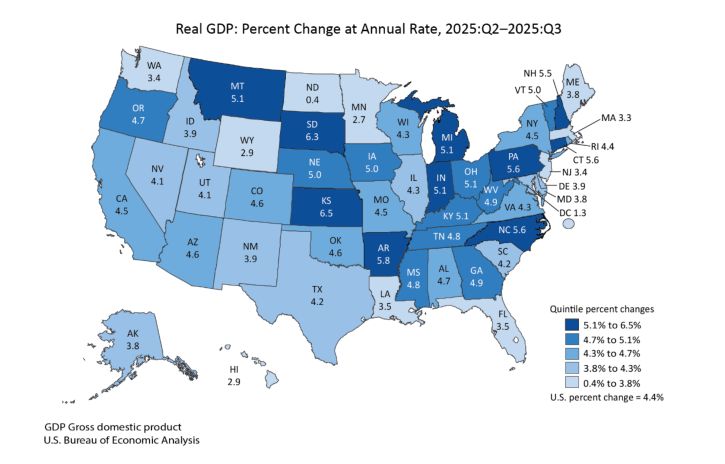
Now zoom out from jobs to output, because this is where Kansas has a real bragging right. In the latest state GDP release, Kansas posted the fastest real GDP growth in the country in the third quarter of 2025: 6.5% at an annual rate, versus 4.4% nationally.
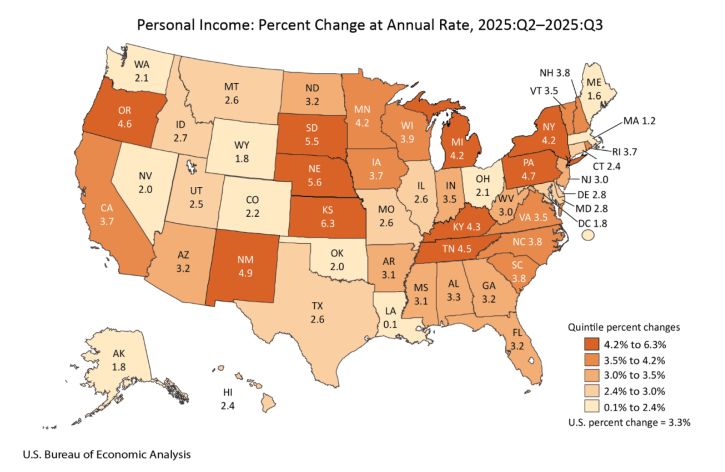
Kansas also led the nation in personal income growth at 6.3%, versus 3.3% nationally. That is not normal performance. That is Kansas leading.
BEA also notes that agriculture was the leading contributor to GDP growth in Kansas, and that durable-goods manufacturing increased in every state. Translation: Kansas didn’t “win the quarter” through a government-spending sugar high. It grew through production.
So why isn’t Kansas clearly pulling away in the labor market if output and income were that strong? Because one great quarter is not a long-run strategy. Hiring responds to what businesses expect next: taxes, spending growth, regulation, energy costs, and whether future lawmakers will treat surpluses like a shopping spree.
That’s where Kansas policy has been too weak, especially under Gov. Kelly. Instead of using this moment to harden Kansas’s competitive edge, the default posture has too often been to expand government, defend the status quo, and call it “investment.” That approach may buy headlines, but it doesn’t buy long-run growth.
Kansas needs a different model: rules that restrain government automatically and reward work automatically.
First, Kansas should adopt a strict spending limit tied to population growth plus inflation. No gimmicks. Without a cap, any tax relief is temporary because spending pressure always comes back.
Second, Kansas should use its surplus buydown trigger: every dollar collected above the spending limit should go to buying down income tax rates until Kansas reaches zero. Surpluses are not “free money.” They’re evidence the state collected more than it needed under a responsible budget. The best use is permanent rate reduction, not permanent spending.
Third, Kansas should stop pretending property tax pressure can be solved with carveouts (i.e., Panasonic, Integra, Chiefs, homestead exemptions,etc.). The real driver is spending growth. If lawmakers want lasting relief, they must restrain the spending that drives local levies.
Kansas can lead. The data prove the state has the capacity. But Kansas won’t lead on autopilot, and it definitely won’t lead by drifting toward bigger government while hoping one more strong quarter bails everyone out. The playbook is clear: cap spending, buy down taxes with surpluses, and let Kansas producers and workers keep more of what they earn.