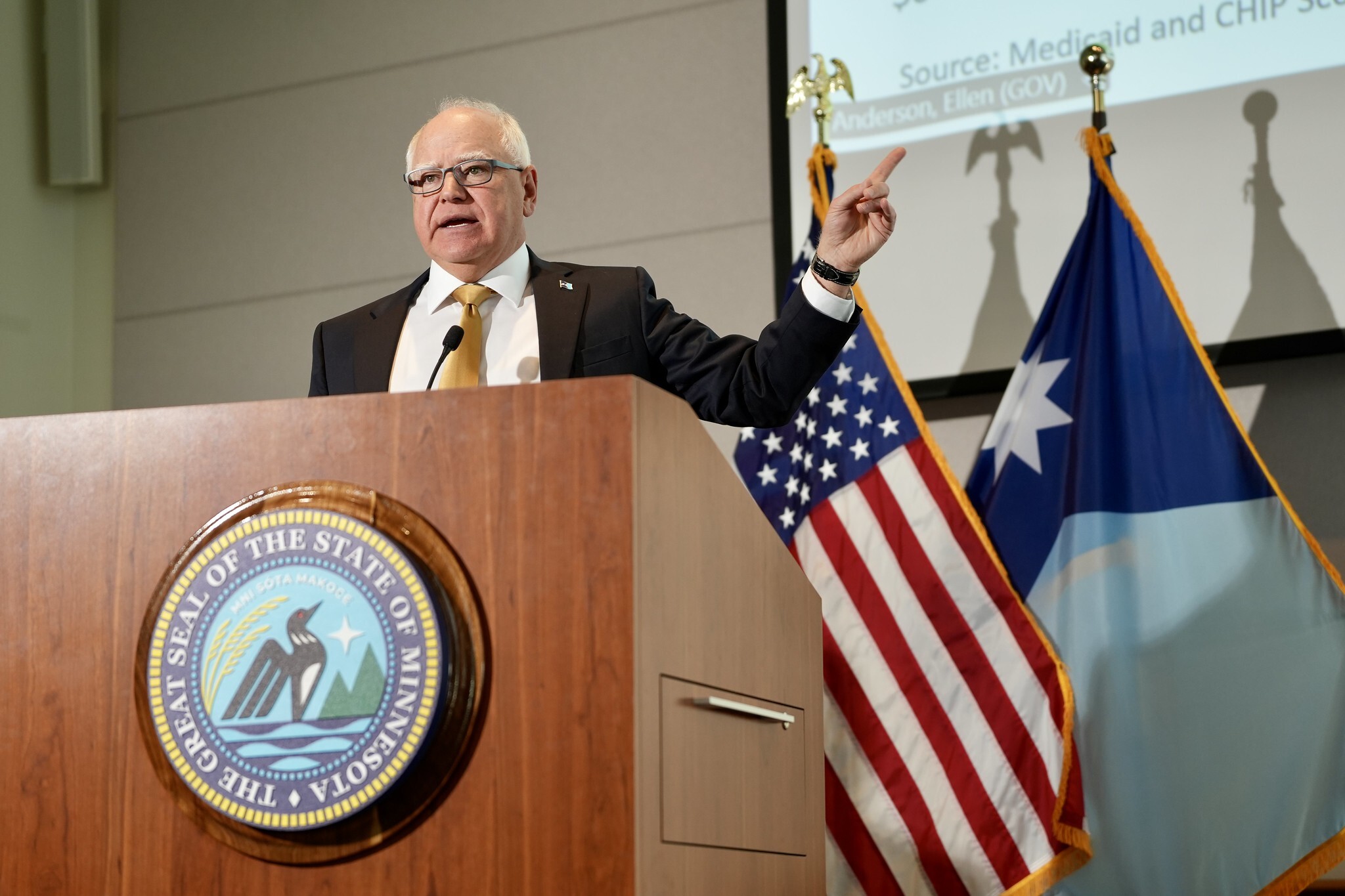
During the federal government shutdown, Gov. Walz tweeted that “Every $1 invested in SNAP generates $1.80 in economic activity.”
This sounds too good to be true. With SNAP costing an estimated $8 billion each month, that means $14.4 billion of “economic activity” generated. If this is correct, shouldn’t Congress double SNAP spending and generate $28.8 billion in extra economic activity? Or triple it for $43.2 billion?
Sadly, if something sounds too good to be true it usually is.
Gov. Walz’s tweet is based on the economic concept of the “expenditure multiplier,” which argues that each dollar in spending generates some multiple — $1.80 in this case — of extra spending. “Why does this multiplier exist?” one of my old textbooks asks. When the SNAP recipients spend their benefits, this:
…increases the incomes of the firms and workers that produce these goods. [Some portion of] this extra income is spent on other goods and services, further increasing income and consumption elsewhere in the economy. But this additional income is also spent, so that the initial increase in government expenditure sets in motion a sequence of rising incomes and consumption throughout the economy, which serves to magnify the initial demand boost.
This traces back to Keynesian analysis. In his book “The General Theory of Employment, Interest and Money,” the economist John Maynard Keynes argued that macroeconomic downturns resulted from slumps in “aggregate demand” as people cut spending for whatever reason. If the economy didn’t adjust to this reduced demand with lower prices — the nominal side — it would do so with reduced output and employment — the real side.
Classical economists had argued that lower spending from a given income must mean higher saving and that this increase in savings would mean a fall in interest rates and increased investment spending so that aggregate demand would stabilize. Keynes rejected this natural tendency to macroeconomic equilibrium. If the economic outlook was bad enough, he argued, it might not pay a return to invest at any interest rate no matter how low. In this case, Keynes argued, the government should step in as spender of last resort, borrowing and spending these savings.
Central to this analysis is the notion that some money is idle — it is being spent neither on consumption nor investment — and it is upon this notion that the multiplier rests.
Is that the case now? The study on which Gov. Walz’ argument rests dates from 2010 and assumes:
…high unemployment, low utilization of production capacity, and low inventory levels. Under these conditions, an increased demand for goods and services from government expenditures will stimulate production rather than simply causing pressure on prices or a rundown of inventories.
But none of that applies in 2025. The unemployment rate is currently 4.3% compared to 9.6% in 2010; real potential GDP was 1.7% above real GDP in the second quarter of 2025 compared to being 3.5% below it in 2010; and real private inventories were 12.9% of GDP in the second quarter of 2025 compared to 12.8% in 2010. The present economic environment is not one of deficient aggregate demand manifesting itself in either tumbling prices, employment, or output, and it would be a mistake to enact policy as though it was. Indeed, it would be the same mistake that lay behind President Biden’s disastrously misnamed “Inflation Reduction Act.”
That dollar of SNAP spending won’t be coming from some idle pool of savings but from some other use. How much “economic activity” would that other use generate? More than $1.80? Less than $1.80? Who knows? Either way, we ought to consider the opportunity cost of that $1 spent on SNAP — the other use it could be spent on. In that case, the “economic activity” it generates is not $1.80 but $1.80 minus the amount that would be generated by spending on this other use. If that is more than $1.80, then the number is negative, and even if it is less, that $1.80 estimate shrinks by whatever it is.
Keynes wrote that “the postulates of the classical theory are applicable to a special case only and not to the general case,” but the same applies to the postulates of his theory, which is no more “general.” There might be good defenses of SNAP spending, but Gov. Walz’ mangled macroeconomics isn’t one.