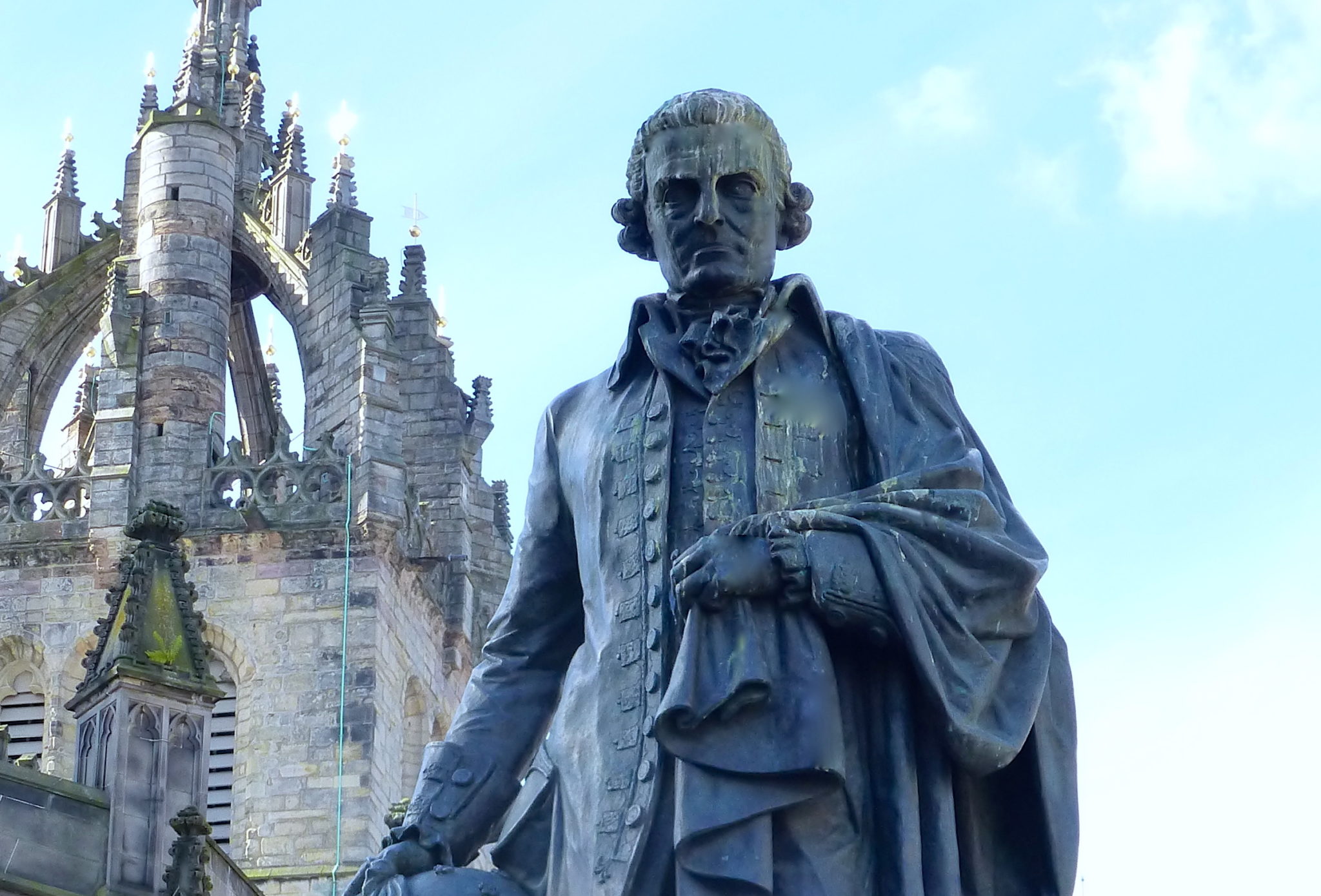
On this day in 1776, Adam Smith published “An Inquiry into the Nature and Causes of the Wealth of Nations.” It was one of the most revolutionary products of a revolutionary year.
Consumption
Smith was motivated to write “The Wealth of Nations” primarily to refute the doctrines of the Mercantilists. They were a group of economists and policymakers who believed that a country grew wealthy by accumulating gold and silver, which it did by exporting more than it imported with the resulting “positive” trade balance being filled by imports of precious metals in payment. This was a “zero sum” world, where every trade had a winner and a loser and one could only get better off to the extent that someone else got worse off.
Smith thought this was wrong. He believed that accumulating gold and silver ought not to be the end of policy but, rather, a means to some other end.
“Nothing,” Smith wrote:
…can be more absurd than this whole doctrine of the balance of trade, upon which, not only these restraints, but almost all the other regulations of commerce are founded. When two places trade with one another, this doctrine supposes that, if the balance be even, neither of them either loses or gains; but if it leans in any degree to one side, that one of them loses, and the other gains in proportion to its declension from the exact equilibrium. Both suppositions are false. A trade which is forced by means of bounties and monopolies, may be, and commonly is disadvantageous to the country in whose favour it is meant to be established, as I shall endeavour to shew hereafter. But that trade which, without force or constraint, is naturally and regularly carried on between any two places, is always advantageous, though not always equally so, to both.
By advantage or gain, I understand, not the increase of the quantity of gold and silver, but that of the exchangeable value of the annual produce of the land and labour of the country, or the increase of the annual revenue of its inhabitants.
“Consumption is the sole end and purpose of all production,” Smith wrote, and people did not consume gold and silver; they used gold and silver to purchase the things they did consume, that “produce of the land and labour of the country.”
Productivity
If the wealth of nations stemmed not from piling up of bits of metal but from increasing this produce – which might today be called Gross Domestic Product – how was that achieved? Smith’s answer was “productivity,” driven, in the first instance, by the division of labor.
“To take an example,” he wrote:
…from a very trifling manufacture; but one in which the division of labour has been very often taken notice of, the trade of the pin-maker; a workman not educated to this business (which the division of labour has rendered a distinct trade), nor acquainted with the use of the machinery employed in it (to the invention of which the same division of labour has probably given occasion), could scarce, perhaps, with his utmost industry, make one pin in a day, and certainly could not make twenty. But in the way in which this business is now carried on, not only the whole work is a peculiar trade, but it is divided into a number of branches, of which the greater part are likewise peculiar trades. One man draws out the wire, another straights it, a third cuts it, a fourth points it, a fifth grinds it at the top for receiving the head; to make the head requires two or three distinct operations; to put it on, is a peculiar business, to whiten the pins is another; it is even a trade by itself to put them into the paper; and the important business of making a pin is, in this manner, divided into about eighteen distinct operations, which, in some manufactories, are all performed by distinct hands, though in others the same man will sometimes perform two or three of them. I have seen a small manufactory of this kind where ten men only were employed, and where some of them consequently performed two or three distinct operations. But though they were very poor, and therefore but indifferently accommodated with the necessary machinery, they could, when they exerted themselves, make among them about twelve pounds of pins in a day. There are in a pound upwards of four thousand pins of a middling size. Those ten persons, therefore, could make among them upwards of forty-eight thousand pins in a day. Each person, therefore, making a tenth part of forty-eight thousand pins, might be considered as making four thousand eight hundred pins in a day. But if they had all wrought separately and independently, and without any of them having been educated to this peculiar business, they certainly could not each of them have made twenty, perhaps not one pin in a day; that is, certainly, not the two hundred and fortieth, perhaps not the four thousand eight hundredth part of what they are at present capable of performing, in consequence of a proper division and combination of their different operations.
Here is Fordism a century or so before Henry Ford. This gave rise to what Smith called “that universal opulence which extends itself to the lowest ranks of the people;” the consumer society.
Trade
This specialization which underlay the productivity which drove increases in the wealth of nations was, Smith thought, driven, in the first instance, by trade; the trade of the worker’s labor for wages or the output of the “capitalist” – a word Smith never uses – for money. “As it is the power of exchanging that gives occasion to the division of labour,” he wrote:
…so the extent of this division must always be limited by the extent of that power, or, in other words, by the extent of the market. When the market is very small, no person can have any encouragement to dedicate himself entirely to one employment, for want of the power to exchange all that surplus part of the produce of his own labour, which is over and above his own consumption, for such parts of the produce of other men’s labour as he has occasion for.
If you have ever been to a small town, you will have seen a general store, you might have noticed how the fire truck, ambulance, or breakdown truck are all the same vehicle, and you might, once upon a time, have noticed how the barber and the pharmacist were one and the same. But, as the market grows, with either more people coming in or with the greater facility to trade without, all these things become specialized. The pharmacist’s green cross joins the barber’s stripy pole on the high street.
It followed from this that Smith believed that the freedom to trade would extend the market and encourage specialization and that the mercantilist policies which sought to restrict this freedom made the country worse off.
Indeed, contrary to the mercantilist doctrines, trade made both parties better off; the parties wouldn’t trade if they didn’t both think that. Most people run a “negative” trade balance with their local store. Most days you go in, hand over some money, and leave with some stuff. To the mercantilist, you are a loser in that trade. To Smith, by contrast, both you and the store are winners. When you hand over $3 for a jug of milk, it is because you would rather have the jug of milk than the $3; you have swapped something you valued less for something you valued more. And, on the other side, the store would rather have your $3 than the jug of milk. This is a “positive sum” world. Both parties to this trade have benefited and, by swapping things they value less for things they value more, have increased their wealth via trade.
Freedom and cooperation
These mutual benefits to trade Smith saw as a foundation for social harmony. “It is not from the benevolence of the butcher, the brewer, or the baker, that we expect our dinner, but from their regard to their own interest,” Smith wrote.
We address ourselves, not to their humanity but to their self-love, and never talk to them of our own necessities but of their advantages. Nobody but a beggar chuses to depend chiefly upon the benevolence of his fellow-citizens.
In this way:
…by directing that industry in such a manner as its produce may be of the greatest value, he intends only his own gain, and he is in this, as in many other cases, led by an invisible hand to promote an end which was no part of his intention.
“The Wealth of Nations” is a product of the Enlightenment and one its themes is of social harmony. Just as John Locke – who inspired so much of 1776’s other revolutionary document, the Declaration of Independence – had argued, humankind, if left largely to its own devices, would not descend into some barbarous free-for-all. “The Wealth of Nations” is a picture of social harmony through voluntary economic interaction.
Government
Yet Smith was not an anarchist. Locke had drawn the distinction between freedom – the ability to do what you like – and liberty, the ability to enjoy your natural rights to life, liberty, and property. The latter, Locke held, needed safeguarding by government and law and Smith followed Locke in seeing a role for government.
These were rather more limited than those roles played by governments today, however. Government, Smith believed, should fulfil some basic functions: defense; justice; public works and institutions that facilitated commerce; the education of ‘people of all ages’; measures against ‘loathsome and offensive diseases’; the maintenance of the ‘dignity of the sovereign’; and the financing of these expenditures through taxation and charges to the beneficiaries (in preference to public debt).
Yet even here he was wary. Smith held monarchs and politicians in low regard:
It is the highest impertinence and presumption…in kings and ministers, to pretend to watch over the economy of private people…They are themselves always, and without any exception, the greatest spendthrifts in the society…If their own extravagance does not ruin the state, that of their subjects never will.
Besides incompetence, there were the temptations which power brought. “The statesman, who should attempt to direct private people in what manner they ought to employ their capitals, would not only load himself with a most unnecessary attention, but assume an authority which could safely be trusted, not only to no single person, but to no council or senate whatever, and which would nowhere be so dangerous as in the hands of a man who had folly and presumption enough to fancy himself fit to exercise it,” Smith warned. This power could be co-opted by those who wished to use it for their own ends. “People of the same trade seldom meet together, even for merriment and diversion, but the conversation ends in a conspiracy against the public, or in some contrivance to raise prices.”
“There is no art which one government sooner learns of another than that of draining money from the pockets of the people,” Smith noted cynically but not inaccurately. Given the necessity of some level of taxation, he set out his four famous principles. First, people should contribute in proportion to the income that they enjoy under the security of state protection. Second, taxes ought to be certain, rather than depend on the arbitrary decisions of tax officers. Third, tax should not be inconvenient to pay. Fourth, taxes should have minimal side effects: they should be cheap to collect; they should not hamper industry and enterprise; they should not be so onerous as to encourage evasion, such as smuggling; and they should not require ‘frequent visits and the odious examination of the tax gatherers’.
Overall, Smith was an optimist. “Little else is requisite to carry a state to the highest degree of opulence from the lowest barbarism,” he wrote:
…but peace, easy taxes, and a tolerable administration of justice; all the rest being brought about by the natural course of things. All governments which thwart this natural course, which force things into another channel, or which endeavour to arrest the progress of society at a particular point, are unnatural, and to support themselves are obliged to be oppressive and tyrannical.
Some of Smith’s earliest readers in Britain’s American colonies would soon take this to heart.