
MONTGOMERY, Ala. – Two lawsuits about the harms of social media ended with landmark rulings against social media giants such as Instagram, Facebook and YouTube.
The verdicts, both announced on Wednesday, found against social media companies. A trial in California found that Meta, the parent company of Instagram and Facebook, and YouTube designed their services to addict young people. A case in New Mexico ended with a jury finding that Meta knowingly harmed children’s mental health and hid what it knew about child sexual exploitation.
The cases are just two of thousands pending against the social media giants across the country. Though the verdicts don’t mandate sweeping changes to how platforms operate or demand enormous sums of money from social media companies, the losses for social media companies represent a change in momentum and open the door to more litigation.
Alabama’s AG candidates talk approach if elected
State attorneys general have played a large role in bringing cases against social media platforms, including in the New Mexico case decided on Wednesday.
Current Alabama Attorney General Steve Marshall is term-limited and is running for U.S. Senate. The Republican candidates to replace Marshall – Pamela Casey, Jay Mitchell and Katherine Robertson– met for a debate in Birmingham earlier this month. They discussed the role they think the attorney general should play in regulating and holding social media platforms accountable.
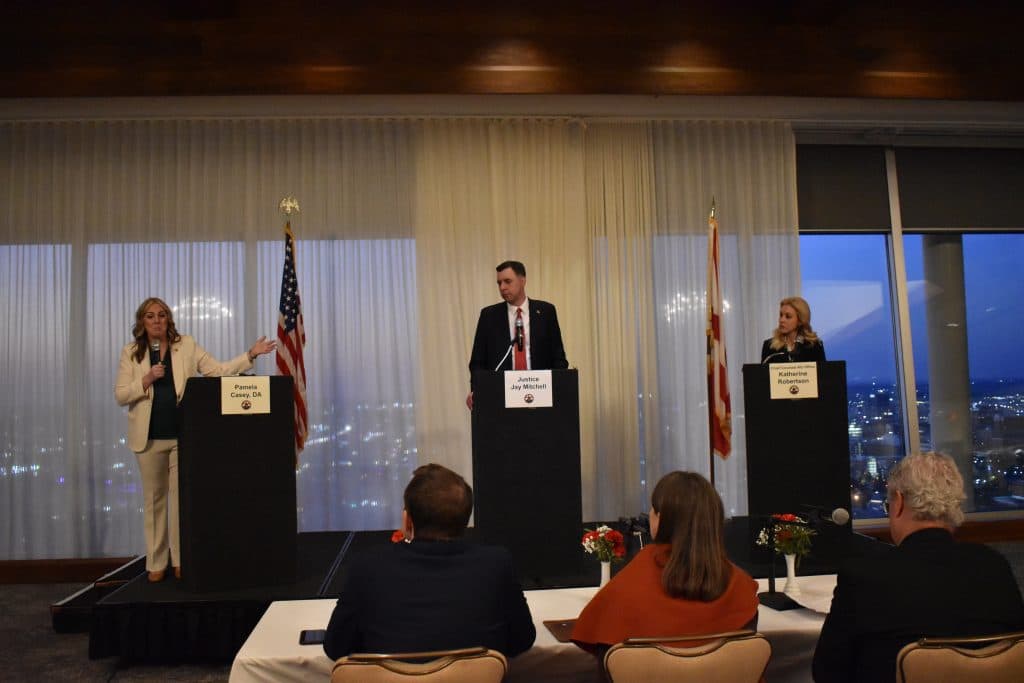
All of the GOP candidates agreed that protecting children online is an important issue, but they mentioned different approaches to achieving wins for the state.
Robertson, who currently works as Marshall’s chief counsel, said she hopes for a federal-level change but talked about working with fellow Republican AGs to “bite off the pieces we can at the state level” in the meantime.
“Every company can’t be your top priority,” Robertson said. “We choose the companies that we feel like we have the best data on, that’s Alabama specific, to establish our standing, and we have friends that choose different ones, and we all work together. It is a critically important collaborative effort, and I’m the one that has those relationships. I’m a phone call away from getting 25 states on anything I want to do.”
She also mentioned Marshall’s lawsuit last April against TikTok and his office’s work with the other Republican AGs to take on big tech companies. Marshall sued TikTok Inc., and its parent company, ByteDance Inc., for “exploiting children, addicting them to harmful content and lying about the safety of its platform.”
Marshall said TikTok has contributed to a youth mental health crisis, similar to the claims made in the two successful cases decided this week.
Blount County District Attorney Casey and Mitchell, a former Alabama Supreme Court associate justice, both said they feel the AG’s office should be doing more to protect children online.
“Our AG should have been over at the Legislature 10 years ago saying we have to do something to protect our children,” Casey said.
Mitchell said he feels the AG’s office has “been doing a lot of joining” but needs to be leading on big issues like social media.
Robertson defended what Marshall’s action as AG and said that the office deals with most cases outside of the public eye.
“You wouldn’t have any idea what companies we are and aren’t investigating, because we don’t advertise that,” Robertson said. “Some states do, we don’t.”
Mitchell and Casey both further emphasized the importance of going after the issue at the state level.
Mitchell said that though people across the nation are debating whether social media regulation should be at the state or federal level, the state has a “huge” role to play.
“… I want to make sure that we, the people of Alabama, have an opportunity to weigh in on that, that we can elect our leaders to go and make sure that we’re protecting our kids and holding those child predators and holding anybody who’s allowing those child predators to get to our kids, holding them accountable,” Mitchell said.
Casey, who has talked about online safety on programs like Good Morning America and The Today Show, said she feels the courtroom experience she gained through her work as a DA has prepared her to lead on the issue. She said online safety would be her priority if elected.
“If I do nothing more as your attorney general, I will make a number one priority (of) keeping our kids safe on their devices and through social media, and not by just lip service of age verification and screen time, (but) by requiring companies because I’m not taking money from companies,” Casey said.
Mitchell commended the Legislature for passing legislation like the app store age verification bill and talked about his own difficulties in parenting in the age of social media.
“It’s so, so difficult for parents, really exhausting, just trying to keep up with the technology and trying to keep your kids from working around then,” Mitchell said. “In many cases, you don’t get any help from the platforms or from the device manufacturers, so parents need help, parents need help in protecting their kids.”
Alabama Daily News attempted to contact Democratic candidate Jeff McLaughlin to offer him the opportunity to discuss the issue. McLaughlin could not be reached for comment.
The primary is May 19.
What have Alabama lawmakers done?
There has been limited action at the federal level to address Americans’ concerns about children’s online safety or the addictive nature of many platforms, but in the interim, many state lawmakers, including those in Alabama, are taking steps of their own to put in place additional protections for children.
Alabama lawmakers have already taken a few steps to bolster guardrails to protect children from harm online.
After a failed attempt last session, the Alabama Legislature this year passed House Bill 161, which requires app stores to verify a user’s age and link parent accounts for minors. Gov. Kay Ivey signed it into law in February.
The bill would sort children into age categories when they make an account on app stores. If users are under age, guardians would have to set up a linked account to approve the minor to download apps and make in-app purchases. If developers make major changes to apps, parents would also have to reauthorize their children’s usage of them.
“(House Bill) 161 is about protecting children online and putting parents back in control,” sponsor Rep. Chris Sells, R-Greenville, said when the bill passed. “App stores are a gateway to what our children see online.”
It also stops app stores from being able to enforce contracts or terms of service agreements against minors without their parents’ permission.
United States Sen. Katie Britt, R-Ala., has also supported bills at the national level taking a stab at protecting children online.
Last week, Britt cosponsored a bipartisan bill to require social media platforms to allow certain safety software providers to monitor and manage the activity of children under 17.
“As parents and legislators, it’s our job to protect our children and teens—our most vulnerable—in every way we can,” Britt said in a news release about the bill. “In the age of social media and the challenges that come with it, Sammy’s Law is a critical step towards protecting our children online by ensuring parents have access to the necessary tools to keep their children safe.”
Last year, Britt and U.S. Sen. John Fetterman, D-Pa., introduced the Stop The Scroll Act, which would require the Federal Trade Commission to place a label on certain social media platforms warning users about the potential mental health consequences associated with the service. The bill has yet to be discussed in committee.