By Sarah Montalbano
Winter Storm Fern brought more than snow and ice to Colorado last month. It brought data that state policymakers should find uncomfortable: thermal resources provided 85 percent of Xcel Energy’s electricity when residents needed it most.
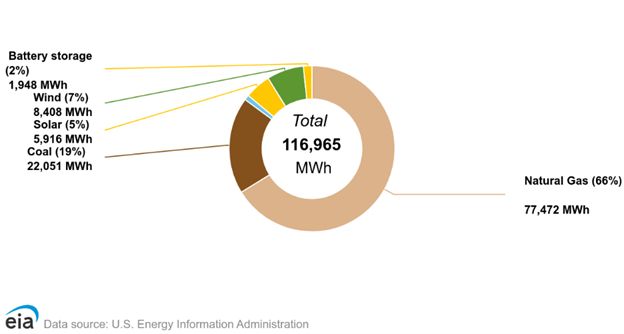
Energy Information Administration data shows that on January 24, 2026, Xcel Energy in Colorado generated 66 percent of its electricity from natural gas and 19 percent from coal, despite making up only 55 percent of Xcel’s generating portfolio. Wind contributed only 7 percent, and solar contributed 5 percent.
Governor Jared Polis and legislative leaders should answer an obvious question: What happens in January 2040 if a storm hits after Colorado eliminates these generation sources?
Of course, Fern affected more than Colorado. Nationally, coal-fired generation rose 31 percent during Winter Storm Fern compared to the prior week. Natural gas rose 14 percent. Solar, wind, and hydropower all declined. Natural gas, coal, and nuclear together provided 77 percent of total U.S. generation during the storm, with higher fractions overnight when solar drops to zero.
Xcel Energy has committed to eliminating all its remaining coal-fired generation by 2031, and ten coal plants totaling over 4,200 MW of nameplate capacity will close. Things could get even worse if Polis supports legislation to accelerate Colorado’s 100 percent renewable electricity deadline to 2040, as he did last year.
Natural gas filled most of the gap during Fern. But if Colorado continues retiring coal without building sufficient reliable capacity to replace it, ratepayers will face higher costs and reliability risks. The Trump administration recognizes this and has used emergency authority to keep Colorado’s Craig Unit 1 running past its planned retirement. Polis criticized the move, saying it was “not needed.” Yet Colorado needed every megawatt of dispatchable generation during Fern.
Keeping existing coal-fired generation running is an economical choice, too. Even taking Grid Strategies and the Sierra Club’s estimate at face value — which assumes the plant is not just available but also operating — keeping Craig Unit 1 operational for 90 days costs an estimated $21 million. The Independence Institute and Always On Energy Research found that getting Colorado to 100 percent zero-emissions by 2040 would cost $114.3 billion compared to operating the current grid, with costs ballooning an additional $214.6 billion after 2040 through 2050. With that price tag, extending the life of Craig Unit 1 is a rounding error compared to the costs of a forced transition to wind, solar, and batteries.
Colorado ratepayers are already feeling the cost of retiring reliable generation too quickly. Since Governor Polis took office in 2019, average residential electricity prices have climbed from 11.91 to 16.26 cents per kilowatthour — a 36 percent increase, outpacing the broader Mountain region. These rising costs reflect the growing expense of replacing dependable thermal plants before proven alternatives are in place.
Colorado’s challenge is getting worse. Xcel Energy projects a 4 percent compound annual growth in electricity demand from 2023 through 2031, up from 0.7 percent annually in prior years. Drivers include data centers, electric vehicles, population growth, and building electrification mandates. To meet this demand, Xcel needs to expand generating capacity from 7 gigawatts to between 7.6 and 9.6 gigawatts by 2031 while simultaneously retiring the coal fleet.
Colorado’s experience during Winter Storm Fern shows that when the grid is under real stress, dispatchable generation carries the load. In the depths of the storm, thermal plants supplied 85 percent of Xcel Energy’s electricity despite being only 55 percent of the generation portfolio. Colorado can’t afford to retire coal or limit natural gas capacity until proven replacements test their mettle against actual peak events. Policymakers should adjust course before the next storm teaches them that lesson the hard way.
Sarah Montalbano is a policy analyst with Independence Institute’s Energy and Environmental Policy Center and a policy analyst at Always On Energy Research.