This week I’ve looked at how property tax hikes are making life less affordable for Minnesotans and at how it is not rising property values but increased local government spending which has driven these hikes. Given this diagnosis, what are we to do to get property taxes under control and ease the squeeze on hard pressed Minnesotans?
We must remember that property taxes are payments for locally provided services like roads, police, and schools. These services ought to be paid for by those who use them, whatever their age and whatever the status of their mortgage. The payments for these services ought to change with the cost of providing them. This cost will change because of increases in the population and/or increases in prices.
So:
- to get property taxes under control and ease the squeeze on hard pressed Minnesotans, we should restrict property tax increases to the rate of population growth plus the rate of inflation growth.
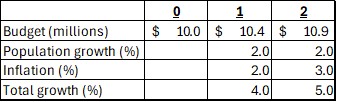
So, a city with a budget of $10 million in Year 0 and forecast population growth of 2.0% over the coming two budget years and a forecast inflation rate of 2.0% in Year 1 rising to 3.0% in Year 2 would see its budget grow by 4.0% in Year 1 and 5.0% in Year 2 for total growth of 9.2% over the two years, as illustrated in Table 1. The result would be that per capita spending would increase by only the rate of inflation; that it would remain static, in real terms.
Table 1: Budget growth with population + inflation formula
There could be local catastrophes which necessitate increases in local government spending above the rate given by population + inflation. In this case, local governments would be able to put the increase to a vote of their residents, much as school district referendums can raise property tax rates to pay for operating costs, building renovations, and technology needs. Neither is it certain, on recent performance, that these referendums would be doomed to fail.
If this means that Hennepin County has to spend $24 million less on “disparity elimination” or that Ramsey County has to freeze the hiring of “racial and health equity administrators” at salaries up 75% above the median household income, so be it. Alternatively, they can go to their residents and explain to them why these posts are so vital that they ought to be taxed more to pay for them.