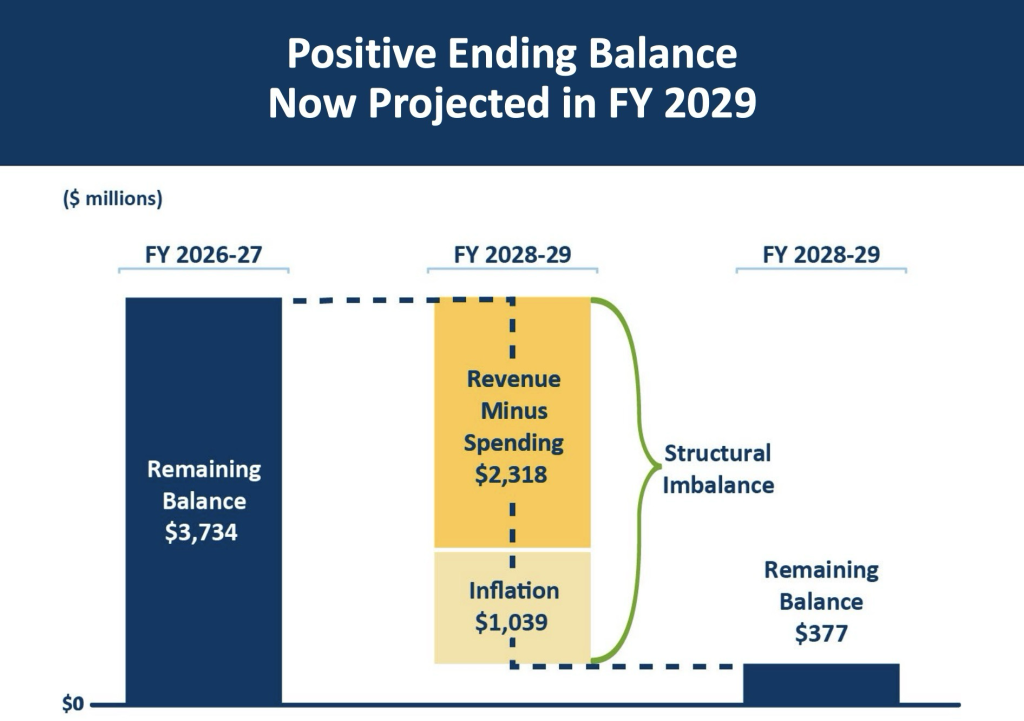
According to Minnesota Management and Budget (MMB), the budget surplus for the current biennium — 2026-27— has grown by over $1 billion since November. Assuming no spending this session, this improved outlook also turns the projected deficit in the 2028-29 biennium into a surplus.
However, as MMB warns, Minnesota’s structural deficit remains, as spending continues grow faster than revenue. Moreover, Minnesota has become more reliant on volatile revenue sources, such as capital gains and corporate profits. This means increased uncertainty, which makes long-term planning more challenging.
Ongoing Risks
Structural budget remains
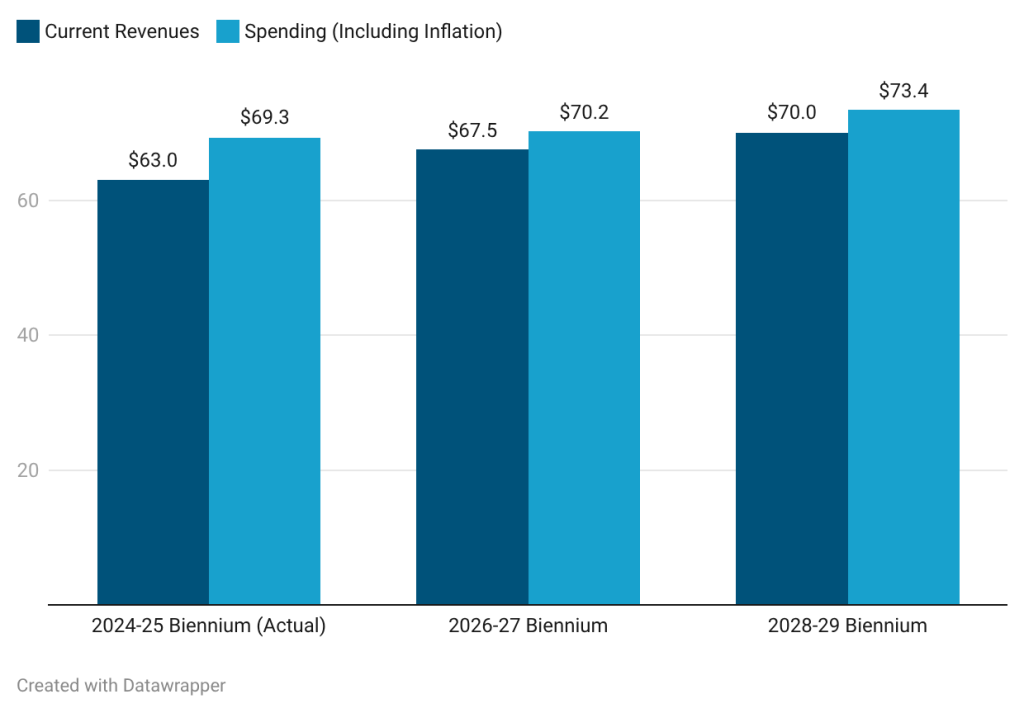
Every year since 2024, Minnesota has spent more than it collects in revenues. That is expected to continue throughout the entire forecast period. Spending will outpace revenues by nearly $3 billion in the current biennium (2026-27) and another $3.2 billion in the 2028-29 biennium. Without spending reform, Minnesota is on track for persistent deficits once the COVID-19-driven surplus runs out.
Figure 2: Spending vs Revenue (Billion $)
Minnesota is becoming more reliant on volatile revenue sources
As MMB notes, Minnesota’s employment growth remains weak. Wage growth has also been revised downward. Instead, rising revenues in the forecast are
driven by increases to the state’s most volatile revenue sources, including tax revenue from capital gains, interest income and corporate profits
Capital gains, interest income, and corporate profits are more dependent on the economic outlook than are wage incomes. Minnesota’s increased reliance on these sources of income means increased revenue volatility, which makes long-term planning more challenging.
As MMB commissioner Erin Campbell explains, raising the budget reserve target could be necessary to hedge against the resulting increased level of uncertainty.
Federal uncertainty
While MMB has included some provisions enacted in the One Big Beautiful Bill Act (OBBBA), some unknowns remain.
The Centers for Medicare and Medicaid Services (CMS) has announced that it could withhold Medicaid payments to Minnesota. This, if undertaken, would mean a larger hole in the budget.
Additionally,
There are also risks to federal funding if the state does not enact statutory changes to comply with federal requirements established in HR1, such as work requirements for some recipients required to begin January 1, 2027. Precise penalties for noncompliance are unknown; however, they could include loss of federal Medicaid funding for the populations impacted by these provisions.
Incorporating HR1 and other federal actions into the budget will likely mean significant (negative) revisions to the budget outlook.
More work is necessary to balance the budget
Minnesota’s slightly positive outlook does not change the state’s long-term fiscal trajectory. Spending not only exceeds revenue every year between 2024 and 2029, but it’s also growing at a faster rate. In the 2028-29 biennium, for instance, spending is projected to grow by $3.1 billion. Revenues will grow by $2.5 billion — a $600 million gap.
As the MMB commissioner simply puts it,
more work is needed to address the ongoing structural imbalance, to align revenues with spending.