The Kansas Department of Education’s mantra – Kansas leads the world in the success of every student – would be more accurately stated as Kansas leads the world in ACT score declines.
District-level ACT scores for 2025 were finally made public yesterday, and it’s no surprise that KSDE kept them hidden for months.
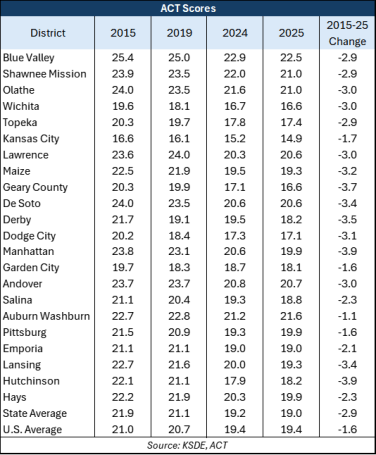 The state average score set a new all-time low of 19.0 on a scale of 1-36. Since 2015, the state average dropped by 2.9 points, nearly double the national average decline of 1.6 points. USD 229 Blue Valley, which considers itself the best-performing district in Kansas, is also 2.9 points lower than in 2015, with a score of 22.5. Most of the largest districts in Kansas have declines equal to or worse than the state average.
Hutchinson and Manhattan fell the most among the larger districts in the adjacent table, being 3.9 points below their 2015 levels. Others with large declines include Geary County (-3.7), Derby (-3.5), De Soto (-3.4), and Lansing (-3.4).
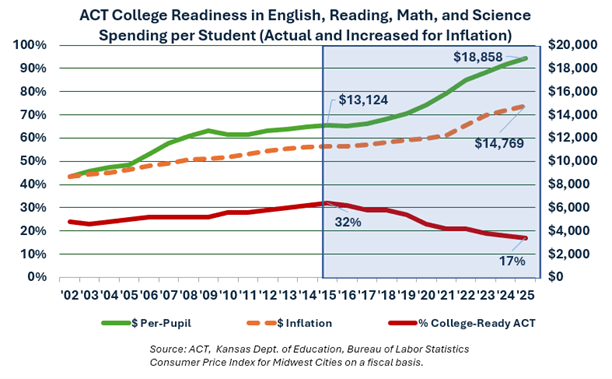
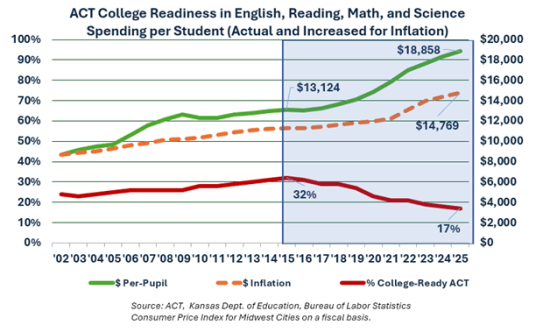
The impact of declining ACT scores is readily apparent. ACT college readiness in English, Reading, Math, and Science has plummeted from 32% in 2015 to just 17% last year. The downfall began when KSDE and the State Board of Education de-emphasized academic improvement as part of the Kansans Can initiative (with the ridiculous ‘leads the world’ slogan).
COVID may be an unfortunate partial factor, but achievement declines were well underway when the pandemic hit.
The college-readiness crisis also cannot be blamed on more students taking the ACT. There was a small uptick in participation in 2020 and 2021, but it has been back to where it was previously for several years now.
Kansas outcomes also declined on the National Assessment of Educational Progress (NAEP) and the state assessment through 2024. Then, KSDE and the State Board of Education implemented a new test with lower proficiency standards to make it appear that outcomes significantly improved in 2025.
They don’t admit that, of course, but their deception is painfully obvious.
Outcomes jumped when proficiency standards were lowered in 2002, 2006, and 2025, and proficiency plummeted in 2015 when high standards were reinstated in 2015.
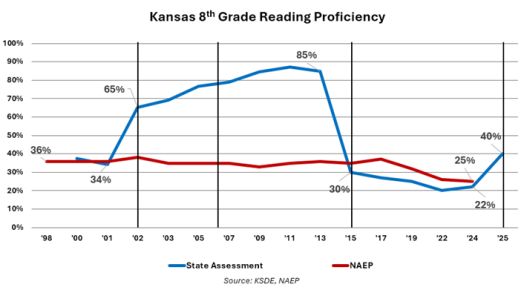
Think of proficiency standards like a grading scale on a test. If the scale for an “A” drops from 90 to 100 to, say, 75 to 100, a lot more students will get an “A.”
The State Board of Education seems determined to cover up poor outcomes rather than do anything about, so now it is up to the Legislature. They can either pass a law requiring KSDE to go back to having high proficiency standards, or allow the deception to continue.