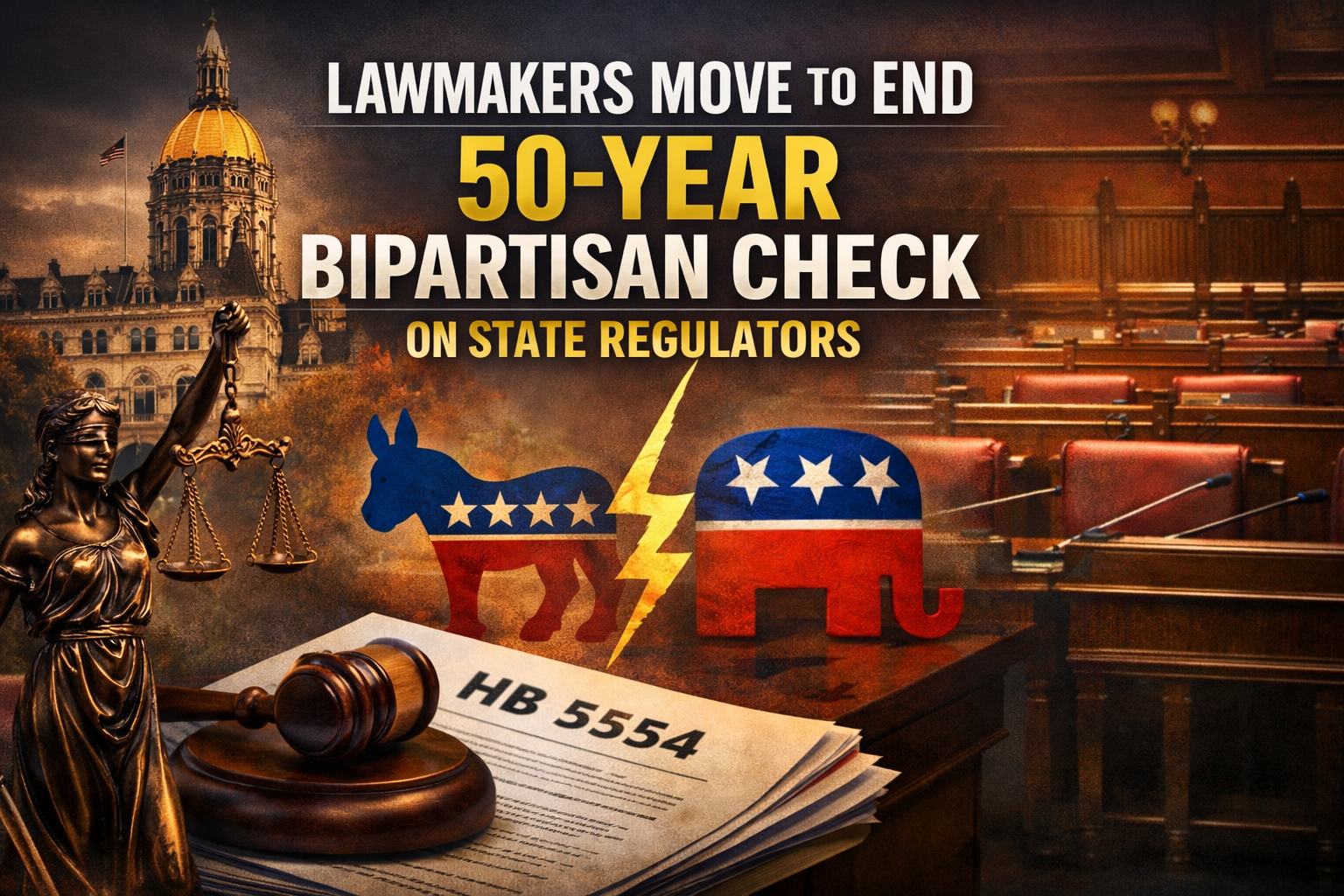
For more than half a century, Connecticut lawmakers have relied on a bipartisan committee to oversee the growing power of state regulators. A new bill moving through the legislature would upend that balance.
HB 5554 would change the structure of the legislature’s Regulation Review Committee — the body responsible for approving state agency regulations before they take effect. Under current law, the committee is evenly divided between Democrats and Republicans. The proposed change would instead allocate seats based on party control of each chamber, giving the majority party effective control.
The bill is scheduled for a public hearing Wednesday, March 18 before the Government Administration and Elections Committee.
The change would dismantle a structure lawmakers deliberately designed in 1971 when Connecticut adopted its version of the Uniform Administrative Procedure Act.
At the time, legislators were concerned about the expanding authority of administrative agencies, and the risk that unelected regulators could reshape public policy through rulemaking.
“Our administrative agencies of State Government have been given increasing powers… over the last few years,” Rep. David Neiditz (D-West Hartford) said during the June 4, 1971 House debate that created the modern oversight framework.
To address those concerns, lawmakers built in a safeguard: bipartisan review.
“This… is an equally divided Committee between both parties,” Neiditz explained. “It is not the purpose of this Committee to be partisan. It’s the purpose of this Committee to see that the legislative intent is carried out.”
That structure has remained largely unchanged for decades.
Today, the committee includes eight House members and six Senate members, split evenly between the two major parties — requiring bipartisan agreement before regulations can move forward.
The Regulation Review Committee plays a significant role in Connecticut policymaking. State agencies cannot implement most regulations, including those affecting environmental policy, labor standards, healthcare licensing, and energy, without committee approval.
Because these regulations are written by executive branch agencies, the committee serves as one of the legislature’s primary checks on administrative power.
The current structure forces negotiation, scrutiny, and compromise.
HB 5554 would remove that requirement.
Instead, committee membership would reflect partisan control of the House and Senate. With one party currently holding large majorities in both chambers, the change would likely give that party a clear voting advantage.
The bill would also eliminate the requirement that the committee’s co-chairs come from different political parties.
The proposal represents more than a procedural adjustment. It would mark a fundamental shift in how Connecticut oversees the regulatory process.
For decades, the system has required bipartisan agreement before rules affecting millions of residents and businesses could take effect. HB 5554 would replace that model with one driven by majority control.
The original architects of the system viewed bipartisan oversight as essential to ensuring that regulations reflected legislative intent, not just administrative preference.
This bill would move the state in a different direction.
And in doing so, it raises a broader question: should the rules governing Connecticut’s economy and daily life continue to require bipartisan review — or be decided by whichever party holds power at the moment?