The Minnesota Department of Education recently announced that the class of 2025 set a new record for high school graduation rates.
At 84.9 percent, the four-year graduation rate is up from last year’s rate of 84.2 percent.
“This is a moment worth celebrating,” said Gov. Tim Walz. “Decades in the classroom have helped inform many of the goals I’ve set and the policies we’ve passed over the last seven years to support our students, teachers, and parents. Every student who receives that diploma is better equipped to navigate the challenges of landing a job, pursuing higher education, and building a future they feel excited about.”
But there is another side to the story that continues to be left out, as was the case last year when graduation percentages were also a record high.
Even as graduation rates climb, academic performance is moving in the opposite direction. In math and reading, Minnesota high school students are performing at the lowest levels ever recorded for a graduating class.
It’s a tale of two stats: a record-high graduation rate paired with declining academic readiness.
Minnesota High School Proficiency & Four-Year Graduation Rate
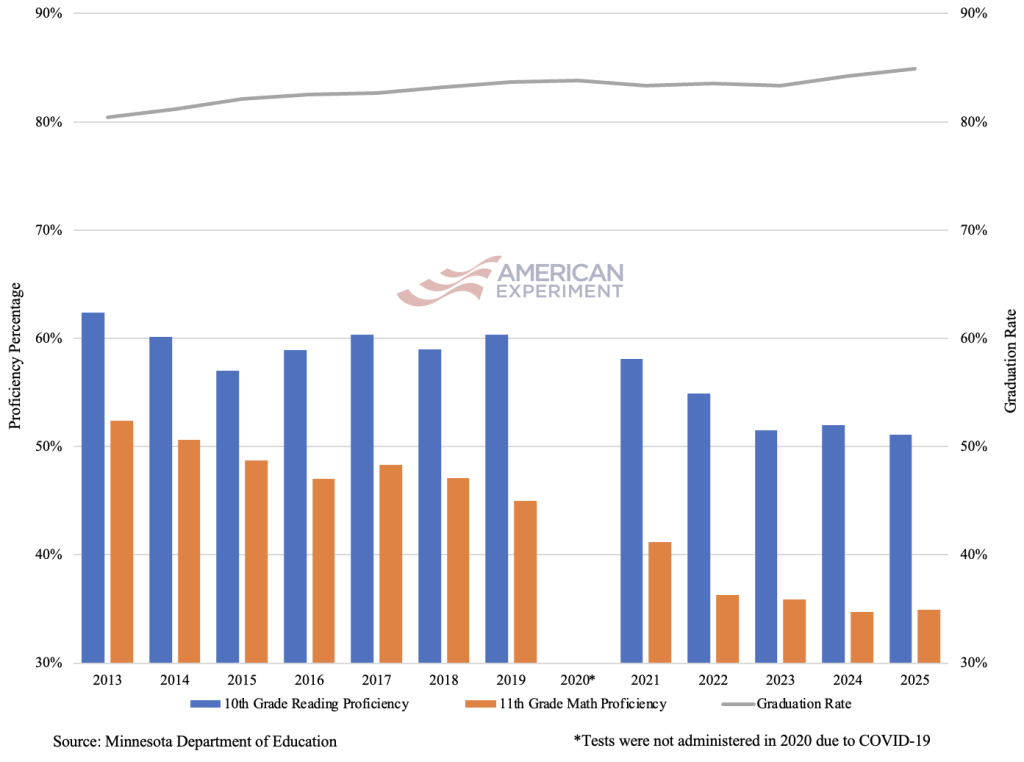
Because high school students take the reading Minnesota Comprehensive Assessment (MCA) in 10th grade and the math MCA in 11th grade, we don’t have a perfect measure of what they know at graduation. But the available data paints a clear picture. As 11th graders, just 34.7 percent of the class of 2025 met grade-level standards in math. As 10th graders, only 51.5 percent were proficient in reading. Both figures represent record lows.
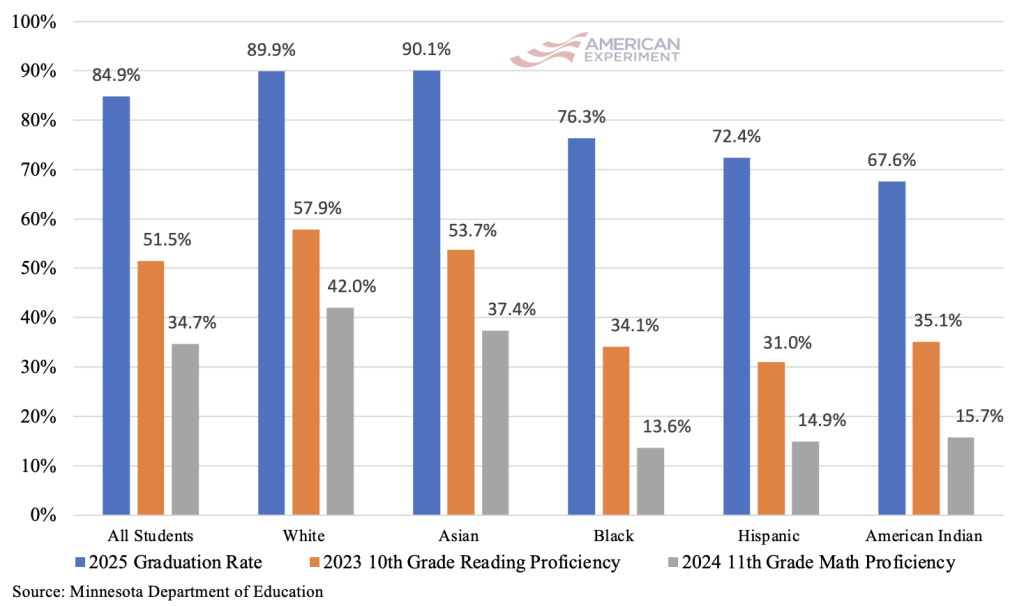
The declining proficiency isn’t limited to the overall student population. Student subgroup data shows similar trends, even as rising graduation rates across demographics receive more attention.
Minnesota High School Proficiency & Four-Year Graduation Rate
by Student Groups
Minnesota requires high school students to complete all state academic standards and a minimum number of course credits in order to graduate, but there is no state-mandated minimum GPA requirement. And unlike in the past, students no longer have to pass a high school exit exam. In 2013, the DFL-controlled legislature eliminated the Graduation Required Assessment for Diploma (GRAD), removing a statewide standard for demonstrating basic competency in reading and math in order to receive a high school diploma.
Since then, the gap between graduation rates and academic performance has become harder to ignore.
ACT results tell a similar story. Scores in English, math, science, and overall composite averages for Minnesota’s class of 2025 remain at record lows. Only 39 percent of exam-takers met at least three of the four college-readiness benchmarks. Perhaps more concerning is that 36 percent — an increase from 2024 — met zero of the benchmarks.
According to ACT, students who meet the college readiness benchmarks “have a roughly 50 [percent] chance of earning a B or better in the corresponding first-year college courses and a roughly 75 [percent] chance of earning a C or better.”
ACT data from prior graduating classes shows that 84 [percent] of students who have met all four benchmarks graduate with postsecondary degrees within six years. Only 38 [percent] of students who meet zero benchmarks and 56 [percent] of students meeting one benchmark graduate in that time.
State data reinforces the connection. Minnesota’s own assessment materials acknowledge a strong relationship between MCA performance and college entrance exam results, which are themselves reliable predictors of early college success.
At the same time, research from ACT shows that grade inflation continues to drive high school grades up, making student GPAs less predictive of student success in college. In contrast, ACT composite scores “continue to be a reliable predictor of students’ early success in college,” according to the report.
While rising high school graduation rates are a positive goal, it is equally important that a diploma reflects genuine academic readiness and that its value is not compromised in the pursuit of these higher numbers. A false sense of achievement not only undermines the credibility of the high school credential but also places unfair burdens on students who believe they are prepared only to find out too late that they aren’t, putting at risk their future success in college, the workforce, or daily life.