
A recent paper released by the Reason Foundation noted that Minnesota ranks fifth in the nation for inflation-adjusted teacher salary growth from 2002-2022.
The average Minnesota teacher salary in 2002 was $42,194. In 2022, the average Minnesota teacher salary was $72,773.
When teacher salaries were adjusted for inflation, Minnesota saw a 2.5 percent increase in salary growth from 2002-2022. Minnesota was beaten by Washington (18.6 percent increase), New York (12 percent increase), Massachusetts (11.7 percent increase), and North Dakota (9.2 percent increase). Forty states saw declining growth in teacher salaries once salaries were adjusted for inflation — even though all states but one boosted K-12 spending, leading to a spending growth of 25 percent per student.
The Reason Foundation argues that the national disconnect between increased funding and consistent teacher salaries is due to 1) the significant increase of non-teaching staff 2) skyrocketing pension debt and benefit spending and 3) considerable national inflation during the COVID-19 era.
While Minnesota prioritizes teacher salary growth more strongly than other states, it is no stranger to these dynamics. It’s possible that some of the lowered educational results that the state has seen have been contributed to by a lack of policy focus on attracting and retaining high-achieving teachers.
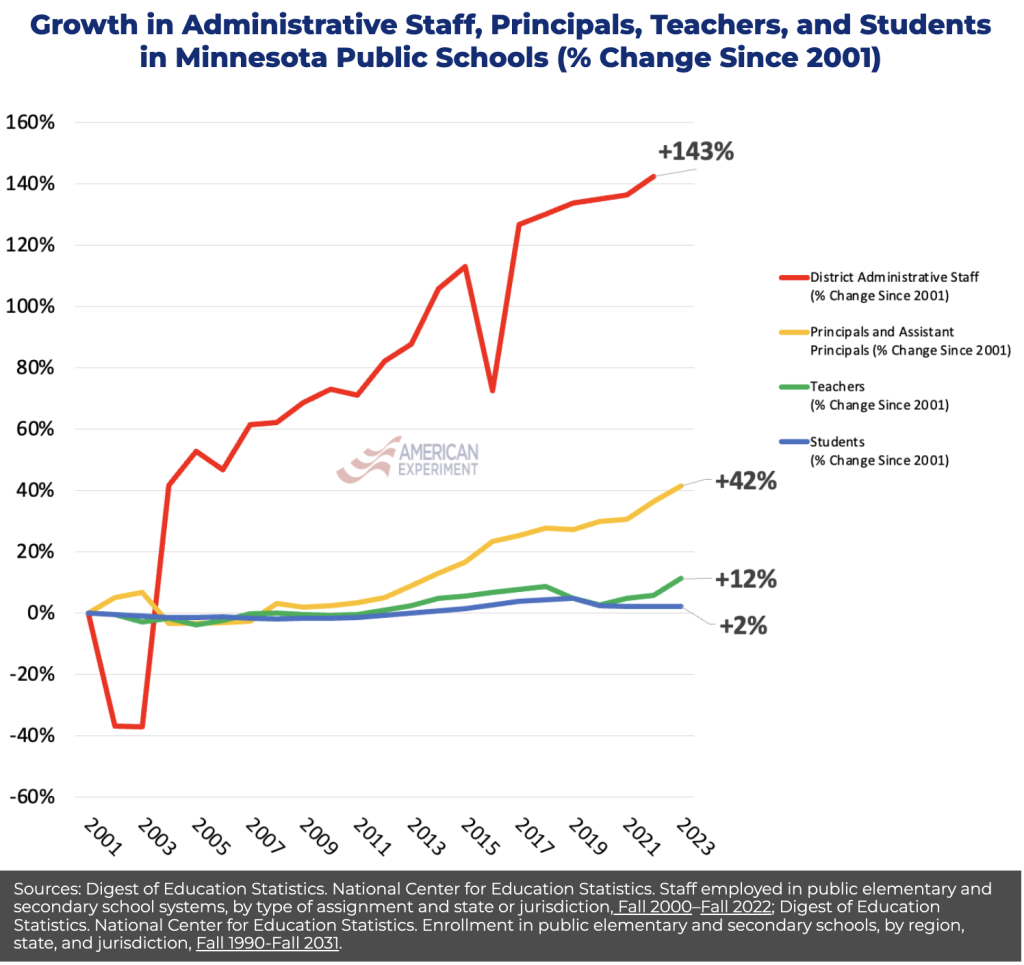
As my colleague Catrin Wigfall has written, non-teaching positions have steadily increased in Minnesota. Non-teaching positions now outnumber teaching positions. Since the 2001-02 school year, principal/assistant principal growth is up 42 percent. School district administrative staff is up 143 percent. Teacher growth over that same period increased 12 percent.
As to the question of skyrocketing pension debt, Catrin has noted that
Minnesota’s teacher pension system is at $7.1 billion in unfunded accrued liability, and its funded ratio is at 79.9 percent. Put another way, only 80 cents on the dollar is available to pay teacher benefits. The fund also continues to run a contribution deficiency. This means that actual contributions once again fail to meet the required contributions necessary to fully fund the pension plan.
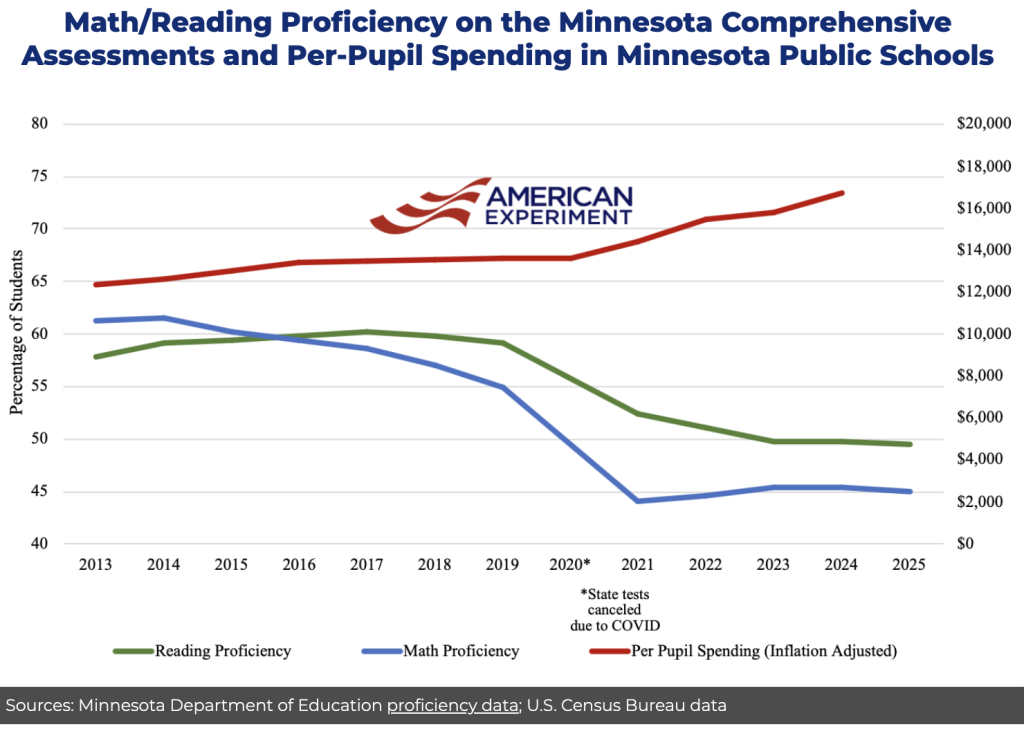
Even though statewide funding has consistently increased in Minnesota, teacher salaries have not commensurately risen, nor have test scores.
We know that a highly effective teacher is one of the most important factors (perhaps the most important factor) in ensuring student success. Competitive salaries are an important part of attracting ambitious, effective teachers. When salaries are tied to efficacy rather than tenure or credential alone, schools can attract a higher caliber of educator. A relatively slim, highly paid, highly effective force of teachers might have better results than a mass of somewhat-effective educators and administrators.
There are many options to reform teacher pay. For example, decoupling teacher salary increases from traditional “step and lane” union-based agreements would add flexibility that allows for quality teachers to be paid more. Incentive pay could take that decoupling a step further. In 2019, Texas began offering incentive pay to teachers, with the goal to give educators “an accessible pathway to a six-figure salary.” Early reports suggest that the program strongly increased teacher retention rates.
Administrators could also give salary incentives for educators who hold subject-specific degrees, in the hopes of rewarding educators who hold deep knowledge in their field.
Perhaps most importantly, Minnesota should look elsewhere in the education budget to see if there are smart ways for districts to free up more money for teacher salaries. For example, there are so many (80+) unfunded state mandates affecting each school district that Rep. Peggy Bennett sponsored a bill in last year’s special session that would allow districts to opt out of some unfunded mandates. The effort was eventually tabled.
Attracting and retaining high-quality educators should be a top policy priority for the North Star state. Teacher salary policies that reward excellence are one aspect of that endeavor.