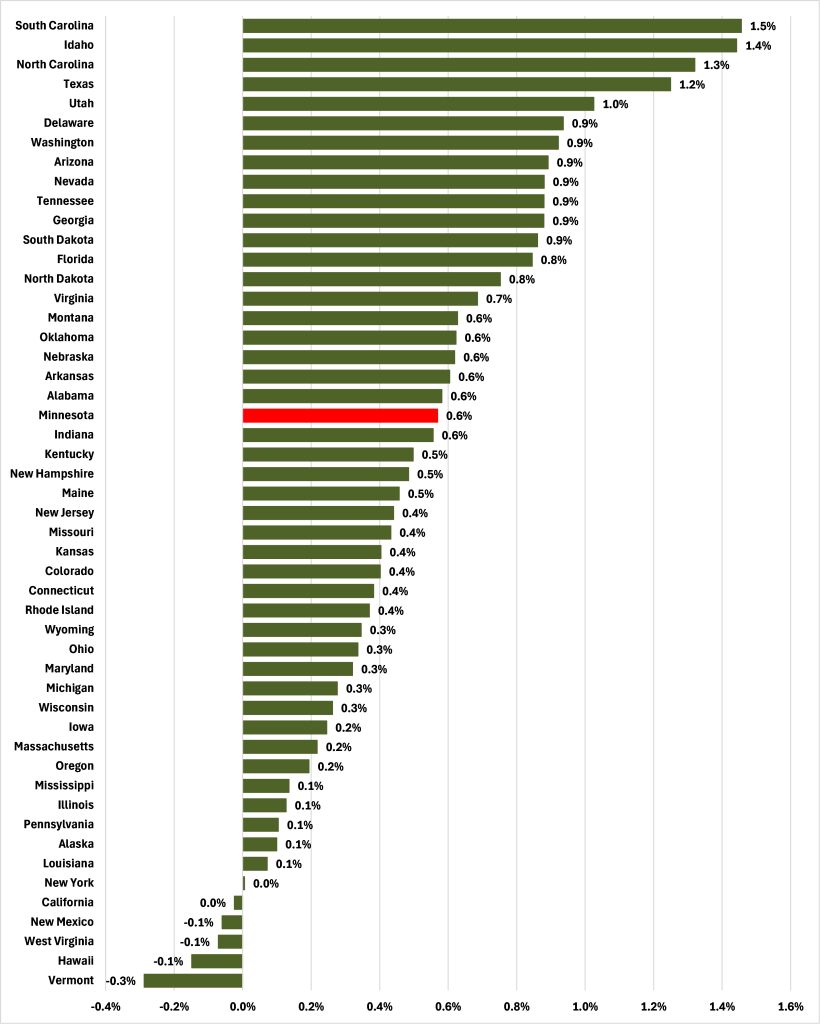
The Census Bureau released its estimates today for state and national populations in 2025. Minnesota’s population now stands at an official 5,830,405. That is up 33,000 — or 0.6% — since 2024, a rate of growth which ranks 21st out of 50 states, as Figure 1 shows.
Figure 1: Population growth, 2024 to 2025
What was behind this?
The Census Bureau breaks these changes into two main categories. The first is “Natural Change,” which is just Births minus Deaths. The second is Net Migration, which is the sum of net International and Domestic migration, both calculated by subtracting the outflow from the inflow. Owing to the existence of a “residual [which] represents the change in population that cannot be attributed to any specific demographic component,” it is difficult to break that overall figure for population change down into those shares arising from these various sources. This mysterious residual ranges from very small — just three people in Georgia, or 0.0% of the total change — to quite large, such as 145 people in New York, or 14.4% of its total population change.
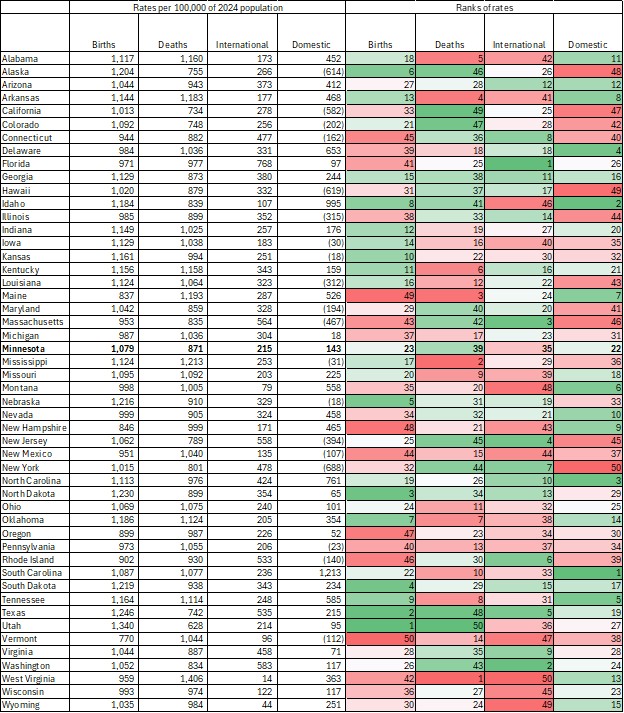
What we can do is calculate the rate per 100,000 of the 2024 population of each of these four sources. As Table 1 shows, Minnesota ranks 23rd out of 50 states for its birth rate, 39th for its death rate, 35th for its rate of net international migration, and 22nd for its rate of net domestic migration. That is the big story here: Between 2024 and 2025, the Census Bureau records more people moving to Minnesota from the rest of the United States than moved out of our state.
Table 1: Rates and ranks of components of population change, 2024 to 2025
The data is seldom kind to Minnesota, so this should be welcomed. As I have written before, if we are to improve our relatively poor performance in per capita GDP growth, we need the people moving here to be more likely to be employed and/or more skilled than those people already resident here. Let us hope for further good news on this front.