Massachusetts lost 35,000 private-sector jobs and is one of just six states yet to regain pre-pandemic employment levels
Boston – Data released today from the Bureau of Labor Statistics confirm that the Commonwealth has lost even more private sector jobs in the years following the COVID-19 pandemic than previously understood.
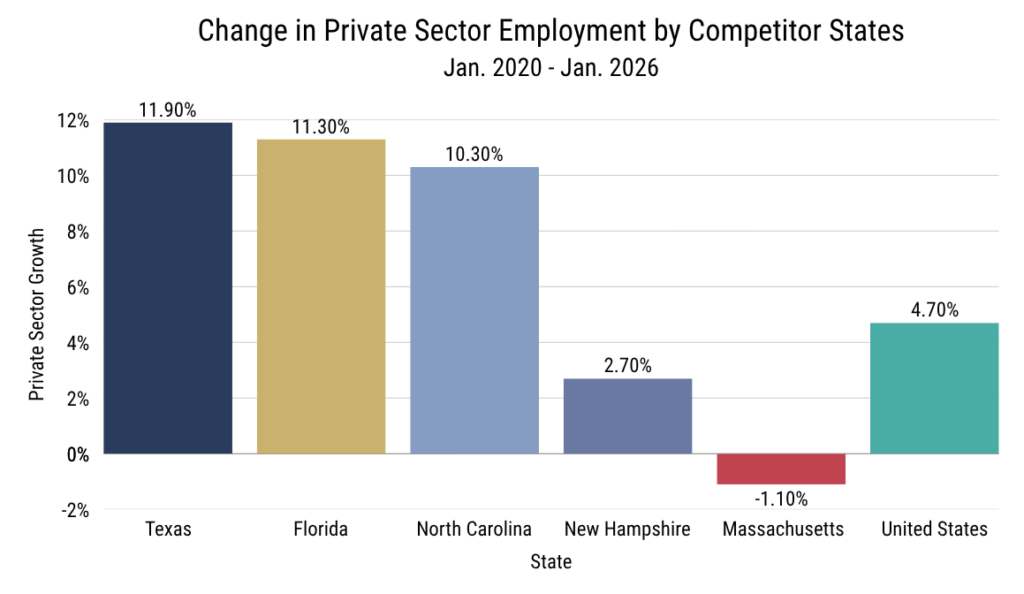
Pioneer Institute’s March 2025 report Massachusetts at Risk: The Alarming Decline of Private Sector Employment Growth found that the Commonwealth had 24,000 fewer private sector jobs than in January 2020 (-0.74 percent), but today’s updated figures revise the decline to 34,700 (-1.06 percent)from January 2020 to January 2026, putting Massachusetts even further behind the national average of 4.65 percent growth over that period.
“The revised data are clear: Massachusetts’ economic challenges run deeper than we thought,” said Pioneer Executive Director Jim Stergios. “Over the past six years, the Commonwealth has lost the equivalent of every private-sector job in Brookline, while business-friendly states have added jobs by the hundreds of thousands.”
Losses did not only occur during the pandemic – from January 2025 to January 2026 the state lost 11,600 jobs (-0.49 percent).
Across the country, benchmark updates to the Current Employment Statistics (CES) dataset reveal that job growth in 2025 was overstated in earlier estimates. However, the impact on Massachusetts is particularly striking. Already one of only six states and D.C. to experience negative private sector employment growth since 2020, the Commonwealth now appears to have experienced an even more prolonged and severe period of stagnation.
The implications are clear: Massachusetts is not just lagging – it is losing ground. While competitor states such as Texas (11.9 percent or 1.3 million jobs), Florida (11.3 percent or 895,000 jobs), and North Carolina (10.3 percent or 401,000 jobs)have continued to post strong private sector job growth since 2020, the revised data show that Massachusetts has failed to keep pace by an even wider margin than previously reported.
This divergence is not occurring in a vacuum – it reflects meaningful differences in policy, particularly around taxes and the cost of doing business. Pioneer recently highlighted that Massachusetts remains a high-cost, high-tax state relative to its competitors, while states like North Carolina have moved aggressively in the opposite direction. North Carolina has steadily reduced its corporate tax burden and is on track to phase it out entirely, while Massachusetts has maintained comparatively higher taxes on income, capital gains, and estates.
Evidence suggests that workers and businesses are responding accordingly, with migration data showing that residents are increasingly leaving high-tax states for lower-tax alternatives. These policy differences help explain why job growth has been far stronger in competitor states and why Massachusetts has struggled to retain both employers and talent.
More concerning still are the trends within key industries. Sectors that have long anchored Massachusetts’ innovation economy – including professional and technical services, information, and manufacturing – now appear weaker than earlier estimates suggested. For example, employment in professional, scientific, and technical services has now declined by 19,700since its peak in August 2022 compared to 14,900 in earlier estimates.
This underperformance has real consequences. Private sector job growth is the primary driver of wage gains and upward mobility. When growth stalls, opportunities diminish. In a state with one of the highest costs of living in the country, a sluggish labor market places increasing pressure on households and risks accelerating outmigration further, particularly among younger and highly skilled workers who are sensitive to employment opportunities and cost of living.
The revised data also reinforce a broader structural concern identified in our report: Massachusetts’ economic model is becoming increasingly unbalanced. Growth in a handful of sectors has not been sufficient to offset declines elsewhere, and the overall pace of job creation has fallen short of what is needed to sustain a dynamic, opportunity-rich economy.
These updated figures should serve as a wake-up call. The challenges facing Massachusetts are not temporary or cyclical; they are persistent and, as the new data make clear, more severe than previously believed. Without meaningful policy changes, the Commonwealth risks entrenching a pattern of slow growth, reduced competitiveness, and diminished economic opportunity.
“The path forward remains the same,” said Aidan Enright, who authored Pioneer’s original report. “Massachusetts must take decisive steps to strengthen its business climate, reduce barriers to growth, invest in its workforce, and address the high cost of living that continues to constrain both employers and workers.”