FOR IMMEDIATE RELEASE
Media Contact: sydney@pelicaninstitute.org
March 31, 2026
“Shock to the System” outlines policy playbook to protect families from rising utility bills
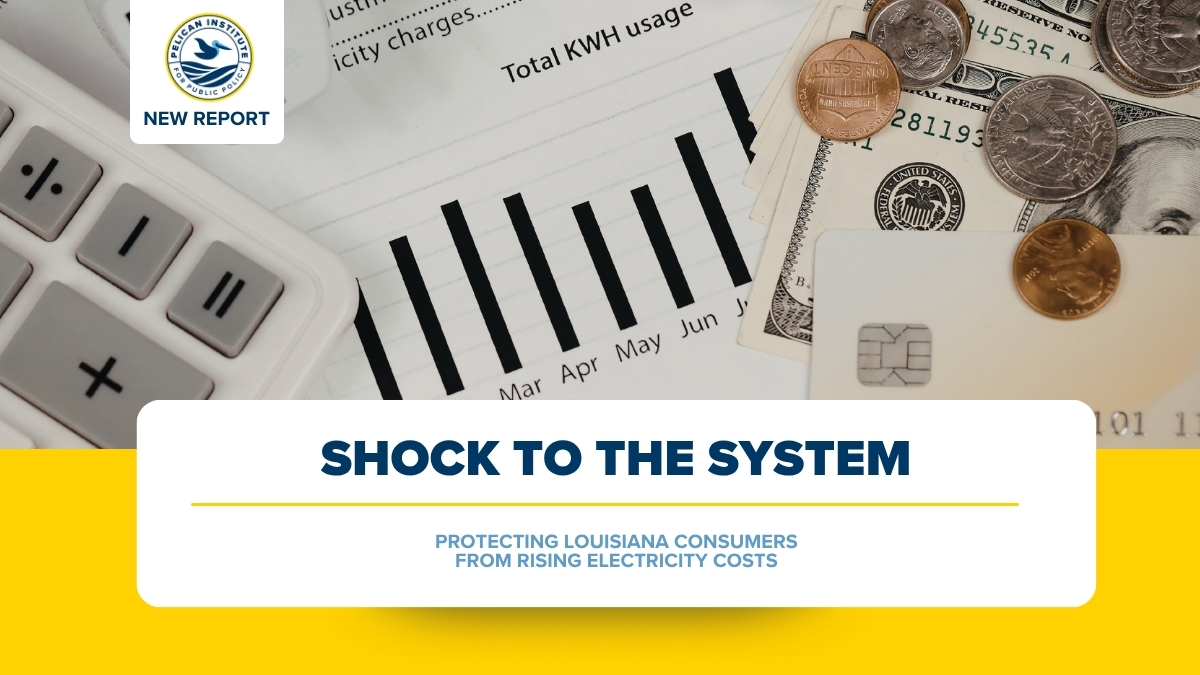
NEW ORLEANS, LA — The Pelican Institute for Public Policy today released a new report, “Shock to the System: Protecting Louisiana Consumers from Rising Electricity Costs,” detailing the structural drivers behind rising electricity bills and offering a comprehensive policy playbook to address affordability and reliability for Louisiana families and businesses.
“While Louisiana has historically enjoyed some of the lowest electricity rates in the country, costs are rising quickly and families are struggling,” said Daniel Erspamer, CEO of the Pelican Institute for Public Policy.
A 2026 Pelican poll found that 66% of Louisiana voters experienced increases in their electricity and gas bills over the last year. In addition, the report notes key data that indicate if current trends continue unchecked, Louisiana could be headed to a full-blown electric affordability crisis.
- Between 2019 and 2024, base rates for residential customers who get their power from Louisiana’s largest utility provider increased over 30%.
- From 2024 to 2025, the average retail residential price per kilowatt-hour of electricity in Louisiana rose by 14.1%, more than doubling the nationwide average increase of 6.5% over the same period, federal data show.
- Potentially compounding the pain, Louisiana’s largest monopoly utility is currently pursuing a series of major capital expenditure projects totaling over $8.5 billion. If all of the proposals and associated rate increases are approved by the Louisiana Public Service Commission (PSC), it is estimated base rates for electricity could climb another 40% by 2030.
“It is obvious that our current trajectory is unsustainable, but it is not inevitable,” Erspamer said. “If we continue down the current path, families will face sustained upward pressure in the future. But if we act now to correct course, we can restore affordability, strengthen reliability, and make Louisiana a national leader in energy abundance.”
Systemic Factors, Not Demand, Are Driving Up Electricity Bills
Contrary to popular narratives, the report finds data centers and rising demand are not the primary drivers of higher electricity prices in Louisiana today. Instead, the sticker shock consumers are experiencing now stems from structural flaws in the state’s regulatory framework, including:
- Heavy reliance on a single energy source, leaving customers exposed to fuel price volatility
- Large-scale infrastructure spending with limited cost discipline and guaranteed recovery for monopoly utilities
- Weak competitive safeguards in utility procurement
- Regulatory policies that limit consumer choice and allow utilities to shift costs and long-term risk onto captive ratepayers.
“Families are feeling the consequences of a regulated monopoly system that lacks competition and cost discipline,” said Melissa Landry, Director of the Center for Energy at the Pelican Institute. “When utilities can recover costs automatically, the incentive is to build more, not to build efficiently.”
A Clear Path Forward: Market-Based Reforms
The report outlines a practical, pro-growth policy playbook that can be implemented within Louisiana’s existing regulatory framework to keep electricity rates in check while meeting increased demand for power.
Key recommendations include:
- Expanding consumer choice and direct market access to allow large load users to build or buy their own power
- Restoring competitive procurement to ensure lowest-cost energy investments
- Streamlining permitting to accelerate energy infrastructure development
- Strengthening regional transmission through full participation in the Midcontinent Independent System Operator’s (MISO) Long-Range Transmission Planning process
- Enabling next-generation energy technologies, including advanced nuclear and geothermal.
These reforms are designed to introduce cost discipline, expand access and options to help attract private capital, and ensure that infrastructure investments benefit, not burden, Louisiana ratepayers.
“This is not about dismantling the system—it’s about fixing the incentives,” Landry added. “With the right approach, Louisiana can meet growing demand, continue attracting major investment, and keep electricity affordable for families. But if current trends continue unchecked, rising energy bills could become a more permanent feature of our economy.”