In the first annual “Phone-Free Schools State Report Card,” only two states — North Dakota and Rhode Island — earned an “A” for enacting comprehensive, statewide phone-free school laws.
The Report Card, produced by The Anxious Generation, Smartphone Free Childhood US, the Institute for Families and Technology, and the Becca Schmill Foundation, evaluates state policies against a model framework that calls for bell-to-bell prohibition, off-person storage, limited exceptions, and enforceable compliance mechanisms. (The research and practitioner testimony cited in the Report Card reinforces what many parents and teachers already know intuitively: when phones are removed from classrooms for the school day, disruptions decrease and student engagement improves.) States received top marks for policies that require bell-to-bell restrictions and mandate that phones be stored out of reach and out of sight for the entire school day.
North Dakota’s state law met those standards, receiving the highest score in the nation. Its law includes defined legal and medical exemptions, clear enforcement mechanisms, and protections to ensure that safety and instructional flexibility are preserved.
Minnesota, by contrast, received a “D.” The state lost points for not requiring bell-to-bell restrictions, not mandating inaccessible storage, leaving key device definitions unclear, and omitting enforcement provisions.
During the 2024 legislative session, Minnesota lawmakers required school districts to adopt a cell phone policy by March 15, 2025. But they decided against establishing statewide standards. Instead, implementation was delegated to local districts, with principal associations tasked with developing best-practices guidance to “minimize the impact of cell phones on student behavior, mental health, and academic attainment.”
Minnesota lawmakers are now reconsidering that approach. The Senate Education Policy Committee heard S.F. 508 on Monday, a bill that would prohibit cell phones and smart watches in schools for K-8 students and prohibit their use in classrooms for grades 9-12. The proposal includes medical exemptions and accommodations for students with disabilities, while also allowing for other exceptions according to administrative discretion.
Testimony in support of the bill focused on the detrimental effects of cell phone use, arguing that prohibiting phones would reduce disruptions and improve student focus and mental health. Supporters also cited Article XIII of the Minnesota Constitution, arguing that a uniform statewide standard on classroom phone use fulfills the legislature’s duty to establish a “general and uniform system of public schools.” The bill’s author noted that “how” the statewide restrictions are “done is absolutely completely up to each individual district.” Opponents agreed on the negative effects of cell phone use during the school day but emphasized the importance of maintaining local control, allowing districts the flexibility to develop community-driven policies tailored to their students’ needs.
Overall, supporters emphasized statewide consistency while opponents emphasized local autonomy and community-driven decision-making. The bill was laid over for possible inclusion in an education omnibus bill.
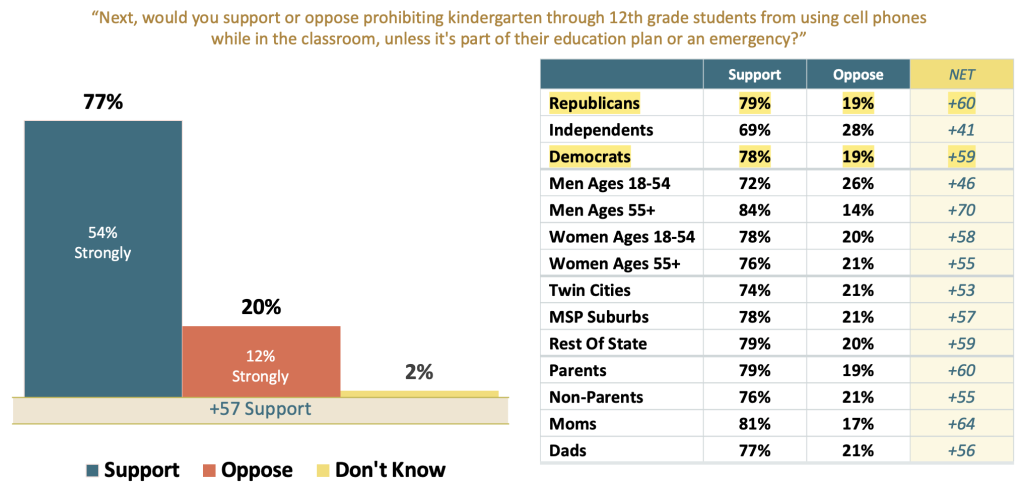
According to American Experiment’s December 2025 Thinking Minnesota Poll, 79 percent of Republicans and 78 percent of Democrats support prohibiting K-12 students from using cell phones in the classroom, unless it is part of their education plan or an emergency.
Currently, 18 states plus the District of Columbia have statewide full bell-to-bell bans in effect or being implemented. A handful of other states require restrictions on device use during instructional time only (versus a full-day prohibition). While the U.S. doesn’t have a federal mandate on phone restrictions, the growing number of state initiatives increasingly aligns with global trends, where regulating cell phone use in schools is a worldwide occurrence.