Democrats contend they withheld reopening the government during the 43-day shutdown because Republicans refused to extend temporary COVID-19 subsidies for health plans purchased through the Affordable Care Act (ACA) exchanges. Republicans stood firm. As the government reopens without this extension, many Democrats are now asking why federal workers went unpaid and SNAP beneficiaries faced food insecurity.
If the shutdown was not truly about health care, what was it about?
“I don’t know what about the last seven days would lead to the conclusion that they should cave,” said Minnesota DFL Senator Erin Maye Quade, calling the Democratic strategy “malpractice.” She obviously meant political malpractice—not medical. In defining this, she revealed the shutdown’s true purpose: stoking anti-Trump sentiment ahead of the 2025 elections.
If Democrats genuinely sought to restore their highest priority, COVID-era health policy, they would have prioritized extending the temporary Medicaid expansion—not the ACA exchange subsidies, which primarily benefit a smaller group of higher-income enrollees.
At its peak in 2023, the temporary Medicaid expansion drove enrollment to nearly 100 million—17.3 million more than today. Democrats championed and oversaw this policy. Yet where are the demands to restore coverage for the millions disenrolled from Medicaid?
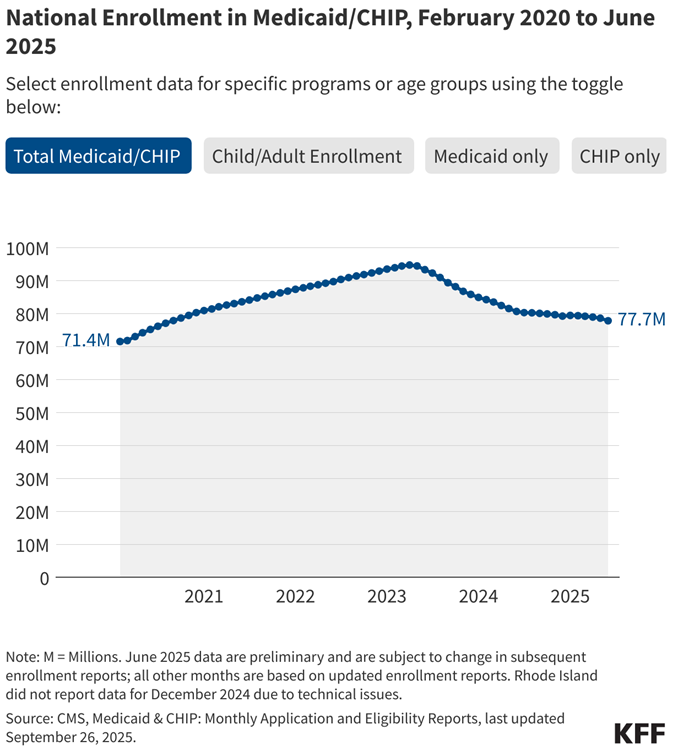
To maintain insurance coverage during the COVID-19 pandemic, Congress expanded Medicaid eligibility and increased subsidies for ACA marketplace plans. When the public health emergency ended, the Medicaid expansion expired, resulting in 27 million disenrollments. After accounting for reenrollments and transitions, net Medicaid enrollment fell by 17.3 million.
According to the Kaiser Family Foundation, roughly one-third of those disenrolled are expected to transition to private insurance, while 25%—approximately 4.3 million—will become uninsured.
The Congressional Budget Office estimates that the expiration of enhanced ACA subsidies in January 2026 will cause 2.2 million people to lose coverage—about half the number projected to lose insurance due to the Medicaid unwinding.
Democrats, including Minnesota Governor Tim Walz—who voted for both provisions as a congressman—blamed Republicans for the outcomes. Clearly, Democratic leadership anticipated political pressure from higher-income early retirees who benefited most from the enhanced ACA subsidies to at worst pressure GOP congressmen, and at best flip their votes.
Senate Majority Leader Chuck Schumer succeeded in staging a high-profile confrontation with Republicans in the run-up to the 2025 elections. But the eventual capitulation has left many wondering: Why extract such a steep cost—unpaid federal workers, disrupted safety-net programs—for a policy concession that was never secured?