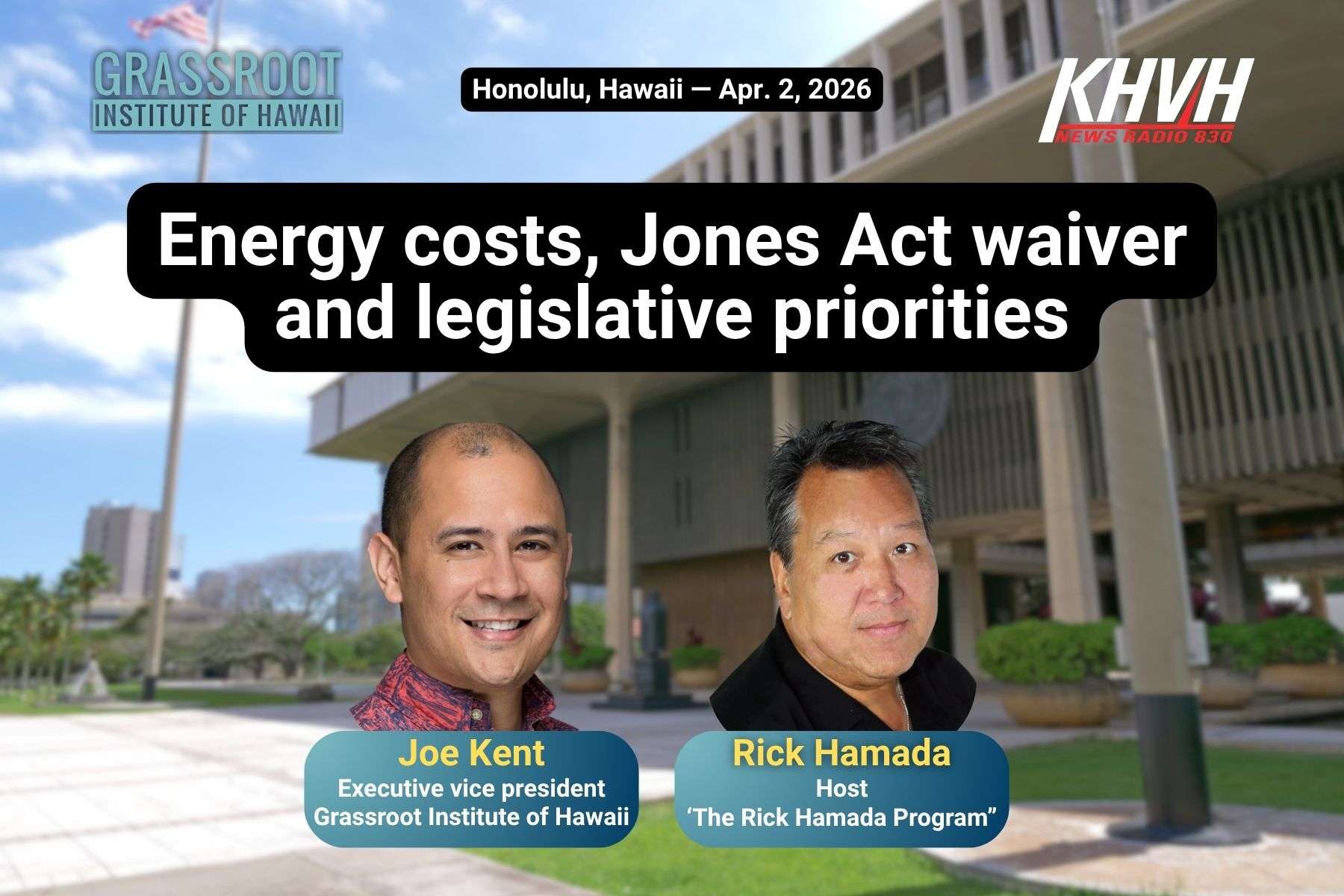
Joe Kent, executive vice president of the Grassroot Institute of Hawaii, had a wide-ranging conversation with KHVH radio host Rick Hamada on April 2 that touched on fuel prices and energy policy, the recent Jones Act waiver, some of Grassroot’s legislative priorities this session, cutting the state budget, the government’s role in economic recovery and more.
Hamada asked Kent why Hawaii’s energy prices are still skyrocketing in the wake of war in Iran, even though only a small percentage of the country’s imported oil travels through the embattled Strait of Hormuz. Kent pointed to the Jones Act, which has dictated since 1920 that cargo cannot be transported from one U.S. port to another on any foreign-built, foreign-flagged, foreign-crewed or foreign-owned vessels.
Because of the Jones Act, Kent said, Hawaii imports most of its oil from non-U.S. sources that have felt more impacts from the closure of the strait. “Hawaii, you could say, is even more affected than the rest of the nation because of this Jones Act law,” he said.
Kent noted that Grassroot is closely tracking any tankers that take advantage of President Donald Trump’s 60-day Jones Act waiver that’s currently in effect.
The two then discussed energy policy and fuel alternatives, with Kent commenting: “We’re on an island here. We can’t do like what they do on the mainland, just plug into a nearby state. So we have to solve this problem all by ourselves. And the best way to solve it is to keep all options on the table.”
From there, the two discussed a bill that would limit the governor’s emergency powers and one that would make it easier for people to become hair braiders in Hawaii.
“We’re tackling this because it’s an example of a business regulation,” Kent said of the hair-braiding measure.
Switching gears to talk about the state budget, Hamada wondered whether the state might hike taxes to help cover the cost of rebuilding after the recent Kona low storms.
Kent noted that the state has a hurricane relief fund that could be used, as well as budget surplus funds and a rainy day fund.
“We had a literal rainy day here, this is what these monies are for,” he said. “If taxes [increase] forever to pay for this one-time event, you know, that would be … a failure of budgeting, really, because what they’re not doing is taking a hard look at the budget.”
Kent and Hamada also discussed the Honolulu City Council’s proposal to disband the county’s Office of Economic Revitalization, and the state’s role in providing relief to agricultural operations.
“I always warn people, don’t look to the government to save you after a crisis,” Kent said. “Look to your neighbors and friends and churches and nonprofits and, you know, roll up your sleeves.”
You can listen to Kent’s entire 40-minute with Hamada by clicking the image below.