How can we make sure that a diploma isn’t just a piece of paper?
Last week, my colleague Catrin Wigfall wrote about Minnesota’s 2025 graduation rate (highest on record at 84.9 percent) and the Class of 2025’s correspondingly record-breaking poor academic readiness. She wrote:
Even as graduation rates climb, academic performance is moving in the opposite direction. In math and reading, Minnesota high school students are performing at the lowest levels ever recorded for a graduating class. It’s a tale of two stats: a record-high graduation rate paired with declining academic readiness.
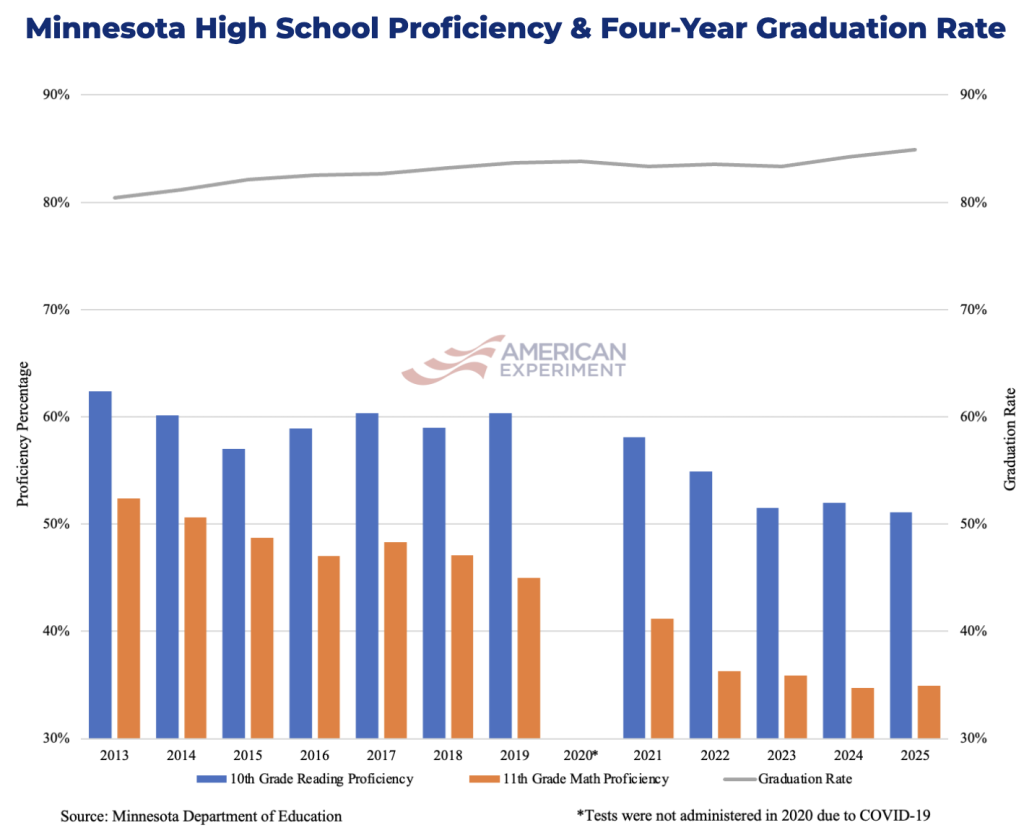
The combination of Minnesota’s high graduation rate and low test scores raises many questions. Why is the mismatch occurring? Is this something to be concerned about? How can we rectify the situation?
In an ideal world, both proficiency and graduation rates would be the same rate: 100 percent.
However, when there is such a strong disparity between students’ actual knowledge (as measured by the state test) and their graduation rates, it’s clear that the relationship between the two is so weak as to be functionally disconnected at many levels. Unfortunately, Minnesota isn’t the only state in the nation struggling with this dynamic; many states are facing significant grade inflation issues.
Since most employment opportunities require a high school diploma, educators understandably endeavor to help as many students cross the stage as possible. However, a student’s career and academic success is also dependent on the formation received while in the classroom. No matter what a student’s life path might be, it’s important that they master high-school level mathematics and reading before their graduation. A diploma must be a prize earned, not a gift bestowed.
The weakening of a high school diploma has negative social ripple effects. Former Assistant Secretary of Education Chester Finn has remarked that there are significant
[C]osts of low-standard diplomas. Besides the divergence between grad rates and achievement levels, setting a low bar carries huge negatives both for “graduates” and for the country. It’ll push more kids into college who don’t belong there and worsen credential inflation as employers seek alternate proof of true competence. It’ll degrade colleges, too, making them more remedial, forcing them—because they need students, graduates, alumni—to ease their own standards. It’s bad for the economy. It’s bad for international competitiveness. The U.S. will do even worse on PISA. And so much more.
Policymakers should consider ways to achieve these two essential and complementary goals: high levels of actual educational attainment and high graduation rates.
To this end, I suggest three possible structural changes to Minnesota’s school system that could close this gap between actual learning and diploma attainment:
First, policymakers should consider returning an updated version of the Minnesota Graduation Required Assessment for Diploma (GRAD) exit exam, which was jettisoned in 2013. While exit exams have fallen out of fashion nationally, the concept might be due for a refresh, not a continued rejection. Exit exams should be one key component (not a cornerstone) of a highly functional state education program. The mere presence of a graduation requirement can kickstart the entire system, pushing educators, parents, and students towards achievement. A refreshed Minnesota exit exam could include realistic academic standards, several retake opportunities, and exceptions for students with IEPs. Most importantly, it would stand as a barrier between a student and a useless diploma gained by “failing upwards”.
Interestingly, high school exit exams have positive effects on students in expected ways. When high school graduation requirements are made more demanding through the implementation of exit exams, local arrests decrease.
Second, systemic guards against grade inflation should be implemented. When a student attains a passing GPA despite a despairingly low level of actual knowledge, the problem lies with a system that accepts brokenness. Strong structural incentives have created a grade-ballooning environment in both K-12 and collegiate classrooms. Nationally, about eight in ten students currently receive a B average or higher. This dynamic sidelines parents that incorrectly assume their children are doing well, disempowers students that need to understand the relationship between effort and results, and smothers honest conversation about how to help struggling students. Minnesota’s students deserve more than staying in lockstep beside disheartening national norms.
There are many potential avenues for grade inflation reform. For example, external checks on grades, like end-of-course exams, can be incredibly helpful. Transparent final report cards are essential; even if classroom grades remain inflated, printing a child’s standardized test results alongside their grade level proficiency can clue parents in. Most parents (74 percent) who know that their child is performing below grade level in math are likely to schedule meetings with their child’s teacher for personalized advice. Additionally, Minnesota’s districts should avoid faddish, potentially inflationary grading reform schemes such as equity-based grading, which can be disastrous if not implemented thoughtfully.
Finally, creative overhauls of the entire diploma system might be in order. The current academic system is largely geared towards college readiness, with mandatory courses often selected with future college attendance in mind. Minnesota, like many states, ostensibly aims to prepare graduates for both postsecondary education and highly skilled work. But it’s difficult, if not impossible, to do both. One 2018 study found that a high majority of states (including Minnesota) had not achieved full or partial alignment between their high school diploma requirements and the minimum admissions criteria for higher education admittance in their state.
If students have different interests and life pathways, one inflexible diploma pathway will not adequately encompass how a rigorous education might differ between students. Almost half of America’s states offer multiple pathways to graduation. Some states, like Louisiana, have addressed this issue by providing students in tenth grade with a choice to either attain a university pathway diploma or a technical pathway diploma. Others, like New York, Ohio, and Texas) have “honors” diplomas, designed for students that plan to attend a university. For Minnesota, bifurcating diplomas into a career and a collegiate pathway (like Louisiana) seems both effective and elegant. Especially as a first reform step, two diploma pathways would be more than enough; some states have found that adding too many pathways leads to confusion.
However, Minnesota cannot and will not implement any of these reforms until honest conversations are had. Too many well-meaning school leaders dismiss the low state assessment results as one data point out of many and laud the high graduation rates as definitive achievements. Yes, Minnesotans should celebrate the attainment of a high school diploma — but they can’t allow their excitement to overshadow the task of ensuring that the diploma is meaningful. Students depend too much on their schools for system leaders to eschew seriousness about real learning.