Minnesota Secretary of State Steve Simon pushed hard in the 2023 session to pass automatic voter registration, replacing the opt-in checkbox previously in law. The new law was in place for the 2024 and 2025 elections and automatically added anyone to the voter role (or updated their information) who came in contact with state government. Most automatic voter registrations are the result of driver’s license changes, but registrations also come from applications for MinnesotaCare and any application for benefits or services from a state agency. If you change your driver’s license or apply for welfare, the state is going to register you to vote at your new address.
At the time of passage, Simon testified to the House Elections Committee in favor of the bill. He told the committee, “If you have misgivings about same day voter registration, this is the bill for you, since it would probably cut 80-90 percent of same day voter registrations.”
That was a bold claim, but it made sense. Assuming most same day registrations occur when people move from one precinct to another within the state of Minnesota, handling that on the back end between the Department of Public Safety and the Secretary of State’s office should eliminate the need for most voters to register on election day in their new precinct.
Now that we’ve had our first two elections with automatic voter registration, was Simon’s estimate correct? Not even close, and it’s important to find out why.
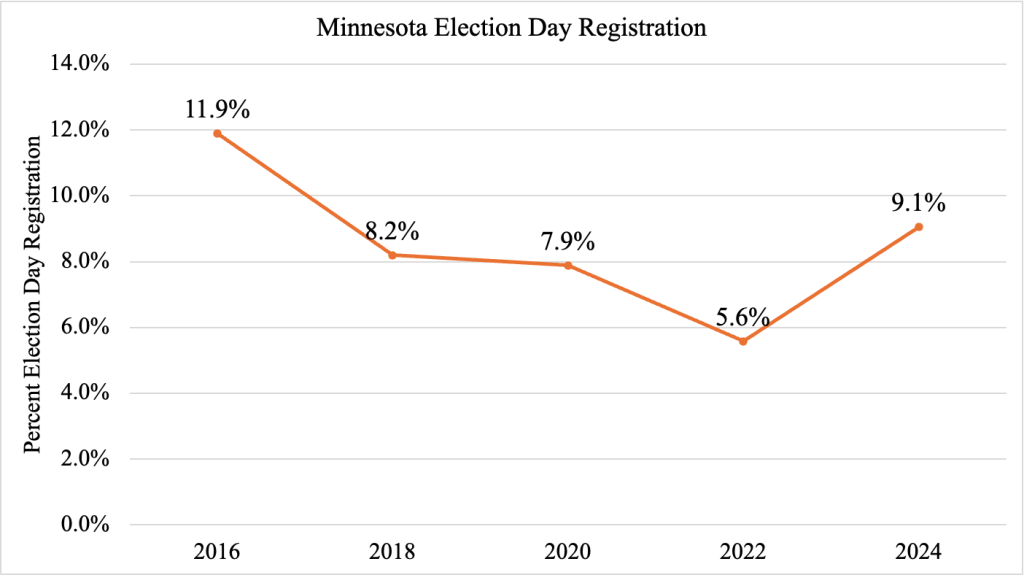
According to data from Simon’s own office, election day registration increased from 5.6 percent in the 2022 election to 9.1 percent in the 2024 election, a 40 percent increase. Automatic voter registration had no impact at all on election day registration over the last five statewide elections.
Secretary Simon provided an update on automatic voter registration on September 12, 2024, reporting 65,339 Minnesotans had been successfully registered to vote through the state’s new system. But just a few months later 327,2414 voters still needed to register on election day. The question is, why?
Did 327,414 voters move right before the election? Unlikely. Are they college students who come and go each semester? That’s part of it, but not the whole story. Here are the top twenty precincts from the 2024 general election ranked by percentage of election day registrations:
| Precinct | EDR | Signatures | Absentee | Total Votes | EDR % |
| Minneapolis W-4 P-9 | 225 | 83 | 81 | 164 | 137.20% |
| Saint Cloud W-1 P-1 | 285 | 331 | 8 | 339 | 84.10% |
| Mankato W-3 P-11 | 619 | 734 | 17 | 751 | 82.40% |
| Collegeville Twp P-2 | 521 | 624 | 11 | 639 | 81.50% |
| Duluth P-10 | 918 | 1236 | 108 | 1344 | 68.30% |
| Winona W-3 P-1 | 568 | 764 | 138 | 902 | 63.00% |
| Minneapolis W-2 P-4 | 458 | 646 | 118 | 771 | 59.40% |
| Bock | 20 | 0 | 35 | 35 | 57.10% |
| Minneapolis W-2 P-2 | 575 | 805 | 216 | 1030 | 55.80% |
| Northfield W-4 P-2 | 649 | 1120 | 55 | 1180 | 55.00% |
| Moorhead W-2 P-6 | 346 | 504 | 122 | 630 | 54.90% |
| Minneapolis W-2 P-6 | 1087 | 1561 | 436 | 2001 | 54.30% |
| Minneapolis W-2 P-7 | 362 | 584 | 241 | 829 | 43.70% |
| Minnesota Lake | 3 | 0 | 7 | 7 | 42.90% |
| Bemidji W-1 | 480 | 883 | 265 | 1151 | 41.70% |
| Mankato W-3 P-13 | 490 | 912 | 274 | 1189 | 41.20% |
| Albert Lea Twp P-2 | 4 | 6 | 4 | 10 | 40.00% |
| Mankato W-5 P-8 | 543 | 1009 | 413 | 1426 | 38.10% |
| Minneapolis W-2 P-1 | 484 | 1076 | 292 | 1374 | 35.20% |
| Winona W-3 P-2 | 259 | 570 | 184 | 754 | 34.40% |
| 16526 |
Many of these precincts represent college campuses across the state, indicating college students account for some of the EDR numbers. But same day registrants from those precincts only account for 16,526 of the 327,414 election day registrations statewide. That’s only five percent. College students are not the driving force behind the statewide election day registration numbers.
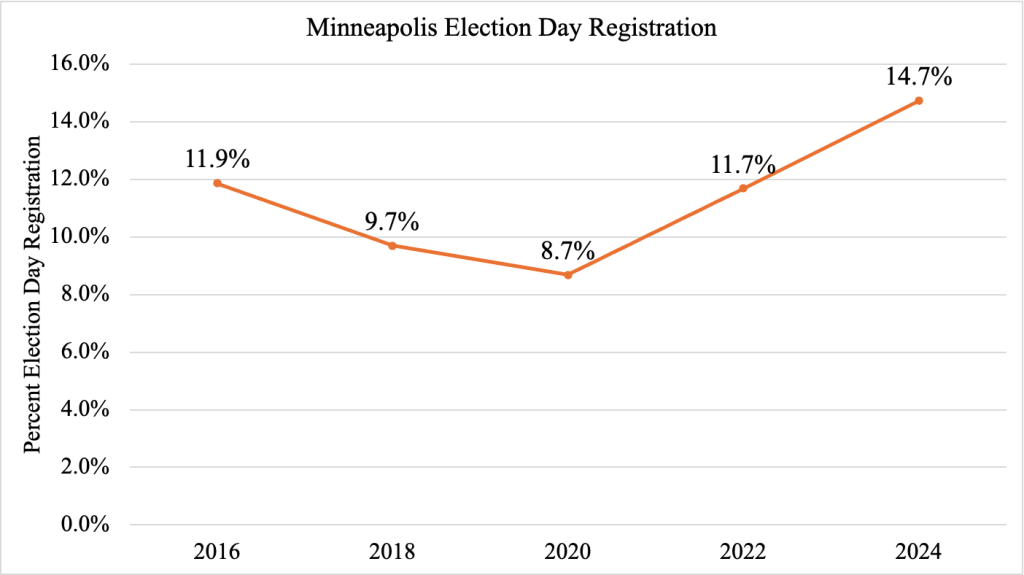
Minneapolis is consistently higher
Election day registration percentages in Minneapolis are significantly higher than the rest of the state. That could be explained by the higher than average percentage of rental housing and the aforementioned college campuses. But it’s also ground central in the Democratic Party’s voter identification and turnout efforts that helped them win every statewide election since 2006.
The 2025 election
The 2025 general election had a much smaller sample size with only 625 of Minnesota’s 4,000 precincts participating in this off-year election. Outside of special elections in Senate District 47 (Woodbury/Maplewood) and Senate District 29 (Wright County), most races were for school board and municipal offices. The biggest municipal race was for mayor of Minneapolis between Jacob Frey and Omar Fateh.
Sixty percent of the statewide election day registrations in 2025 came from the city of Minneapolis (15,629 out of 26,284). The election day registration percentage for the Minneapolis municipal election was 10.6 percent, almost double the statewide number of 5.4 percent. Without Minneapolis, the rest of the state had a 3.1 election day registration percentage, a 44 percent decrease in same day registration over the 2022 election. That’s still far short of Secretary Simon’s predicted decrease of 80-90 percent.
The deeper we went with the research, the more questions arose. Several precincts deserve more scrutiny:
- Minneapolis Precinct 4-9 reports more election day registrations than voters, which is probably a mistake. At least I hope it is. The data says that 225 registered to vote but only 83 actually voted.
- In Minneapolis Precinct 2-4 (a U of M precinct), 318 out the 322 election day votes were the result of election day registration. That means only four voters walked in, found their name already on the voter roll, requested a ballot and voted. That seems incredible. Several other precincts fit the pattern of almost 100% turnover from election to election. Are there precincts on college campuses with no permanent housing? Don’t any students stay in the same residence for more than one year?
This data does not necessarily show voter fraud, but it does tell us where to investigate further (and we will). The next time Secretary Simon appears at a legislative hearing, someone should ask him why his prediction didn’t come true.