
A warning
This summer I blew the whistle on the Minnesota Department of Correction’s (DOC) early release incentive that was about to go into effect. As planned, the DOC intended to make nearly 90% of our state prisoners eligible for early release, reducing their incarceration time by up to 50%. The program was part of the Minnesota’s Rehabilitation and Reinvestment Act (MRRA) passed by the DFL led Legislature in 2023.
In our Thinking Minnesota magazine article, “Jailbreak,” I threw cold water on the notion that reducing the amount of time our state prisoners served behind bars was an effective method to ensure rehabilitation.
“There is little doubt that improving the rate of earnest involvement in programming, work details, and vocational training can have a positive effect on behavior and recidivism.
The question is whether the early release incentive made available to the majority of prisoners will result in “earnest” participation in programming, or whether it will be used by an advantageous prison population to scam an already-lenient sentencing system.”
David Zimmer, Public Safety Policy Fellow
The case of Viance Nin
This week, Alpha News reported on an inmate, Viance Nin, 23, who was one of the first to be released early under the MRRA. If Nin is any indication of how the MRRA will play out, it won’t end well for the DOC or the state.
Nin did not have a favorable history to indicate she would be a good candidate for early release.
Court records indicate that by 20 years old Nin had racked up eight bench warrants for her arrest. Bench warrants are issued by judges, usually for failure to abide by conditional release mandates in existing cases.
In March 2022, while a fugitive on one of those bench warrants, Nin was arrested in Faribault while in possession of 20 grams of methamphetamine and marijuana. She was originally charged with First Degree Sale of a Controlled Substance and three other lessor drug related charges. The Minnesota Sentencing Guidelines recommend a presumptive commitment to prison for 65 months on a single First Degree Sale of Controlled Substance conviction with no prior criminal history. Arguably, that should have been the least amount of time Nin served.
Then, while Nin’s case progressed through the pre-trial stage, she secured a $50,000 bond for her release pending trial. Such a bond usually requires the defendant to pay the bond company $5,000 cash. Nin was released but failed to appear at a subsequent hearing resulting in her ninth bench warrant. After being arrested again, Nin secured another bond, this time for $75,000. Within a few months she failed to appear at a hearing, and her tenth bench warrant was issued. She was eventually re-arrested, and this time entered into a plea agreement with the Rice County Attorney which led to her receiving a 48month prison commitment and the agreement that two other pending cases would be dropped. She also received 316 days credit for the time she spent in jail pending trial. Ultimately this gave her about 37.5 months to serve, which she began serving on May 29th 2024 in Shakopee woman’s prison.
This is where the MRRA kicked in. Despite her record of playing the system repeatedly, she was granted eligibility for the early release incentive. In September 2025, just 15 months into her commitment, Nin was released from prison. Her “rehabilitation” didn’t last long. According to Alpha News, Nin appeared on the DOC website last week as a DOC fugitive, meaning a parole violation warrant had been issued for her arrest pursuant to a confidential violation.
A check of the Rice County Jail roster today indicates the Nin was arrested and booked into the Rice County Jail yesterday where her probation violation hearing will be held in the coming weeks.
Our biggest public safety failure
Unfortunately, Nin isn’t a unique case. We can expect similar examples to play out with many inmates who the DOC simply will not have in their custody long enough to make meaningful rehabilitative efforts. In its 2025 report to the Legislature, the DOC reported the dismal recidivism rate involving Minnesota’s prison population. 49% of people convicted of a property crime were convicted of a new felony withing three years. Drug crimes and person crimes were slightly lower at 35% and 39%, respectively.
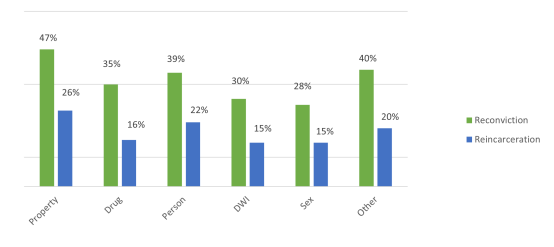
Image source: Minnesota Department of Corrections 2025 Annual Report to the Legislature
No matter how you cut it, this represents our most significant public safety failures – failing to incapacitate convicted criminals for sufficient periods so our prisons can ensure they are rehabilitated before release. The revolving door of justice is serving all of us poorly, including offenders.