By Sarah Montalbano
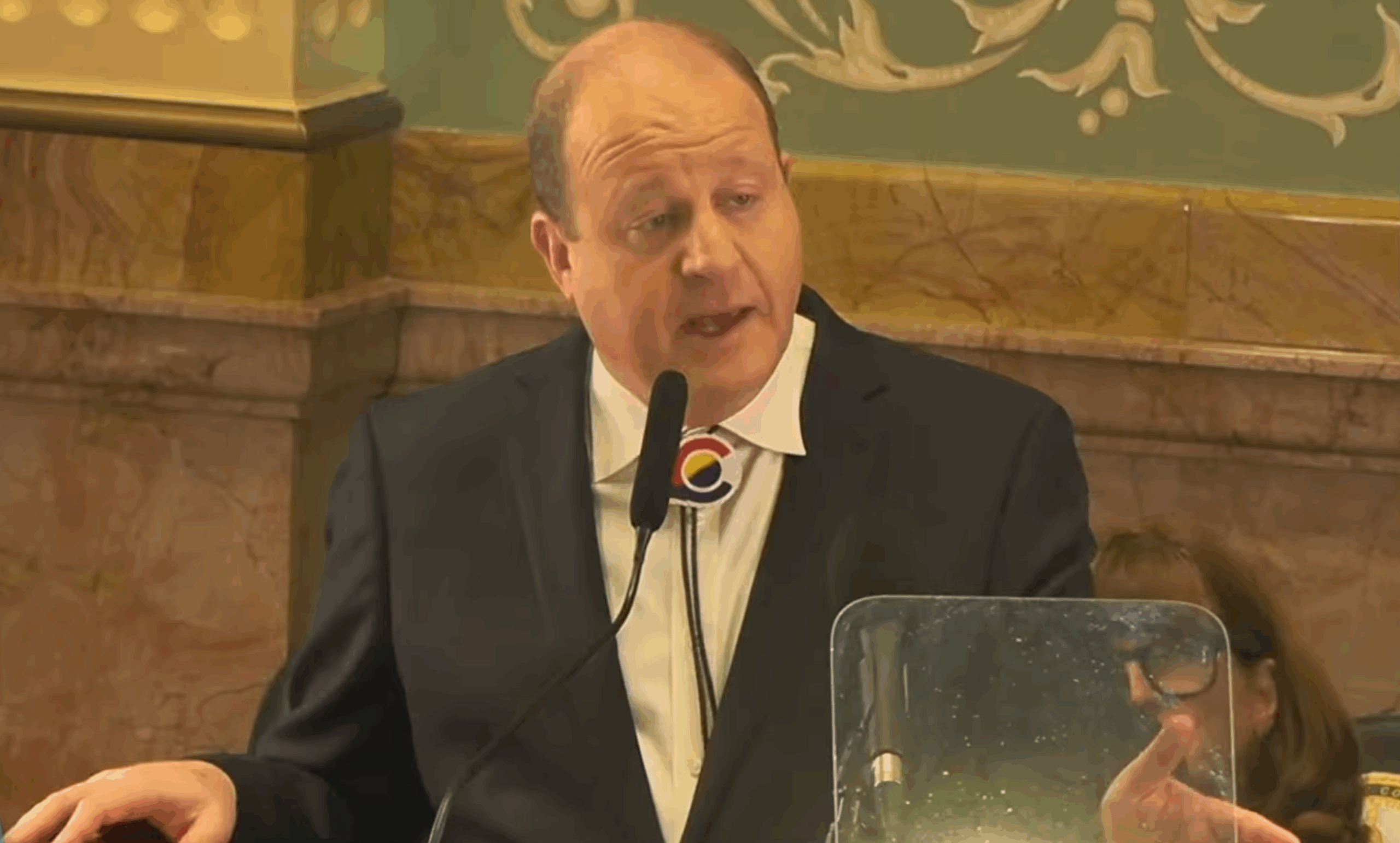
Governor Jared Polis addressed the General Assembly in his final State of the State address last week. Polis repeatedly invoked his efforts to build “low-cost clean energy,” but it’s the very same wind, solar, battery storage, and electric vehicles that will make higher energy prices for Coloradans his legacy.
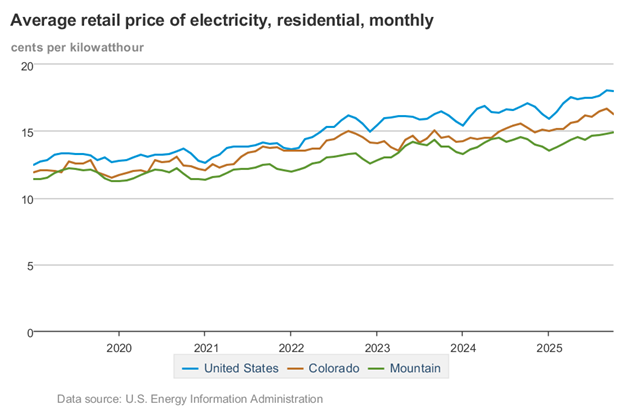
Between January 2019, when Polis entered office, and October 2025, the latest data from the Energy Information Administration, the average residential electricity price in Colorado has risen from 11.91 to 16.26 cents per kilowatt-hour (kWh). That’s up 36.52 percent, compared with an increase of 30.78 percent in the wider Mountain region. Since 2004, when Colorado enacted its first renewable portfolio standard, all-sector electricity rates in Colorado have risen from an average of 6.95 to 12.80 cents per kWh in October 2025.
That isn’t a coincidence. The legislature passed an aggressive bill in 2019 requiring the power sector to reduce CO2 emissions by 80 percent by 2030 and, with a 2023 law, reach 100 percent renewable by 2050. Meeting those mandates will require retiring ten more major coal-fired units before 2031, or 4,200 megawatts (MW) of nameplate capacity, which planned wind and solar cannot reliably replace. It’s worth noting, too, that Colorado fell short of its first statutory requirement to reduce emissions overall by 26 percent by the end of 2025, though not for lack of trying.
The Independence Institute, in conjunction with Always On Energy Research, found that the Polis administration has underestimated the costs of getting Colorado to 100 percent zero-emissions by 2040. The true costs would add $114.3 billion compared to operating the current grid, and another $214.6 billion through 2050, while creating massive blackouts.
Polis also took shots at the Trump administration’s moves to delay premature retirements of coal-fired generation in Colorado, saying that, “Washington D.C. is tipping the scale toward expensive, out of date coal production that drives up costs.” But the high costs that ratepayers are seeing now are due to blue-state choices to pursue emissions reduction targets at the expense of affordability, reliability, and physics. In fact, an AOER report finds that 86 percent of states with electricity prices above the national average voted for Democratic presidential candidates in 2020 and 2024, and 80 percent of the 10 states with the lowest electricity prices are red states.
Polis’ claims about electric vehicles and the oil and gas industry during his State of the State address are also worth examining.
Is the oil and gas industry “thriving,” as Polis said? Colorado’s oil and gas production peaked at 577,000 barrels per day in November 2019, a mere 11 months after Polis assumed office, and hasn’t recovered. That’s thanks to SB19-181 and its attendant regulations, which fundamentally changed the mission of the state oil and gas commission from promoting to preventing oil and gas development.
Polis also said that, in 2019, there were 18,000 electric vehicles “driving around Colorado” and 204,000 today, which has cut emissions by “almost 600,000 tons of carbon dioxide every year.” That sounds impressive, but Department of Energy data suggests that in 2024, the 127,000 electric vehicles registered in Colorado were only 2.3 percent of all registered vehicles in the state.
Taxpayer money backs every EV purchased in Colorado. Currently, Colorado offers the most generous subsidizes EV purchases and, in November 2025, raised its rebates to $9,000 for new EV purchases and leases and $6,000 for used EVs. Prior to the phasedown of the federal EV tax credit last September, Coloradans could capture up to $26,500 in tax incentives.
Colorado wants 940,000 electric vehicles by 2030 — so Polis and his successor will merely have to register 736,000 more EVs in the next four years, or about seven times the average rate of EV registrations between 2019 and 2025. Best of luck.
And, as the Governor mentioned in his State of the State address, he has big plans for the legislative session. Democrats are likely to introduce a bill aimed to “prevent local permitting from stopping clean energy projects,” which will override local input and proliferate the impacts And look out for legislation this session to “maintain the important goal of 100% clean energy,” probably a decade earlier than current law, that also must “adapt to realities, to federal headwinds, and protect consumers.”
Unfortunately for Polis’ agenda, the best way to protect consumers and adapt to reality is to stop prematurely shutting down reliable thermal plants and overbuilding expensive wind, solar, and battery storage. Ratepayers deserve frank discussions of the tradeoffs of aggressive climate mandates.