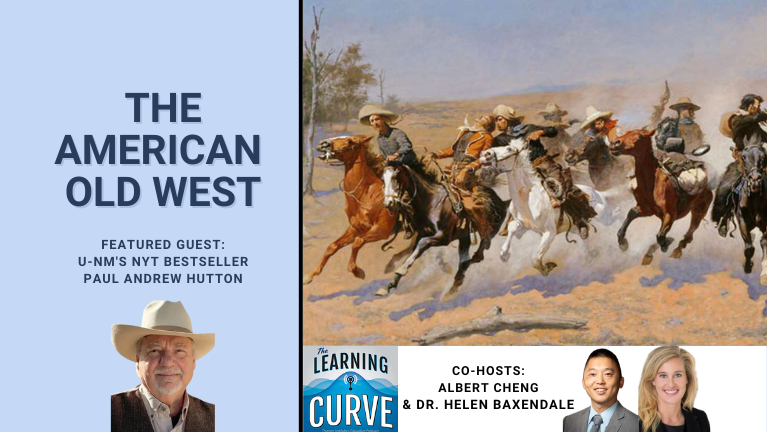
The Learning Curve Paul Andrew Hutton
[00:00:00] Albert Cheng: Well, hello everybody and welcome to another episode of the Learning Curve podcast. I am one of your co-hosts this week, Albert Cheng, and my co-host is none other than Helen Baxendale. Helen, what’s up?
[00:00:13] Nice to have you on.
[00:00:14] Helen Baxendale: Good to be with you again, Albert, and have you back in the driving seat.
[00:00:18] Albert Cheng: Yes, that’s right. And happy Thanksgiving to you as well as we maybe do a little bit of a commemoration on this, though, not entirely, but happy Thanksgiving nevertheless, and to you too. We have an exciting show.
[00:00:32] We’re gonna have Professor Paul Andrew Hutton, who’s gonna come talk to us about one of his many books now, the Undiscovered Country, triumph, tragedy, and the Shaping of The American West. And so we’re not gonna be talking about, I guess, colonial history and Thanksgiving, you know, the origins of Thanksgiving this week.
[00:00:51] But nevertheless, we’re gonna talk about some of our country’s history. And so, uh, looking forward to this interview.
[00:00:56] Helen Baxendale: Yeah, me too, Albert. It’s, uh, as a, a now resident of the American West, I’m very interested in hearing more from Professor Hutton.
[00:01:04] Albert Cheng: Before we get to him though, let’s talk about some news and, and I guess we’ve been hitting on this theme of civic education and understanding our country’s history, and so I’d, I’d wanna share one article that caught my eye.
[00:01:16] It’s entitled The Role of Music in Civic Life. Strengthening our shared American identity can be as simple as song. It’s written by Jacob Lt, and I don’t know if anyone’s pointed out, you know, how apropos his last name is, uh, Jacob Lt. But anyway, he’s got a fascinating article, which, you know, kind of dabbles into something that I, I thought about often on, but never very deeply.
[00:01:40] And the role that music and a shared cultural repository musically speaking. Can bring civic unity and shape our, our life together. You know, of course he, he brings up the classic American tune to start his essay, uh, take Me Out to The Ball Game. So we all kind of know that baseball being, uh, America’s great pastime and something we sing at every game.
[00:02:05] But, you know, he, he talks about lots of other shared anthems and tunes that we all sing, um, and he calls music as a, a cultural leaven. That works into our hearts and minds and helps us develop a sensitivity to all of us in our community. So I’m gonna be spending a lot of time thinking about this article.
[00:02:25] There’s, I think there’s a lot of insight. We don’t often think of music attached to civic education, but I don’t know if you, you’ve thought about this or if you’ve seen this being enacted in, in some schools.
[00:02:35] Helen Baxendale: To some extent yes. In terms of the sort of your formal music education at a, at a lot of classical schools, Albert, but I too am highly intrigued by this article because it had not occurred to me before the kind of civic and social galvanizing type role that these sort of common touchstones of song might play.
[00:02:55] I guess the question I have is in a. Contemporary sort of situation where so much of our taste is now fractured and kind of catered to through algorithms and have this multitude of platforms and everyone can kind of exquisitely curate their own tastes. Are we gonna have such artifacts from our own period or are we always gonna be hearkening back to the musical or folks on a ball game, you know, songs of the, the 1920s and earlier?
[00:03:24] Yeah. Fascinating question, and I agree with you, a really intriguing and novel kind of take in the article.
[00:03:31] Albert Cheng: It’s funny you bring that up because the, the author does talk about this. I mean, I’ll just read this passage and then hand it over to you to talk about your article. I mean, the author here, Jacob Luke, he observes that in some sense, our knowledge of kind of our inherited musical traditions have gave way to kind of the individualized musical tastes that we have today because of those algorithms and the kind of music platforms we have.
[00:03:53] And so he touches on this and, and observes the societal fragmentation that it’s caused. So I think, I think you do raise an important point and perhaps there’s some work that needs to be done in fostering some kind of, I guess, shared musical inheritance. So there’s a lot to think about there. But I want to hand it back to you though, ’cause you, you found an interesting article as well.
[00:04:12] Helen Baxendale: Yeah, I did and I’m, I’m gonna try and give a neat summation rather than a kind of in Kuwait rant, because that’s how annoyed I am by the article, or rather, not the article, but at least the story it describes this week, which is, uh. A story that seems, you know, unlike so often, we, you know, when we, we compare our articles, Albert, I suspect, you know, it’s kind of inside baseball for ed policy wonks.
[00:04:34] Whereas this one, I think really did kind of penetrate the conscience of the country more broadly. And I, I speak here of the scandal of abolishing standardized test scores as a primary consideration for college admissions. And in the last week or so, we’ve seen an extraordinary report out of, uh, uc, San Diego, which reveals that during the period from which they went test optional, I think starting in 2020 onwards, the students that have been admitted to uc, San Diego have required remedial math and to a lesser, but still just alarming degree remedial English and writing instruction.
[00:05:14] To an extraordinary degree, and even with these remedial courses are still ill prepared to tackle what we would have typically regarded as a kind of college level curriculum. And I give uc, San Diego a lot of credit for airing its dirty laundry like this, you know, they weren’t obliged to. And I think really kind of thrown a spotlight on what is a phenomenon that plagues institutions well beyond uc.
[00:05:40] We have seen some elite colleges in the last year or two bring back standardized testing is the primary means of admission, which is good. But I guess what infuriates me so much about this is that. Many people at the time that standardized tests were being abolished, rightly pointed out, including actually a faculty body at uc who advised their own regents not to do this because it would have precisely the opposite outcome than the one they they intended.
[00:06:09] Now all of this was done ostensibly to help level the playing field for admission for, you know, lower income black and brown students. But of course, who doesn’t get discovered? Who is less equipped to play the much more subjective game of admissions essays and so on, and extracurricular kind of, you know.
[00:06:28] Arms race when you stop using SAT and a CT scores, it’s precisely those students. Mm-hmm. And, and so this is what, you know, the uc faculty report contended, they’ve been completely vindicated. And on top of that, you had a bunch of probably very deserving students who missed out on admissions to these schools at the same time as.
[00:06:48] Admitted students who are now being really ill served because of their lack of preparation. You know, it’s basically a kind of massive fraud that’s been perpetuated to, in terms of what high school transcripts say. Mm-hmm. Kids are capable of that. They’re clearly not, and so this is. Kind of like the subprime mortgage crisis of education.
[00:07:09] You know, there’s just a whole lot of bad mortgages out there that are, you know, now starting to unravel. Yeah. And so I guess, you know, I get exercised about this because it was obvious at the time that once again, it’s the kids with the most to lose who are ultimately the victims of this. The ultimate example of kind of luxury beliefs Run riot.
[00:07:30] Yeah. Yeah. So yeah, that’s my rather, uh, disappointing story for the week. I’m afraid Al, but we’ll, we’ll have to move on and talk about something a little more cheerful.
[00:07:39] Albert Cheng: Sure, sure, sure. But hey, look, we need to take an honest look and honesty and truth, I think is such a, a great light that helps us move forward and, and look, I mean, speaking of which, I mean, I didn’t see the exact same article you were sharing, but I did, I did see it.
[00:07:53] Someone else write. Something about the grade inflation as it pertains to this report. And so, you know, speaking of truth, we do students a disservice when we award them high grades that don’t truly signal what they’re capable of. And so this is a serious matter, and I look as a professor myself, I understand the pressure to appease students and to avoid hard conversations that a student isn’t meeting expectations, but.
[00:08:19] Remind myself often that to let the students live a lie is even worse. So these are hard conversations that, that we definitely need to have.
[00:08:27] Helen Baxendale: Yeah, and, and you’ve just reminded me, Albert, I, I don’t think I ever said the authors in the precise title of the articles, but the authors at Tamar Casby and Sharon Sorkin, the title is The Ideological Erosion of College Readiness, and it was published in real clear education.
[00:08:41] But it is just one of many pieces on this particular story that if listeners haven’t already delved into and they, like me, wanna elevate their blood pressure, they could go and check this out.
[00:08:55] Albert Cheng: Well check out those articles, but that’s it for news for now. Coming up on the other Sydor the Break, we’re gonna have Professor Paul Andrew Hutton.
[00:09:06] Paul Andrew Hutton is a distinguished professor of history emeritus at the University of New Mexico. He’s the author of the 2025 New York Times bestseller, the Undiscovered Country Triumph Tragedy, and the Shaping of the American West. He’s also the author of the Apache Wars, the Hunt for Geronimo, the Apache Kid and the Captive Boy who started the longest war in American history.
[00:09:28] Phil Sheridan and his army, and he is the editor of Roundup. Western Writers of America presents great stories of the West from today’s leading Western writers and the Custer reader. Dr. Hutton is the former executive director of the Western History Association and former President of the Western Writers of America.
[00:09:49] He has appeared in, written or narrated over 150 television documentaries on C-B-S-N-B-C-P-B-S, discover Disney Channel, T-B-S-T-N-N-A-N-E, and the History Channel. Hutton earned his ba, ma, and PhD in history from Indiana University at Bloomington. He lives in Cody, Wyoming. Professor Hutton, welcome to the show.
[00:10:16] Delighted to be here. You’re the author of The New York Times bestseller, the Undiscovered Country Triumph Tragedy, and the Shaping of the American West, uh, which has received wide acclaim. Why don’t you give our listeners a brief overview of the main themes, and you’ve organized this book with seven key historical figures, and so briefly introduce us to those seven individuals as well.
[00:10:39] Paul Andrew Hutton: I see the book not only as the story of the American Frontier moving and it, it is a story of the frontier because, you know, it begins in Pennsylvania in 1755. It concludes essentially with the Wounded Knee Massacre in 1890, and I bookend it. The story purposely with those two, you know, terrible events. I see this, the story of America and I, I believe, like the greatest story.
[00:11:03] Frederick Jackson Turner said that the story of the west was the story of America for that first epoch of American history. Now, obviously other things are going on. The American Revolution, the Civil War slavery. I don’t ignore those in the book at all. In fact, the beginning of the book deals extensively with the American Revolution and the Civil War also plays a key role as does slavery in the story of the American West.
[00:11:29] But the story I’m trying to tell is through these seven lives and the characters I use are some well known, some not Daniel Boone. Red Eagle, who was the leader of the Creek Indians against the American bands in the war of 1812. Davey Crockett, kit Carson Mangus Colorados who united, all the Apache bands, sitting Bull, the great Lakota leader, and Buffalo Bill.
[00:11:51] Cody and I picked these characters and it’s, it was a tough choice. And, and since the book’s come out, I’ve been agonizing over, oh my goodness. I should have included, you know, like Narcissa Whitman, I, I should have included Elizabeth Custer or something, but they were tough choices, but I picked them. For both geography and for chronology, and I used them to kind of tie my narrative together.
[00:12:14] Sometimes they interact, sometimes they don’t. But together those lives span this long period of American history.
[00:12:23] Helen Baxendale: I think it’s a great literary device, professor Hutton and I, I, I think we’ll try and hang our interview structure around these seven lives, but before we delve into first of those characters, I, I just wanted to pick up on your mention earlier of Frederick Jackson Turner, who I imagine like you, you know, was of the view that the quote that.
[00:12:43] True point of view of the history of this nation is not the Atlantic coast. It is the Great West. You begin the undiscovered country by saying that my book’s title a nod to Shakespeare refers to the dark irony of how the conquest of the west build a new nation. But at the cost of the destruction of another people and the pristine land that had sustained them.
[00:13:04] Could you expand a little on Turner’s quite influential frontier thesis and then, you know, how, how the West and our understanding of the opening of the American frontier is such a powerful force in shaping the American character and its institutions and, and even contemporary identity.
[00:13:22] Paul Andrew Hutton: Well, there’s certainly, you know, many ways to view the American past and, and certainly in the last few years we’ve had interpretations of the American past, you know, from the African American perspective, through the lens of slavery, through the perspective of immigration, from, from all around the world.
[00:13:39] What I tried to do was construct a story around Turner’s ideas. Now, Turner, of course, has fallen in and out of favor many times. He’s having a little renaissance right now. Scholars who once dismissed him are now beginning to embrace him in the academic world, but generally he’s disdained as being somewhat ethnocentric and you know, not in touch with kind of the modern view of history, but.
[00:14:05] I always felt that he was talking about a very distinct period of history and how it shaped the American character and how it made peoples from all around the, the world, whether they’re coming from Africa or Asia or Europe or, or Latin America, molded these people in, in into one people this new breed, this American, and.
[00:14:28] He felt that the American character was shaped over and over again by successive frontiers, and each time the Frontier Line moved, it changed and shaped the people that were living there according to the environment. You know, be that environment. The southeast that I deal a lot within the book, be it the Southwest, that I deal a lot with the Great Plains to the north.
[00:14:51] That environment is so essential. And so in, in a way, Turner was our first environmental historian, and you saw how environment, you know, shaped character and our sort of political and cultural institutions grew outta the frontier movement, he said. And I just agree with that. I, I think that is essential.
[00:15:09] Now, I don’t want your listeners to think that the book is a, you know, intellectual discussion of the Turner thesis. Turner certainly is at the beginning, at the end of the book, I like to think of the book as kind of a grand adventure story and hopefully a page turner, but certainly the shadow of Frederick Jackson Turner’s over every page of the book.
[00:15:28] Albert Cheng: Well, let’s, uh, speak of Paige Turner and an adventure story. Let’s talk about some of the characters beginning with Daniel Boone. And so you write in, in your book quote, Daniel Boone, his hair plated and clubbed up in Indian fashion, garbed in black dyed deer skin had come to search of the rude grave of his eldest son.
[00:15:48] I mean, now that’s, I think that’s kind of riveting, and you’ve got me intrigued here, but tell us about Diana Boone. I mean, scholars have. Said the early 19th century novelist, James Fennemore, Cooper’s Iconic Frontier Warrior Scout, Natty Bumppo, nicknamed Hawkeye and Pathfinder was based on Daniel Boone.
[00:16:04] So yes. Who was Boone?
[00:16:07] Paul Andrew Hutton: Well, he’s come down to us as sort of an American Moses leading the people into the Promised Land. He was absolutely obsessed with Kentucky. He was a long hunter. The name derives from the fact that these hunters would go out a year, two years at a time. And of course, it was the white tailed deer.
[00:16:25] That they hunted. Deer skins were then a major commodity going back to the European market in these long hunts. He found Kentucky to be a hunter’s paradise, and so he helped to open Kentucky up and then he felt it would be the great seat of, kind of a new empire and, and so he began a series of very difficult trips into Kentucky in which he lost two sons, a brother and a brother-in-law.
[00:16:52] So it was a very. Costly personal travail that led to the eventual settlement of Kentucky. Of course, Boonesborough, his settlement became the Western most outpost of liberty during the American Revolution, and its survival was essential to our eventual claim along with the activities of George Rogers Clark.
[00:17:13] To the Old Northwest and to the land, all the way to the Mississippi River. So just a critical character. And, and he tied in so well with the main theme of my book, the Tribe and the tragedy of, of the story. Because after all this struggle and all this sacrifice, he has no place in the land. He has found it.
[00:17:32] And in fact, like Moses, you know, he, he can’t stay in the promised Land. He moves on to the Wildes of Missouri. He said he needed elbow room. That’s another theme that is throughout the book, and we see in awe of Western history and frankly, it’s part of the American character. This idea that you move and reinvent yourself, and we still do that.
[00:17:54] As a people. I just did it after leaving the academy after 40 years and moving up here to Cody, Wyoming to become a museum curator and in a way, moving here was kind of going back in time. George Catlan said back in the 1830s that going up to Missouri River was like going back in time. It’s like a time machine, and there are still parts of the west that are that way where you can kind of step back into a quieter, easier place in time.
[00:18:24] Helen Baxendale: I love that idea. Tell us a little now about Red Eagle, who, in your book, you introduce his, his early life. You know, you write that in the Upper Creek Village of Ada. A son was born in 1781 to the Scottish trader, Charles Weatherford and his native wife Seaho. They named the boy William, although among the creeks he was called Lamo chatty, and later by the Americans Red Eagle, and he became a creek chief who led many of the redick’s actions in the creek war of 18, 13 to 1814.
[00:18:58] What’s his enduring significance in Western history?
[00:19:02] Paul Andrew Hutton: Well, I particularly liked him because. He was of mixed race and he was conflicted over whether the creek should, you know, break with the Americans. Assist the British, or corroborate in fact with the Americans, and he was very distinguished Creek family and it was a very difficult decision.
[00:19:28] He was in, in fact, three quarters white and yet he becomes in the war of 1812, next to, to Kmsa, the greatest of all the Indian leaders. And he’s infamous, of course, for the Fort Mims massacres it was called, which really initiated the conflict between the Americans, but he’s, he’s a wonderfully conflicted.
[00:19:48] Figure, I found him a very heroic figure. And like so many native leaders, he is making the best out of a very difficult situation. It’s, it’s almost as if no choice is a good choice for him. So heroically does he fight and so impressive is he as, as a human, that when he finally surrenders to Andrew Jackson, Jackson, uh, shouts down a mob that wants to lynch him.
[00:20:15] And takes him back to the Hermitage to protect him. Later he becomes essentially a planter in the American South and his children all intermarry with prominent, you know, white families. And he dies though before the Trail of Tears and, uh, Indian removal that his friend Jackson is instrumental in. So it, it really seemed to me that.
[00:20:40] He was sort of the poster child for the difficulties that faced the Indians of the Southeast in particular, but also the Indians of the Old Northwest as well. And of course it was a no win situation for them.
[00:20:54] Albert Cheng: Professor, let’s move on to the next individual, and this is from your chapter that you’ve entitled The Lion of the West, and we’re talking about Colonel David Crockett, or I guess as my son would know, because the ballot of Dave Crockett often comes up on our playlist.
[00:21:12] You know Dave, Dave Crockett, king of the Wild Frontier. Right? So tell us about Davey Crockett.
[00:21:20] Paul Andrew Hutton: Albert, I know that song very well. I’m a victim of Walt Disney. Um, in 19 55, 56, I like millions of other baby boomers, saw that television show and was absolutely enthralled and I’ve long in my career been fascinated with the intersection of popular culture and history and we see in.
[00:21:42] That Disney television show, and there’s other shows that Disney did. History shows that Disney did kind of entree point for millions of children to become fascinated with the with history, and that’s certainly what happened to me. It all began with Walt Disney’s, Davy Crockett for me, and the film actually for a 19 55, 56 television miniseries is excellent and does a fairly good job of telling Crockett’s story.
[00:22:07] He’s just a fascinating character. Of course famous in that show as a hunter and a Indian fighter, but he was remembered in American history as a politician and a celebrity. He was, in fact, one of the first Americans to make a living off his celebrity status. He was elected to three terms in Congress. He eventually sacrifices his political career to.
[00:22:31] Protect the Indians from Indian removal. He had been in, in, of course, the creek Indian War had fought against Red Eagle, but had come to understand that actually the pioneer settlers that he represented from his district in West Tennessee and the native peoples actually had more in common than they did with the planter class, the slave ocracy, the folks in the east who were pulling all the strings.
[00:22:55] And causing all the trouble in the West. And so standing up against Jackson, who he had once supported, he became a symbol of the age of the common man and a very celebrated character in his own lifetime. Alman acts were published about him. He published his own autobiography, which was a bestseller. Good Move to Write Your Autobiography two years before You’re Killed, defeated in Politics.
[00:23:18] He told his constituents they could go to hell, he was going to Texas. People are still debating those. Choices and wound up, of course, at the Alamo, which was a very bad life decision, but an excellent legend decision because out of that funeral par at the Alamo Rose, a gray legend and made Davy Crockett one of the great characters in American history.
[00:23:39] But he, he deserves that place. And so he was a great transition figure for me out of the revolutionary colonial period into, you know, that era of the 1820s, 1830s. As Americans sought a new beginning and they looked to the west, you know, they looked to the West, William, Henry Harris, Andrew Jackson, Henry Play Rocket, Sam, Houston.
[00:24:01] They looked to those characters as new leaders as the founding generation died off. You know, that was a time not unlike our own, where we’re so nervous with the passing of the World War II generation, they felt the same way about the loss of the founding generation. Well, the West and the rise of the West, both politically and culturally, gave to them a new beginning.
[00:24:25] And once again, we saw the West now shaping America. Of course, it’s the west of, you know, Mississippi, Arkansas, Ohio, Kentucky, Tennessee, Indiana. But that was the Wild West back then, as Turner pointed out, the frontier movement spread slowly across the country.
[00:24:44] Helen Baxendale: Fascinating. Period. And, and I wanna ask about another.
[00:24:48] In this case, Apache leader, Magna RAs and Professor, please do instruct us on the correct pronunciation of these names, but he was the undisputed leader of the Chi Kaha Apaches, and also one of the few Apache leaders who was able to unite the wildly independent tribal bands you write in in your book. He was called Red Sleeves in English.
[00:25:11] He sought a confederation among the various Apache peoples and was very gifted at forging alliances. Tell us a little about him, why you selected him among the seven figures you profiled, and what influence he exerted in this sort of broad sweep of Western history.
[00:25:28] Paul Andrew Hutton: He’s a very important character in Western history and he has a nice connection with Kit Carson as well.
[00:25:33] So that worked well for me in terms of connecting tissue, you know, for the book, he was the only Apache leader that ever really united the various Apache bands. There were about 8,000 Apaches in the Southwest. They were late comers to the Southwest, really arriving just before Coronado did. They had migrated down the front range with the Navajo from the Pacific Northwest in Canada.
[00:25:58] And they lived very isolated lives. Their loyalty was to not the greater tribe, but to the band, to the family. Magnus managed to unite all of the various Apache bands in a war against both the Mexicans to the South, and then finally against the Americans. He tried very hard to live in peace with the Americans.
[00:26:19] In fact, during the Mexican American war, was united with them. In the battle against Mexico. But a, a series of unfortunate events led to conflict. And then he fought the great battle that Apache passed, which is the really, the largest of the battles of the Apache wars, which for the most part, the conflict was very s.
[00:26:40] Small unit action conflict, but he then sought peace with the Americans and was betrayed under a flag of truce and murdered, and really a, a, a huge act of betrayal. He really, again, provided an example of this, this kind of insidious conflict that went on, you know, between the advancing American frontier and the native peoples.
[00:27:05] And it allowed me, of course, to bring in the American Southwest, the Mexican American war and show the interconnection of a character like Mangas. Colorados with a character like. Carson Cochise became the most famous of the Apache leaders before Geronimo and Cochise was, in fact, the son-in-law of Mangus Colorados.
[00:27:23] And so, and Geronimo was one of Mangus Colorado’s most prominent warriors. So that war of course, continued on until 1886, and with the surrender of Geronimo in that year, brought to a close, really one of the longest sustained conflicts in all of American history. And so a really important story. Which I, I tell in full in, in my previous book, which was the Apache Wars
[00:27:51] Albert Cheng: professor.
[00:27:51] You’ve been talking about Kid Carson and his relation so far. So why don’t we focus on him right now? You write in your book, quote, post-war, New Mexico Held promise of prosperity and Return to family life for Kit Carson as well. By 1849, he was one of the most celebrated Americans in the world. The inheritor of the buck skin mantle of Boone and Crockett as the nation’s preeminent Frontiersmen.
[00:28:17] End quote. And now here you’re connecting him to Daniel Boone and David Crockett. So how does Kit Carson fit into this story and, and how did he shape the American West?
[00:28:28] Paul Andrew Hutton: We really see a connection between a character like Hit Carson and Boom and Crockett before him, and then William f Buffalo, bill Cody after him, and, and all of them had a certain consciousness.
[00:28:40] Carson himself never learned to read and write, even though it becomes a general in the United States Army and is a very important Indian agent in the Southwest. But nevertheless, he had a. A sense of his place in history that he was, of course, someone who was viewed as having the, you know, that buckskin mantle of, of Boone and Rocket.
[00:29:03] He’s kinda the Forest Gump of my story. He’s everywhere. He’s doing everything. He is part of the mountain men. He ran away from home as a teenager, did a Huck fin and lit out for New Mexico and on the Santa Fe trail became a mountain man. Then later. Of course became the celebrated scout for John c Vermont on his expeditions, which placed him in California during the California conquest, and he played a very important role in that.
[00:29:30] He carried the first dispatches, announcing the discovery of gold back to President Polk. In Washington later, he would become one of our best Indian agents in the American Southwest for the Utes and the Hickory Apaches. He also became famous as an Indian fighter, of course, most famously in his campaign against the Navajos.
[00:29:51] For that. He, he has become a controversial figure in American history and especially in the Southwest, especially in New Mexico where I lived for so long. He’s generally condemned. In fact, um, in Taos where he lived his whole life, married into a prominent Hispanic family, and Spanish was the language of his home.
[00:30:09] The citizens there just changed the name of Kit Carson. Park to Red Willow Park because they didn’t want to honor him, which I think is a very misguided position to take. He really was a fabulous character who did so much for our country. And of course, in the Americans Civil, the war becomes a breeder general and is instrumental in fighting off the Confederate end of New Mexico, and then after the war becomes a important Indian agent.
[00:30:37] Died quite young, but nevertheless made a very deep impression on the history of the American Western. For me, just in terms of constructing my story, he’s a, a fabulous character to bridge, you know, the 1820s all the way to the Civil War through the war. And then the post-war changes that were gonna come to the West with the railroad and a new military structure.
[00:31:01] So just a fabulous character. I think of all the frontiersmen that I deal with, he really is the most significant.
[00:31:08] Helen Baxendale: Let’s switch up the geography a little, professor Hutton and move from Taos, New Mexico up to the Great Plains. And you, you write the hunk of Papa. Were a small tribe of the Western Sioux as the whites and their Indian enemies called them all Lakota as they called themselves and sitting bull.
[00:31:25] Was a hunk of Papa Lakota chief and holy man who united the Great Plains Sioux Tribes against white settlers in the US Army. Tell us a little more about his leadership during the, uh, Plains Indian Wars, and particularly the, the very famous victory he won at the Battle of Little Bighorn in 1876.
[00:31:44] Paul Andrew Hutton: He’s a wonderful character, of course, and, and he really bridges my story beautifully because not only is he one of the last leaders of native resistance against the American advance after the victory at Little Bighorn, of course he flees to Canada with his people and then eventually has to return and surrender, and then he goes on the road with Buffalo Bills Wild West.
[00:32:05] And so that was just a fabulous connection and they became great friends. Cody gave him a, a show horse that he had ridden in the arena during the show. It’s just a wonderful transition that you see where Sidney Bull becomes first a great leader of resistance then. She goes into the show business just like Buffalo Bill had done himself and then returns to the reservation.
[00:32:30] He gets caught up in the ghost dance, of course, and this leads to very tragic circumstances with his death. But he united the Sioux bands together, and of course in 1876, they were encamped on the little Bitcoin river just to the north of where I am here in Cody, Wyoming, enjoying a traditional gathering.
[00:32:50] And of course that’s when. Colonel Custer in the seventh cavalry attacked Sidney Bull, had ordered back to the reservation. He had never gone into the reservation ever. He refused to go in, that sent the Army columns after him. It’s ironic in the book, I’ve written a lot about Custer in my career and I’m, I’m fascinated by him as a character, but I didn’t have room for him in the book, and so he dies off screen as they say.
[00:33:12] And I don’t really do the battle in much detail, but a huge victory for the Sioux. And one of the great moments in history is, and this is in the book, sitting Bull, had engaged in the Sundance and had gone into trance and had a dream that soldiers would come. Into camp upside down. So he predicted the destruction of Custer and the Seventh Cavalry.
[00:33:37] That battle, of course, even though a great victory for the Lakota, was also instrumental in their defeat because the Army now swarmed across the plains and the Natives were really. Quickly defeated, but he’s just a powerful figure of resistance. And I give a whole chapter to his death, which I call the dancing horse, in which the horse that Buffalo Bill had given him plays a, a critical and mystic role in the events that transpire.
[00:34:05] I love that story very much. I hope people enjoy it in the book.
[00:34:09] Albert Cheng: Well, speaking of Buffalo Bill, let’s talk about ’em. And you point out that of course, that’s a nickname and you’ve, you’ve mentioned William f Cody in your previous answer. I mean, I’m not gonna sing the little Diddy that folks sang, you know, but it goes like Buffalo Bill.
[00:34:22] Buffalo Bill, never missed and never Will. Always aims and shoots to kill. And the company pays his Buffalo bill. So. Tell us about Buffalo Bill, Cody, the American soldier, bison, hunter, and showman. And how did he become one of the most famous, legendary figures in the American old West?
[00:34:42] Paul Andrew Hutton: Certainly in his own time.
[00:34:44] William f Cody was probably the most Amer famous American on the planet, certainly rivaled, even Theodore Roosevelt and his Wild West Show entertained audiences both here and abroad for two generations. It’s absolutely astonishing success and it really set all of the tropes that we then became familiar with in the Western films that would be made in the 20th century.
[00:35:07] And often Cody is seen just as a sequined showman, but actually it was the real deal. He had been raised on the Kansas frontier. His father had been martyred in the struggle to keep slavery out of Kansas. Cody had fought as a union soldier in the Civil War. After the war, he’d become a buffalo hunter. And this.
[00:35:26] Is how he got his nickname Buffalo Bill, but he was not part of the great slaughter of the buffalo that would come in the 1870s and eighties. He hunted for the railroad to feed the railroad workers, so he was a market honor, and later he became something of a conservationist and he condemned the slaughter of the buffalo, and he worked with Theodore Roosevelt to help to establish a society that protected the last remnants of the great herds.
[00:35:51] Once there had been, perhaps, well, the estimates run from 20 to 50 million. Buffalo of the great plains and people couldn’t imagine that they could ever be eradicated, but they certainly were, you know, in a twinkly once the Civil War was over. But by that time, Cody was a scout for the US Army. In fact, he was the only scout that was ever hired permanently.
[00:36:12] General Phil Sheridan was his patron, and Sheridan was very fond of him, and so Cody was with the Fifth Calvary. He engaged in a series of combats, received the Greel Medal of honor for a running fight with a Sioux, and then he was discovered by a Pope Rider named Ned Bun Line. Who made him famous back in the East in a series of, you know what would become called dime novels.
[00:36:35] First they were tabloid newspapers. Then they turned into dime novels. Cody returned east to visit with Bunt line. There was a stage play going on about him. He appeared on the stage just to nod and say hi. Said. He was terrified by the whole experience, but that was the beginning of a grand career. He spent 10 years on the stage.
[00:36:52] Stage wasn’t big enough to contain the story he wanted to tell. He wanted to tell the story of the American West that he had lived, tell the story of the Cowboys and the Indians, and put together this fabulous, he never called it a show, but Buffalo Bill’s Wild West and Congress of Rough Writers of the World and featuring were a hundred Indians, real cowboys from the west.
[00:37:13] In fact, it was Cody who took the name Cowboy, which had been a pejorative and made it into a positive, made the cowboy into an American icon. The show began in 1883. It finally went bankrupt, uh, in 1913 was the end of it, and he became an American icon himself. Annie Oakley was in the show. Sitting Bull was in the show that kind of won over the popular mind.
[00:37:36] And so while Frederick Jackson Turner may have won the intellectual battle to proclaim the victory of the West in the Story of America, Buffalo, bill won the pop culture battle. A fabulous character.
[00:37:48] Helen Baxendale: Yeah. Fascinating. And, and a man who led five lives in one, it sounds like. Tell us a little more about how, how he is the kind of progenitor of the name cowboy.
[00:37:58] And you said, you know, it’s kind of went through this reinvention from a, initially being a pejorative term to, to something that was embraced and indeed celebrated. There’s a nice line in your book where you say, in time with Able assist from Owen Wister, Theodore Roosevelt. Charlie Russell and Frederick Remington the cowboy became a defining figure of the American character.
[00:38:18] Obviously Buffalo Bill played a key role in that, but could you riff a little for us on just how the cowboy has become the kind of icon of the Old West itself?
[00:38:28] Paul Andrew Hutton: Buck Taylor was the king of the Cowboys. Johnny Baker was the cowboy kid, and Cody brought these real cowboys out from his Wyoming and Nebraska ranches to the show.
[00:38:38] And, and they did trick riding and they did, you know, rodeo stunts. And he brought in Vaqueros from Mexico and the American Southwest of course. And eventually there’d be rough riders as they were called from all over the world. And in fact, it was Cody’s show that gave to Theodore Roosevelt’s volunteer cavalry, the name Rough Riders.
[00:38:56] And they became so famous. And then when you add in Owen Worcester in the Art of Remington and Russell, you, and then when Teddy Roosevelt himself becomes our first cowboy president, we see the cowboy moving from that, that negative image, the cowboy element, uh, president. Harrison sent troops into Arizona to shut down the cowboy element, and now the cowboy became this American icon that would be solidified in countless films and television shows and novels in the 20th century.
[00:39:26] Even advertising, when you think of the Marlboro Man, and now that was such a successful advertising trope and it already came from Buffalo Bill’s show and we see things. That were presented in the show, and not just cowboys, but cowgirls as well. Of course, Annie Oakley was a headliner in the show, and she was the second highest paid performer in the show Next to Cody, we see the evolution of this image that would capture the imagination of the world and, and certainly the American film industry with so many, you know, cowboy movies, as they were called westerns in the 20th century, in the 1950s, 1940s, 1950s, into the sixties.
[00:40:02] 30% of Hollywood’s product were westerns. And of course, during the 1950s and up till almost 1970, westerns dominated the small screen dominated television. There are 47 westerns on three channels during the heyday of the Western Craze, which Disney, Stevie Crockett initiated. And so all this Buffalo Bill, and he really did tell the story of America’s a Tale of Progress.
[00:40:26] He had historical pageants in the show as well as these rodeo elements and audiences just loved it. And certainly the early filmmakers like John Ford, they had all seen. Buffalo Bill show in the arena and they brought those elements of Cody’s show business spectacle onto the silver screen and helped to shape a whole century of American consciousness and around the world.
[00:40:53] There’s a wonderful moment in fact, and it’s in the book, which Cody performed at Earl’s Court in command performance before Queen Victoria herself, and this was very important ’cause she had come out of mourning over. Prince Albert, who had died 20 years before for this performance. And Cody and the flag bearer and a group of cowboys and Indians rode forward and he doffed his hat to her and she rose and she bowed to the American flag, and the Cowboys and the Indians led out a war, whoop.
[00:41:21] And it seemed that America had come of age and in fact was conquering Europe. I think I write the book that England hadn’t been conquered so easily since 10 66. It really was an incredible trial for Cody and for the Wild West.
[00:41:35] Helen Baxendale: That’s a wonderful vignette, and I wonder if you could close this out, professor, please, by reading a short extract from your beautifully evocative, very colorful book, the Undiscovered country.
[00:41:46] Paul Andrew Hutton: Well, I will, and I’ll read where we started out. I, I believe Albert read a little bit of this at the beginning. About Daniel Boone going west to bury his son. His son had and companions had gone back to bring up supplies and add horses, and so Boone had gone back to bury the Boy because they had had to just barely cover up the dead as they fled from the Indian threat.
[00:42:13] The dead had been buried quickly, wrapped only in sheets, and now boon journeyed alone to this westernmost tip of Virginia to rebury the His worst fears were soon realized for the graves had been disturbed by wolves under a darkening sky. He rewrapped his son’s mangled, remains in his saddle blanket and reburied him.
[00:42:33] He wept over the grave as a storm broke above him, the melancholy of his feelings. His son, Nathan, later recounted. Mingled with the howling of the storm and the gloominess of the place, it made him feel worse than ever in his life. Saddling his horse. He mounted and rode in a direction unnatural to his restless spirit eastward into the evening shadows.
[00:42:59] Albert Cheng: Thank you. Thank you, professor, for sharing that excerpt and for, uh, giving us your time to tell us about your book. Fascinating Material.
[00:43:07] Paul Andrew Hutton: Thank you both. It’s been a delight to chat with you.
[00:43:23] Albert Cheng: Well, it’s a great interview, Helen. I, it’s been years since I’ve studied and looked at that era of American history, so this was a fun reminder. Um, really enjoyed that.
[00:43:32] Helen Baxendale: Yeah, for sure. Fascinating period. And I suppose living out, out in Arizona, I still see some. Lingering manifestations of this period. So it’s, it’s really fun to talk to a genuine expert about it.
[00:43:45] Yeah.
[00:43:45] Albert Cheng: Well, I wanna thank you, Helen, as always, for co-hosting. It’s always a pleasure.
[00:43:51] Helen Baxendale: Likewise, Albert. It’s been fun. Hope you and yours have a wonderful Thanksgiving.
[00:43:56] Albert Cheng: That’s right. And, and you as well. And for you listeners, we wanna extend the same wishes, but of course, before we close out, we wanna leave you all with the tweet of the week.
[00:44:05] This one comes from education. Next quote. While misconceptions about homeschooling remain prevalent, a growing body of research and data is helping to set the record straight. I’ve seen that article, I’ve read it. Excellent article about the homeschooling population. Full disclosure, I am cited on that, but that’s not why I mentioned this.
[00:44:25] Tweet is. Great tweet independent, uh, my work being covered there. So set that record straight and for our next week we’re gonna have Sean Garrity and Michael Goldstein talk about their book. I’ll do it later, surviving School and Renewing the Love with your A DHD. So should be a fascinating conversation with those authors.
[00:44:49] So hope you join us then. Until then, happy Thanksgiving. Hey, it’s Albert Cheng here, and I just wanna thank you for listening to the Learning Curve podcast. If you’d like to support the podcast further, we’d invite you to donate to the Pioneer Institute at pioneerinstitute.org/donations.