The Louisiana legislature will once again consider bills related to the practice of natural hair braiding. One bill, HB266 by Rep. Michael Bayham, does away with the 500-hour training requirement and instead only requires permittees to pass an annual sanitation quiz. On the opposite end of the spectrum, HB912 by Rep. Candace Newell would increase the number of hours required for an alternative hair design permit from 500 hours to 600 hours, which would make Louisiana one of the most restrictive states in the nation for natural hair braiders. Rep. Newell’s bill has brought unflattering national attention to the state of occupational licensure in Louisiana.
We’ve heard several arguments from members of the legislature and the Louisiana State Board of Cosmetology (LSBC) regarding why it’s important that Louisiana maintain one of the most onerous occupational licenses in the country. With 37 states removing barriers to natural hair braiding, those arguments wither under scrutiny. Let’s untangle the truth from some of the myths you’ll hear about natural hair braiding this session.
MYTH: Louisiana courts determined that the 500-hour requirement for an alternative hair design permit to braid natural hair is appropriate.
FACT: No court has ever ruled on the appropriateness of the 500-hour requirement; only that the state could regulate the practice of cosmetology.
In 2019, Ashley N’Dakpri, a New Orleans based hair braider who learned how to braid hair from members of her family, challenged the LSBC’s 500-hour requirement for an alternative hair design permit. Following a trial, the district court judge determined that the state of Louisiana met the very low burden of showing that the regulation of cosmetology is an appropriate exercise of the state’s police power. The Louisiana First Circuit Court of Appeals affirmed the district court’s ruling, and the Louisiana Supreme Court denied cert.
At no point has a court opined on the number of hours—if any—that may be appropriate for training natural hair braiders. That’s a policy question that the legislature can discuss and debate. And it’s a timely question. In the years following Ms. N’Dakpri’s lawsuit, the Louisiana legislature passed the Right to Earn a Living Act, which allows any interested party to challenge an occupational licensing board’s regulation lacking a health, safety, welfare, or fiduciary justification. Can the 500-hour requirement withstand such a challenge?
MYTH: Unlicensed or unregulated hair braiders are not subject to oversight by the cosmetology board and can cause harm to their clients’ scalps.
FACT: Safety and sanitation are not concerns in the thirty-seven states that do not license natural hair braiders.
HB266 by Rep. Michael Bayham addresses a concern expressed during the 2025 debate over natural hair braiders. The 2026 version of his bill provides that a natural hair braiding permit shall be issued annually to an applicant who can pass a twenty-question examination on sanitation and safety prepared by the Louisiana Department of Health. Each year, natural hair braiding permit holders must review materials on sanitation and safety and pass the test to retain their permit.
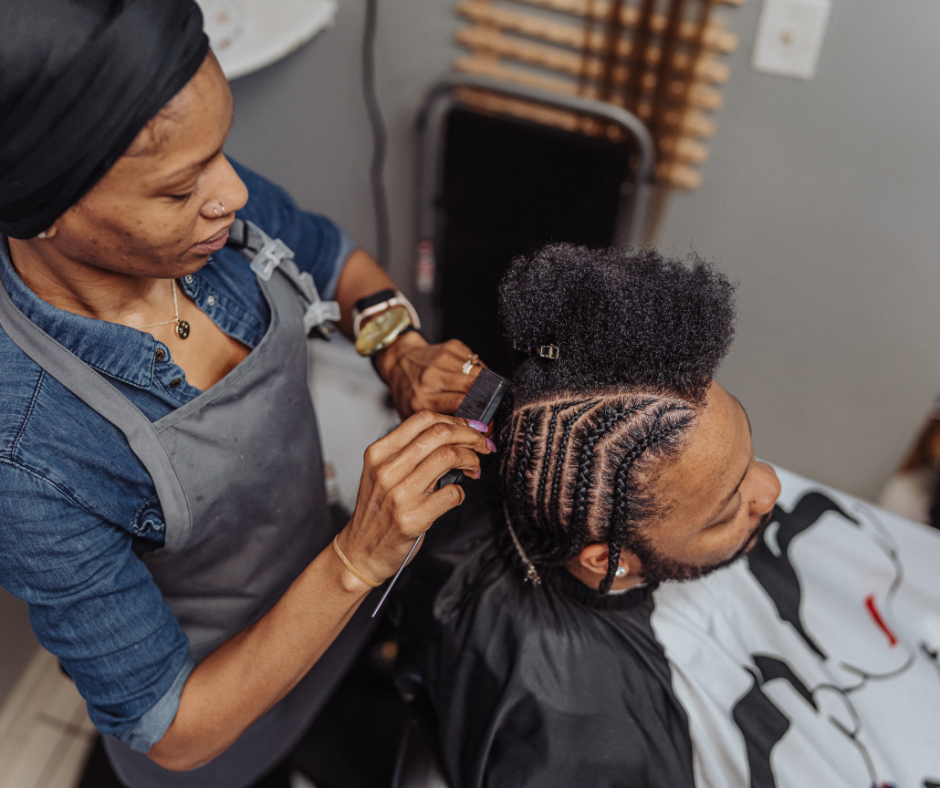
Natural hair braiding requires a braider to use her hands and a comb. Chemicals and hot tools are not used. The Institute for Justice studied braiding in states both with and without strict licensing laws and found that complaints against braiders are extremely rare. In fact, you’re 2.5 times more likely to be audited by the IRS than a licensed or registered braider is to be the subject of a complaint. Surely, an epidemic of scalp diseases or hair loss caused by unregulated hair braiders would spark a national outcry.
Furthermore, any cosmetologist licensed in Louisiana can legally braid hair even though hair braiding is not part of the 1500 hours of cosmetology curriculum. Several members of the legislature expressed concern that a hair braider who had not been properly trained might braid hair too tightly and cause her clients to experience traction alopecia. One legislator even testified that a licensed hair braider caused her traction alopecia. Licensing is not an indicator of quality, or even of training.
Nevertheless, the oversight argument is a red herring. The LSBC funds itself through licensing fees and fines. The fine for working as an unlicensed braider is up to $5,000 per instance. A search of any social media platform for “natural hair braiders near me” yields several braiders who do not match a list of licensed braiders provided by the LSBC pursuant to a public records request. Certainly, the board could create quite a payday for itself if it wanted to by cracking down on unlicensed braiders, rather than smaller fish like Amy Cao and her fellow manicurists.
The LSBC asserts that it provides a path to legitimacy for braiders working underground and at the same time argues that it lacks the personnel to police existing braiders. The path preferred by the board requires 500 (or possibly 600) hours of training at a cosmetology school. Cosmetology school owners control a majority of the votes on the LSBC. Rep. Bayham’s far less onerous path allows braiders trained in their families to earn their permit upon annual passage of a 20-question test but doesn’t require aspiring braiders to pay tuition to a school.
MYTH: There are plenty of schools offering the alternative hair design curriculum where aspiring braiders can earn their permit.
FACT: Only ONE school contacted confirmed that they offer the alternative hair design curriculum.
The LSBC provided a list of cosmetology schools that, according to their records offer a 500- or 600-hour course in alternative hair design. Our friends at the Institute for Justice called every school on the list. Of those schools, only one confirmed that they offer the program, nine did not answer the phone, 32 responded that they did not offer the program, and three were closed or the phone number was out of service. The only school that confirmed having an alternative hair design program is in New Orleans. Shreveport, Monroe, Alexandria, Lafayette, Lake Charles and Baton Rouge—all cities with significant Black populations—do not have easy access to a hair braiding course in this state.
MYTH: There are sufficient licensed natural hair braiders to meet demand.
FACT: There are 124 alternative hair design permittees in Louisiana.
Pursuant to a public records request, the LSBC confirmed that there are only 124 alternative hair design permit holders in Louisiana, and that 8 or fewer permits per year have been issued each year since 2023. The records show that most of the permittees were “grandfathered” although there does not appear to be a process described in the rules or statutes related to cosmetology.
Meanwhile, Mississippi eliminated its hair braiding license and has nearly 7,000 registered braiders who pay a $25 registration fee. Mississippi has a smaller Black population, and a smaller population overall, than Louisiana.