Even a highly capable, incredibly thoughtful Minnesota teacher may be stymied in the classroom by a lack of consistent student attendance. When students aren’t present, they lose essential instructional time — and when they return, they disrupt classroom routine and order as teachers rush to bring them up to speed.
While chronic absenteeism (when a student misses 10 percent or more of the academic year) has always been a concern in Minnesota, COVID escalated it into a crisis. In the 2018 and 2019 academic years, 14 percent of all Minnesota students were considered chronically absent. Post-pandemic, chronic absenteeism peaked at 30.2 percent in 2022, and while slightly dropping to 24.5 percent in 2024, continues to be of concern. (Data for 2025 is not yet available.) It is highly likely that chronic absenteeism remained high during the untracked years.
With that in consideration, about one in four students in Minnesota has been chronically absent for the last half-decade.
Chronic absenteeism affects all types of students, but some students are more susceptible to becoming chronically absent. Minority students, students in poverty, and special education students hold high levels of chronic absenteeism in Minnesota, which will almost certainly worsen achievement gaps and academically harm these learners.
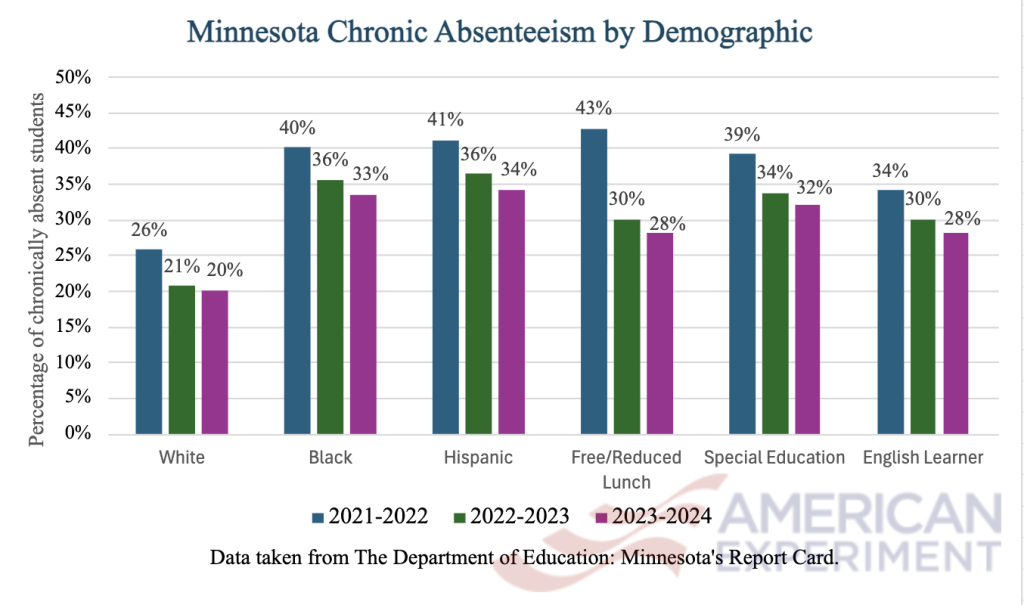
It’s unlikely that Minnesota will lower today’s high levels of chronic absenteeism without strong intervention.
Nationally, public schools have similarly struggled with high levels of chronic absenteeism, with the current national average for 2025 (not all states reporting) at 23 percent of students being considered chronically absent. The American Enterprise Institute’s Nat Malkus has argued that these elevated numbers of chronically absent students are likely the new baseline for chronic absenteeism; the post-COVID persistence of chronic absenteeism and the high numbers of chronically absent young learners, who never missed school due to COVID, suggest that norms have changed. He wrote recently that
These patterns suggest that the across-the-board increases in post-pandemic absenteeism are largely a matter of across-the-board shifts in attitudes and behavior. Six years after the start of the pandemic, students and their parents simply place less value on going to school each day.
The Data Divide
Minnesota’s chronic absenteeism data is released on a two-year delay, making it functionally useless for policymakers and researchers. Within two years, students graduate, change schools, or, perhaps, drop out completely.
This data release schedule is far slower than many other states. Modernizing the chronic absenteeism data system would be a significant step in the right direction.
Coordinating student attendance between parents and school administrators can be complex, but Minnesota must continue prioritizing uniform data collection and parent transparency. In 2025, legislators required that individual attendance data be released to parents as a part of the individual report that reports the student’s performance on standardized state tests. This move toward parent transparency will help schools and families coordinate to ensure student attendance. That session also saw a statewide clarification on the definition of truancy and a new requirement that schools must notify a welfare agency if consecutive student absences exceed 15 days.
During the 2026 legislative session, American Experiment hopes to see legislation that prioritizes timely attendance data release schedules to the public and to parents.
What’s after the data?
Timely reporting of the data on chronic absenteeism is an essential part of allowing policymakers to understand who is primarily susceptible to becoming chronically absent and why. But knowledge does not automatically bring students back into the classroom — so after the data is published, what comes next?
Some recommendations might come from a state-funded $4.7 million three-year pilot program that began in 2024. That program gave 12 school districts funds to spend however they saw fit to combat chronic absenteeism. For example, Windom Area Schools used their $60,000 grant to hire a former police officer to serve as an attendance coordinator. Minneapolis Public Schools created student-led attendance teams and a mentorship program. Districts are required to meet quarterly in order to update other program participants on their progress and share successful or failing strategies.
The lead school district, Minneapolis Public Schools, must submit yearly reports to legislative K-12 education committees. Last year’s report suggested that the schools had not yet found winning strategies to combat chronic absenteeism, but that more time was needed to hone tactics. (The report only included comprehensive attendance data from fewer than half of the twelve schools.) The next reports are expected in July 2026 and September 2027.
Other recommendations could be taken from the Minnesota Legislature’s Student Attendance and Truancy Legislative Study Group, which released a report in 2024. That report primarily emphasized the importance of creating up-to-date, granular data systems that shared data sets quickly across school districts, county governments, and state agencies.
Districts, of course, should have access to their own attendance data and can make their own plans on how to combat chronic absenteeism. Districts without copious extra funds might consider restructuring their support staff schedule to include weekly attendance checks. For example, one Connecticut school lowered their chronic absenteeism rate from 31 percent to under 10 percent in just one year. They implemented regular staff meetings to review attendance data and constructed a robust parental connection regimen that includes regular emails and letters home.
Other districts might consider investing in attendance technology, which can streamline the morning attendance-taking process and send automated texts to parents when a child is absent. One widely used attendance technology company, SmartStatus, found in a recent report that early interventions given before a student is chronically absent worked successfully, with 51 percent of students whose families received one letter changing their attendance behavior so that no second letter was necessary. Researchers posited that many families don’t understand how quickly absences rack up, but are highly responsive to checks from the school administration.
Compulsory attendance is required by the state, but a successful education is ultimately the product of a collaboration between parents and schools. Unfortunately, some students may be chronically absent due to their parents misunderstanding or shirking their familial responsibilities. Researcher Nat Malkus has argued that protecting and serving these students requires strong advocacy on the part of the school system that may impact their parents.
Schools must effectively communicate the importance of consistent attendance to families and support those facing concrete barriers from transportation gaps to health crises to trauma. But while supports are necessary, they are insufficient…Consequences for students and families are essential, rather than optional, for any serious attempt to dramatically improve attendance. The pandemic opened the door for students to miss school for reasons that would not have been condoned six years ago. Reasonable consequences—loss of privileges, school-based detentions, or mandatory parent conferences—are essential to both communicate the expectation of consistent attendance and the disincentives to breaking it. Discussing supports for families is popular while talk of consequences is often not, but acknowledging how tough the fight to change attendance behaviors at scale is requires recognition that we will not reverse this trend with one hand tied behind our backs.
To fulfill the mission of public education in serving Minnesota’s students, chronic absenteeism must be treated as a high state priority. Minnesota’s school administrators and policymakers must send a clear message that these high levels of chronic absenteeism will not be tolerated. Under that leadership, districts will feel the ability to construct programs that combat chronic absenteeism without fear of parental pushback.
In the 2026 legislative session, American Experiment hopes to see a bipartisan push to hold chronic absenteeism in the center of the education conversation. We also hope to see districts take strong initiatives to construct personalized, district-level plans to combat chronic absenteeism.