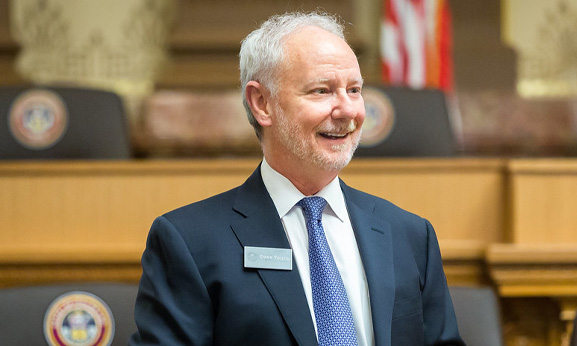
In a recent Denver Post opinion piece, State Treasurer Dave Young urges higher taxes on the wealthy and energy production as a fix for the legislature’s ongoing and self-imposed struggle to balance Colorado’s state budget.
Rather than engaging in this year’s budget challenges in good faith, Young turns to euphemisms, slogans, and strawmen to deflect from the state’s fiscal decadence and drum up support for increased taxes.
Overall, it’s an impressive display of hubris, as well as contempt for the intelligence of Coloradans.
The ‘austerity’ bogeyman
One of Young’s chief claims is that “austerity” is sending the state toward a fiscal cataclysm: “Austerity has also choked our revenue stream. Our current approach has placed a vice grip on state and local agencies.”
Young cites tax reforms in the federal One Big Beautiful Bill Act (OBBBA) as imposing budgetary austerity on Colorado (similar claims are often made in conjunction with the Taxpayer’s Bill of Rights (TABOR), although he did not explicitly state it this time).
Because Colorado has rolling conformity to federal tax policy, the state immediately saw a modest shortfall in available dollars for the already appropriated 2025-26 budget.
However, as I explained months ago, the reduction the OBBBA caused to the Colorado budget, while challenging for lawmakers, put more money back into Coloradans’ pockets, which is ultimately a good thing.
Overzealous spending is actually the primary cause of Colorado’s underlying budget challenges, not the OBBBA or TABOR as so often claimed.
I previously refuted similar claims regarding TABOR, but it is worth examining again here.
According to Britannica, “austerity” is defined as a set of policies that raise taxes, cut spending, or both to reduce budget deficits.
As state treasurer, Young has no excuse for not knowing that Colorado’s 2026-27 state budget is still expected to grow by nearly 6 percent, hardly a spending cut.
Instead, the recently proposed ‘progressive’ tax measure Young presents as a solution would certainly impose greater austerity, given that it is a $4.1 billion tax increase.
Young does not stop there, as his other proposed solution is to increase severance taxes on oil and gas production, again an actual “austerity” measure.
Young’s distress over austerity is ironic and timely, given that increased severance taxes would likely increase energy costs for all Coloradans.
And with the Public Utilities Commission (PUC) already forcing Colorado down a needless and costly march toward energy austerity, Young’s catastrophizing claims become even harder to take seriously.
Taxing the rich
A similar claim by Young that collides with reality is that higher-income Coloradans do not pay their “fair share” of state taxes.
Yet despite only accounting for 8.4 percent of Colorado households, those earning $200,000 or more already pay 48 percent of all state income taxes.
At what point would it be considered a fair share, 50, 60 percent? Why not 100 percent?
And yet, these higher-income Coloradans, who are also highly mobile, generously (or perhaps naively) remain in a state whose government no longer hides its disdain for them.
To sum it all up, if Colorado were operating under a forced austerity agenda as claimed by Treasurer Young, then: a) the state would be cutting spending, or b) the state would be increasing taxes.
The state is not cutting spending, but rather increasing it, and Dave Young’s “solution” to not cutting spending is to increase taxes.
Perhaps Treasurer Young is counting on Coloradans not noticing the glaring contradiction.