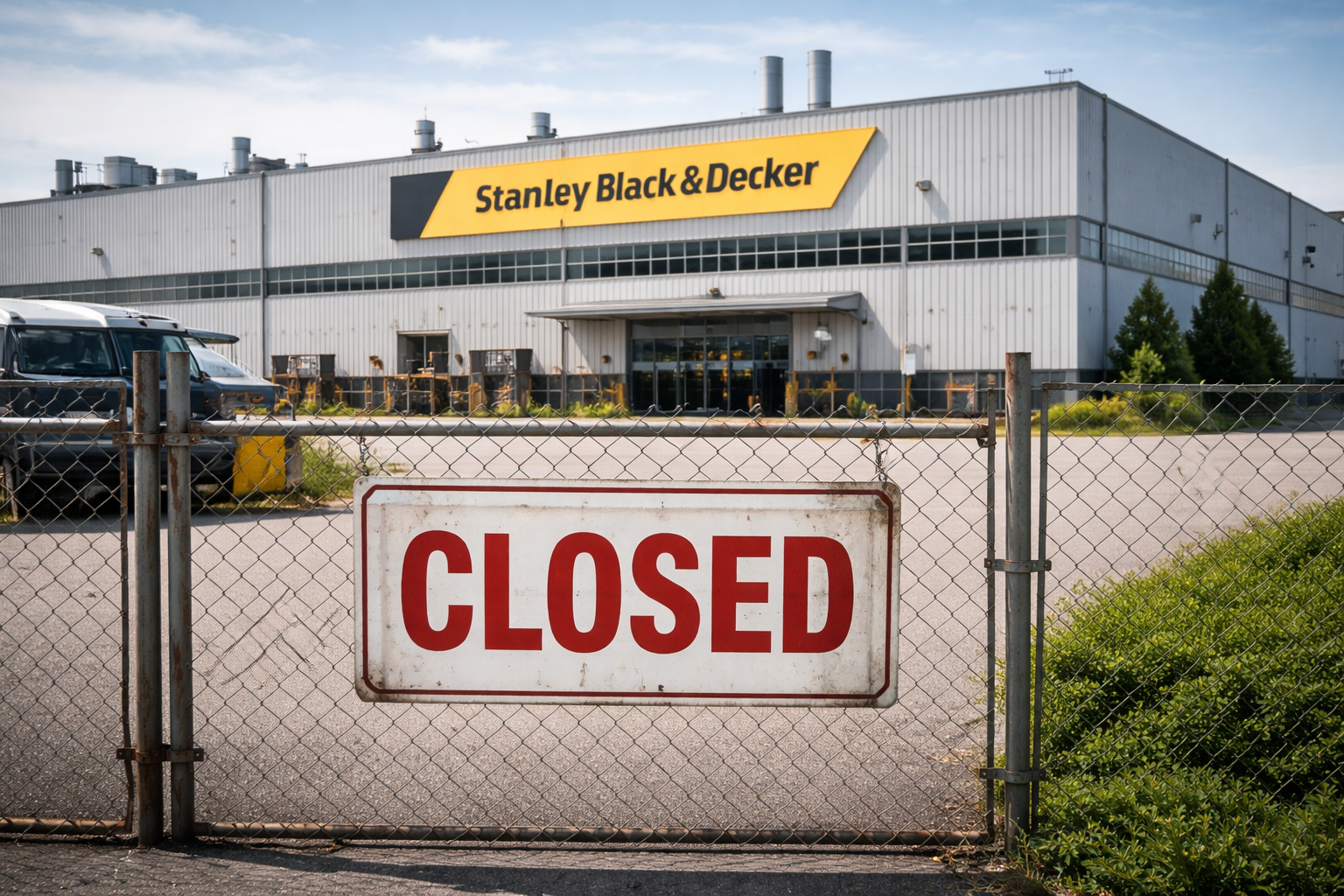
Stanley Black & Decker’s decision to close its last manufacturing plant in New Britain, Conn., the city long known as “Hardware City,” is more than a local story. It is the latest example of how one of America’s most historically industrial states continues to struggle with competitiveness in the modern economy.
The closure will result in more than 300 layoffs. For nearly two centuries, Stanley Black & Decker manufactured products in New Britain. Now, even with its global headquarters still located there, its in-state manufacturing presence is coming to an end.
A company representative said the closure reflects shifting “demand for single-sided tape measures” that are “quickly becoming obsolete.” In response to the lost jobs, Gov. Ned Lamont (D-Conn.) has stated his office is “working closely” to “support affected workers,” while “reimagin[ing] the factory site so it can continue to create opportunity and strengthen New Britain’s economic future.”
But for Connecticut, the move is déjà vu — a recurring problem plaguing the “land of steady habits.”
Stanley Black & Decker joins a growing list of companies that have reduced operations or left Connecticut over the past two decades. The litany includes the Winchester Repeating Arms Company, General Electric, Aetna, Edible Arrangements, United Technologies and Raytheon, Stag Arms, Alexion Pharmaceuticals, and even LEGO.
“How many times are we going to see this movie?” said Erin Stewart, former New Britain mayor and Republican gubernatorial candidate. “There’s only so long any enterprise can exist with the highest cost of living, the highest cost of energy, the highest cost of doing business, and utter hostility from the state capitol before they have to make the heartbreaking decision to leave or close their doors.”
The reasons vary by company, but the pattern has raised persistent questions about the state’s cost structure and regulatory climate.
Connecticut routinely finishes near the bottom in national business climate surveys. Wallethub ranked the Constitution State in the bottom tier for both ‘Business Environment’ and ‘Business Costs.’ Similarly, CNBC’s 2025 “America’s Top States for Business” report placed Connecticut 38th for Economy, 44th for Cost of Doing Business, and 37th for Cost of Living.
These issues stem largely from a burdensome tax climate. The Tax Foundation’s 2026 State Tax Competitiveness Index ranked Connecticut 47th overall, ahead of only California, New Jersey, and New York. The state received particularly poor marks in property and individual income taxes.
Layered on top of that are high electric and gas rates, elevated housing costs, and one of the highest per-capita tax burdens in the country.
The economic pressure is not limited to corporations. A recent AARP survey found that 37% of Connecticut residents — ages 45 and older — are considering leaving the state, citing cost-of-living concerns. Business surveys show similar anxiety: 91% of respondents in a 2025 Connecticut Business & Industry Association survey reported rising costs, while only 12% believed the state’s business climate was improving.
Overall, in 2025, Connecticut’s economy had a “mixed year,” as the CT Mirror reported. Unemployment increased by one percent to 4.2% — still below the national average — but the state lost nearly 2,200 jobs. Meanwhile, the GDP grew 5.6% in the summer, among the best in the nation; however, the private sector’s job creation has largely “stalled,” as the CBIA suggests.
When businesses leave or reduce operations, the impact ripples outward. Local suppliers lose contracts. Municipal tax bases shrink. Workers relocate. Remaining taxpayers shoulder a larger share of fixed costs.
At the same time companies are evaluating whether to stay, Connecticut lawmakers are debating proposals that would further increase taxes and expand regulation, including higher income taxes on top earners, capital gains surcharge, a so-called mansion tax, and other proposals that would raise energy costs, regulate self-checkouts, and allow union workers on strike to collect unemployment benefits.
Supporters argue these policies promote equity and environmental goals. Critics contend unrestricted government spending inevitably produces cascading effects on both residents and businesses alike in the form of higher tax burdens.
The debate highlights a broader economic tension: whether states with high fixed costs can remain competitive without structural reform.
In today’s economy, capital and talent are mobile. Companies can shift operations across state lines with increasing ease. Workers can relocate. Investment flows to jurisdictions offering stability, predictability, and competitive cost structures.
Stanley Black & Decker’s plant closure may reflect evolving product demand. But it also occurs within a broader economic environment shaped by tax policy, energy costs, labor regulations, and fiscal management.
States such as North Carolina, Texas, and Florida have aggressively marketed lower taxes and streamlined regulatory frameworks to attract businesses and residents from higher-cost regions. For Connecticut, located between two of the nation’s highest-tax states — New York and Massachusetts — the opportunity exists to differentiate itself. Whether it chooses to do so is a policy decision.
Connecticut’s challenges are not inevitable. They are the result of choices — and they can be changed by different choices. When operating costs rise and regulatory complexity increases, companies reassess investment decisions. When taxes climb and affordability declines, residents consider relocating. Over time, those individual decisions accumulate into structural economic shifts.
If the state addresses its structural cost drivers and improves its competitive standing, it can strengthen its economic foundation. If not, closures like Stanley Black & Decker’s may become less surprising, and more routine.