2025
On May 8, 2025, the Senate DFL announced:
The Minnesota Senate passed bipartisan legislation creating an independent Office of the Inspector General Thursday, establishing a new state office to protect public money in Minnesota from bad actors and criminals seeking to defraud state agencies and programs.
“One of the most important responsibilities of state government is protecting the taxpayer dollar. That’s why it’s time we create an independent watchdog for Minnesotans that will identify and investigate potential fraud,” said Senator Heather Gustafson (DFL-Vadnais Heights), who chief authored the bill. “This Office of the Inspector General is a practical solution to ensure accountability, transparency, and fiscal responsibility in state government.”
The bill, passed Thursday in a bipartisan vote of 60 to 7, has made 11 committee stops since being first introduced. At almost every committee hearing, the bill was co-presented by Senator Michael Kreun (R-Blaine) who served as the lead Republican co-author on the proposal.
“Minnesotans have paid far too much due to years of unaddressed waste, fraud, and abuse. They are tired of this being a constant issue, and they expect us to get this situation under control – today’s bill will create an office with the sole purpose of stopping fraud and waste before they can begin,” said Sen. Kreun. “Our role as legislators is to protect taxpayer dollars, utilize that funding responsibly, and prevent waste, fraud, and abuse from occurring. This bill takes a step towards restoring trust that Minnesotans should have in their leaders. Families deserve to know we are taking all fraud allegations seriously, and we are doing our part to mitigate future instances of waste, fraud, and abuse.”
The responsibilities of this new Independent Office of the Inspector General would include conducting investigations into any entities that receive state dollars, public or private if there is a reasonable suspicion of fraud. The office would be authorized to issue subpoenas, refer matters for civil, criminal, or administrative action, recommend legislative or policy changes, and issue public reports. A new Legislative Inspector General Advisory Commission would recommend candidates to the governor to make a appointment to the position of Inspector General. This appointment must be confirmed by a three fifths vote in the Senate.
The announcement concluded:
The bill now awaits action in the House of Representatives.
As I noted last November: “There was no action.” As WCCO reported on May 22, 2025:
Establishing an Office of Inspector General (OIG) is not part of the budget framework that will set the parameters of what the Legislature will pass in the looming special session, [former DFL House Speaker Emerita Melissa Hortman] explained, citing the $18 million cost over four years at a time when lawmakers are trying to stave off a $6 billion deficit in the future.
“It is dead,” Hortman said.
As I argued last July:
With our Scandal Tracker now up to $661.6 million for the period 2019 to 2025 — or $110.3 million annually — begrudging the $4.5 million a year it would cost to run the OIG looks like a classic example of being penny-wise and pound-foolish.
The Scandal Tracker is now well north of that figure.
In December, Sen. Gustafson (DFL) urged the House to pass the bill in the coming session, something we at Center of the American Experiment support. But that is proving easier said than done.
2026
The bill came up in the House State Government Finance and Policy Committee last Wednesday where, as KSTP reported, Rep. Matt Norris (DFL):
…introduced a so-called “delete everything” amendment that essentially completely replaced a Senate bill that passed the DFL-controlled Senate by a wide margin.
“Minnesota deserves an OIG with independence, transparency, and the sweeping investigative powers to get this essential work done,” Norris said. But his bill makes big changes to the Senate bill, including elimination of an enforcement bureau within the OIG, leaving that to the Bureau of Criminal Apprehension’s financial division. It also allows a governor to appoint someone to the OIG position who is not on a list recommended by an independent commission. His bill also increases the cost of the OIG at a difficult budget time.
His attempt to replace the Senate bill stalled on a 7-7 vote in the tied Minnesota House, with all Republicans voting against it because they had no input on the proposal.
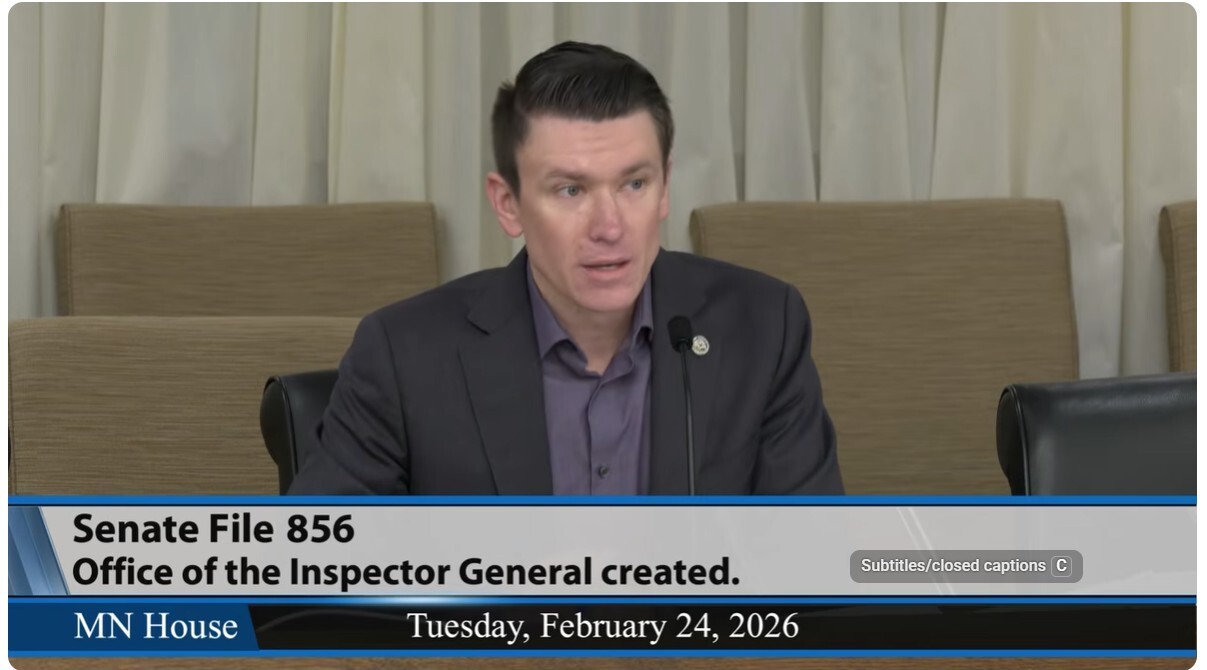
The bill came up again in the House State Government Finance and Policy Committee this week. KSTP reports that:
Two big differences in the Senate and DFL House bills involve who would appoint the inspector general and whether there should be a new law enforcement agency created within the OIG to help fight fraud.
Democrats say a new law enforcement entity is unnecessary. “We have, for instance, a financial crimes division within the BCA that is already doing really good and important work of investigating and arresting fraudsters,” Norris said.
Republicans questioned why Democrats want to give a governor authority to choose the inspector general. “Why does your [bill] give the governor basically all the authority to choose who he wants to be the inspector general?” asked Rep. Ben Davis, R-Merrifield. “To me, that is the fox guarding the henhouse.”
After accepting a few amendments to the Senate bill and rejecting several others, the OIG bill ultimately failed on a 7-7 tie vote.
So this bill, supported by 72% of Minnesotans, remains stuck in the committee, hostage to the DFL’s antics. As KSTP reports:
House State Government Finance Co-Chair Jim Nash wanted the bill sent to the House Judiciary Committee to keep the bill moving through the legislative process. “Or we can hold it in committee,” he said, criticizing DFL members. “Keep it hostage. Not let it go anywhere… Tell Minnesotans that you’re serious about fraud.”
The DFL co-chair, Rep. Ginny Klevorn of Plymouth, said this is just a temporary setback. “The OIG bill is alive and well. It is in committee. We don’t recess until May. We have plenty of time to get this right.”
Nash says unless there’s a compromise, the chance to pass an OIG bill could be lost. “Well, it could remain in our committee until we [adjourn]. It could die there.”
It was Rep. Klevorn who, you will recall, as chair in 2023 waved the bill creating Minnesota’s paid family and medical leave scheme out of the State and Local Government Finance and Policy committee — the very committee tasked with overseeing state and local government finance, as the name indicates — without a fiscal note.
Will the House DFL succeed in squashing the creation of an Office of Inspector General to fight fraud for a second year in a row? Watch this space.