Xcel Energy’s March 2 filing with the Colorado Public Utilities Commission (PUC) reads like a company trying to get ahead of a crisis. On paper, it might be just a simple status update about Comanche Unit 3, a coal-fired plant near Pueblo, which is undergoing repairs. Instead, Xcel sounds the alarm about grid reliability.
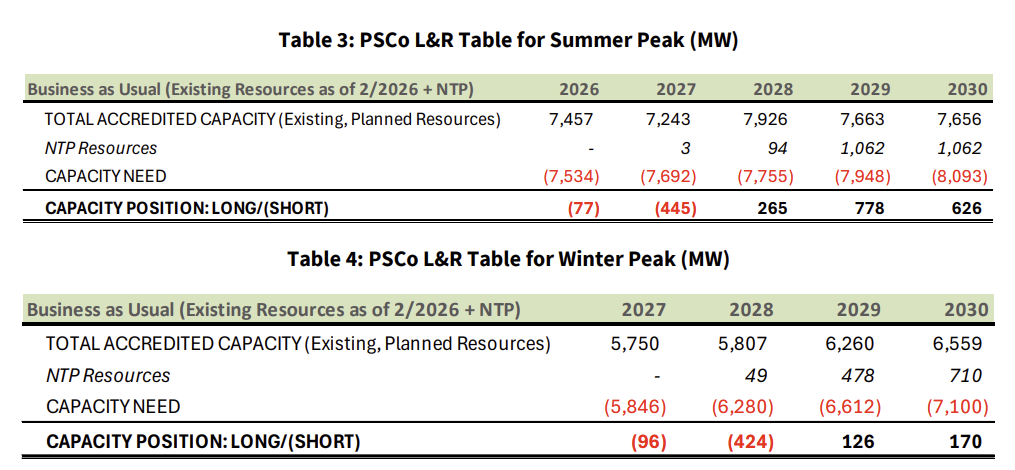
According to Xcel’s filing, the next two years are likely to see capacity shortfalls. Even in 2028, reserve margins, or the percentage of capacity exceeding expected peak load, will be “challenged.” The PUC already reluctantly allowed Comanche Unit 2 to stay online through 2026, though it was supposed to retire at the end of 2025. Even with Comanche 2 as a lifeline, after 2028, when the outlook turns slightly positive, the company warns that the “margin for success is razor thin.”
Xcel says that “all things will need to go to plan” to avoid blackouts. That’s not confidence-inspiring to hear from the company responsible for keeping 1.6 million Colorado customers’ lights on.
Xcel proposes keeping all four of its remaining coal-fired units (Comanche 2 and 3, and Hayden 1 and 2) online through 2030. The company also says that there are “no viable alternatives” to repairing Comanche 3. Replacing Comanche 3’s 415 MW of firm capacity with new generation would “cost billions of dollars” and couldn’t come online before 2029 “at best.” That’s too late by far.
What does this mean for Colorado’s grid right now? Coal and natural gas plants still supply 54.4 percent of the state’s electricity annually. During Winter Storm Fern, thermal generation covered 85 percent of Xcel’s load.
Xcel has sold Coloradans a “steel for fuel” vision that promises that swapping capital investment in wind and solar for fuel costs could keep delivering reliable power and save everybody money, to boot. Xcel and other regulated utilities don’t earn a rate of return on fuel expenses, but they profit from capital investment. The more Xcel and others build, the more they earn. The incentive is clear.
It turns out that the grid still needs the “fuel,” side resources to maintain reliability, but Xcel gets to bill customers for the massive buildout of wind and solar that was supposed to replace it.
This isn’t a theoretical concern for ratepayers. Xcel’s Colorado subsidiary posted $903 million in operating profit in 2025 while seeking a $365 million increase in electricity rates. The company plans to spend $37 billion in Colorado through 2031, nearly tripling its current capital base. Xcel’s own analysis projects that residential rates will likely rise between 20 and 30 percent by 2027 compared to 2024 levels. If load growth comes in below forecast —as it might, if the legislature succeeds in chasing away data center investment — residential rates could rise by 55% by 2029.
Colorado’s 2019 climate legislation requires Xcel to cut emissions 80% by 2030. That mandate, and the billions in spending it triggered, assumed wind and solar would be ready to deliver reliable, affordable electricity. Xcel’s March 2 filing is the company admitting on the record, to its own regulators, that they’re not. If there was ever a time to pump the brakes on mandated coal retirements, this is it.