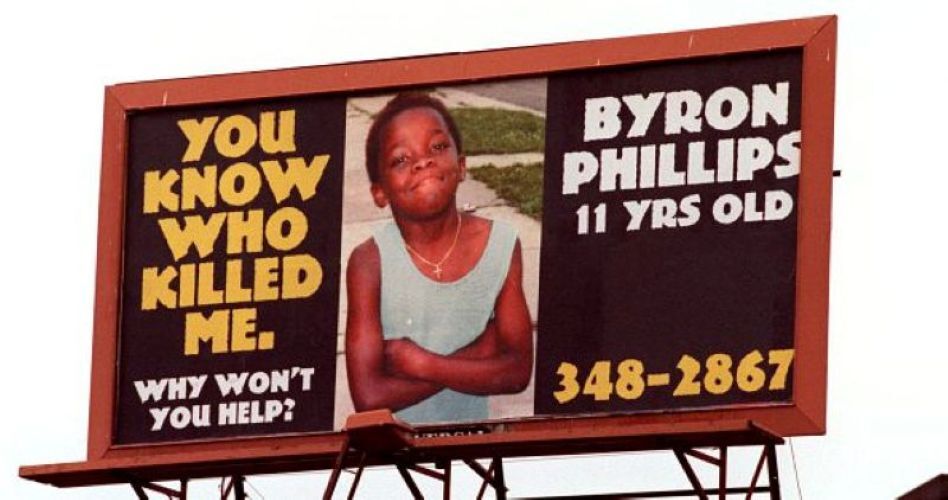
Most detectives will tell you there is a case that sticks with them. For me that case was the murder of Byron Phillips, an 11-year-old African American boy from North Minneapolis who was shot and killed 30 years ago today. Reflecting over the years since, I’m struck by how little has changed.
Byron was struck down when members of the Bogus Boyz gang attempted to kill a rival gang member in a drive by shooting near Byron’s house. He was struck once in the torso and died across the street from his house with his mom looking on in disbelief – blood soaking his “Cat in the Hat” t-shirt.
I was a young detective at the time, and while Byron’s murder wasn’t the first I had worked on, it became the first murder assigned to me and my partner. The gang involvement in the murder made it extremely difficult to solve, but our tenacity paid off nearly three years later with convictions against three Bogus Boy gang members, including a life sentence against Kawaskii Blanche, the triggerman. (Interestingly, Blanche’s first parole hearing was recently scheduled for this August, reminding me how quickly time passes).
I wrote a detailed account of the murder and investigation a few years ago, which you can read here.
Sadly, the calls for change that erupted in 1996 have cycled back and then disappeared several times since, never lasting long or producing any significant change. As a result, there have been far too many other kids murdered in the dysfunctional culture that exists in too many parts of our inner cities.
I wrote about that sad reality as well, in an article entitled, “An all-too-common headline” which you can read here. Re-reading that article this morning brought back the same I have had over the decades – feelings that come from seeing the effect that deflection, obfuscation, and denial involving black violence has had on our collective community.
In the article I lamented the problem that has persisted before and after Byron’s murder:
“In the decades that have followed there have been far too many instances of kids who have been shot and killed in Minneapolis, doing nothing more than riding in a car with a parent, sitting at their kitchen table doing homework, sleeping on a couch, jumping on a backyard trampoline — nearly all of them innocent black children killed by young black males resorting to violence to resolve conflict.
This article is not intended to pile on but asks a tough question. How is it that we have gotten to the point where this level of violence can occur almost exclusively in the black community, and no one in that community, the government, the media, or the policy world is able to call it out? And how do we expect to stop it if we can’t even name it?
We are all expected to accept the narrative that this violence is the result of a complicated web of systemic injustices and disparities. Fingers have been pointed at the police, the courts, sentencing policies, drug policies, housing policies, school funding, healthcare, where highways were built, and so on.
These trope-ish excuses have harmed us all, but they’ve devastated the black community, allowing some to destroy black culture from within, while forcing others to remain silent.
It’s beyond time to flip the script — not to pile on, but to lift the black community and foster the voices of reason that understand it is ultimately up to the black community to reject the violence tearing it apart.
We can and should all demand more of ourselves, and that includes Minneapolis’s black community. Accepting the status quo will only make it more likely that the cycle of violence continues — and that option should be unacceptable to us all.“
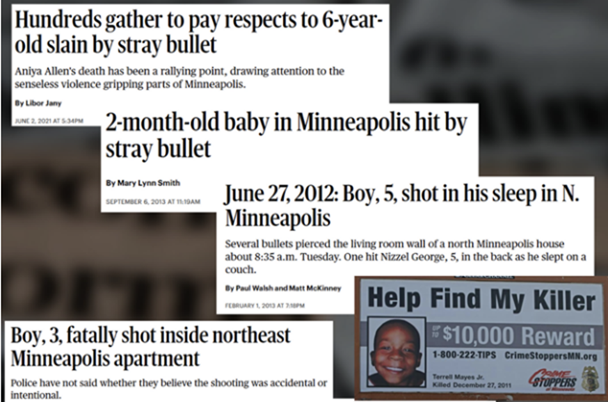
Minneapolis headlines over the years
Tough and pointed words for sure – but true and desperately needed if we expect actual change to occur. On the 30th anniversary of Byron Phillips’s murder, this tough and pointed message is more than appropriate. But will anyone listen?