Schools decry largest expansion of government regulation in state’s history, possible closures
In response to months of panicked, angry phone calls from school leaders and families, Louisiana lawmakers are considering bills to dial back sweeping, costly government overreach on private school prekindergarten (pre-K) programs imposed via a new state law.
Act 409 was passed by lawmakers and signed into law last year in large part based on the testimony of a family regarding an alleged incident involving two 3-year-olds attending a private school pre-K program. The school has reportedly repudiated the incident, and it has never been substantiated in a court of law. There have been no other allegations of widespread child safety issues in private school pre-K programs. The bill, designated a health and safety measure, bypassed the House and Senate education committees that typically hear legislation pertaining to schools. As a result, most school leaders were not aware of the legislation until it had already passed.
The new law requires private school pre-K programs, except for Montessori programs, to be licensed by the state as “early learning centers,” still colloquially known as daycares. This means they are subject to ongoing compliance monitoring and inspections by state education, health, and fire marshal agencies. They must also meet higher child-staff ratios and adhere to new state mandates, some of which private school leaders claim will cost tens to hundreds of thousands of dollars—costs they would have to pass along to tuition paying families or else shut down their pre-K program. State law does not require licensing for public school pre-K programs.
Three legislative instruments have been introduced this year to address school leaders’ concerns: Senate Bill 441 by Senator Beth Mizell, House Bill 1112 by Representative Emily Chenevert, and House Concurrent Resolution 43, also by Representative Chenevert. They propose vastly different approaches.
SB 441 removes licensing requirements by the state Department of Education, but preserves many of the same requirements that must be “monitored” by the agency. Schools that are accredited by or are members of a state recognized organization that certifies a school’s compliance with the safety requirements can be exempt from Department of Education monitoring; however, the problem is that few, if any, accrediting bodies or private school membership organizations engage in routine safety compliance monitoring. That is not their role, and the bill does not offer them any funds to finance this labor-intensive expense. Department of Education officials were unable to identify any accrediting body or private school membership organization that confirmed its ability or willingness to take on this new responsibility.
Whether SB 441’s “exemptions” are even workable is a central question; they appear to be more like lipstick on a pig. Let’s be clear: this bill preserves an ongoing role for the Department of Education in private education across the state, monitoring per a state checklist, responding to parent complaints in lieu of the school’s governing authority, and holding the final say as to what constitutes satisfactory compliance or resolution. This represents a significant departure from the role the state has historically had in private schools. SB 441 passed the full Senate last week after being reported favorably by the Senate Committee on Education.
HB 1112 takes a different approach, recognizing these entities as schools of choice that families often intentionally select because they are different than government-run schools and licensed daycares. It exempts private schools from licensure and does not impose state monitoring requirements. It also increases transparency by requiring that schools notify parents, upon enrolling their children in their pre-K program, that certain federal and state laws and licensing regulations do not apply to them. It recognizes pre-K programs operated by state-approved private schools—a process that has existed for decades under Louisiana’s state constitution—without adding additional layers of government red tape and bureaucracy. The House Committee on Education reported HB 1112 favorably last week.
HCR 43, if approved by both the House and Senate, would suspend the implementation of Act 409 of 2025 for one year. It has not yet been heard in committee.
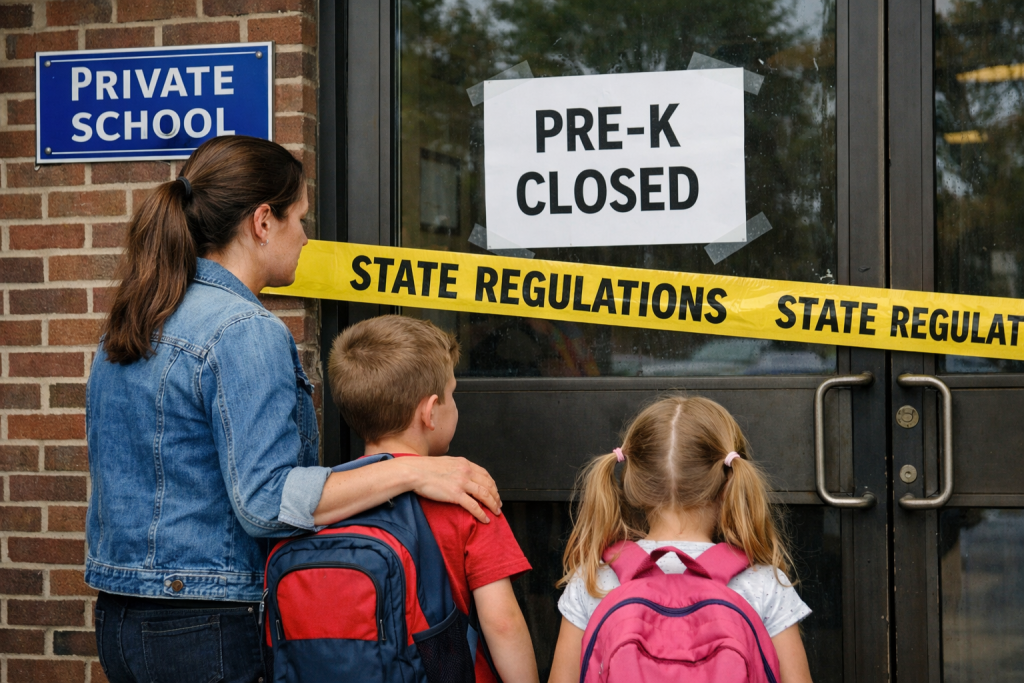
The clock is ticking as many private schools have already enrolled children in their pre-K programs for this fall. Whether they will face increased government regulation and increased costs is uncertain. This also leaves families wondering if they will be asked to pay higher tuition and fee bills this summer, or worse, be notified that their child’s pre-K program will close.
While time is of the essence, what’s most important is getting this right. Louisiana has a cherished history and culture of empowering parents to choose the educational setting that works best for their child—including religious education—and has long respected the role of private schools. This has enabled private schools to thrive across our state and serve thousands of Louisiana families. It’s unfathomable that preserving these options without government interference is even a question in a state with a conservative state government trifecta. The more than 250 affected private schools and the thousands of families they serve won’t soon forget how lawmakers act. The legislative session must adjourn by June 1, leaving just six weeks to bring this unfortunate saga to an end.