
In a recent Post Bulletin reader Q&A, “Answer Man” responded to questions about why Rochester Public Schools graduates students who aren’t demonstrating proficiency in math and reading on state assessments. Several key details were left out of the responses, which I address below.
“MCAs have little or nothing to do with the journey for each student who is graduating from high school”
Standardized assessments are not perfect, and this includes the Minnesota Comprehensive Assessments (MCAs). They are not treated as the full picture of a student’s education, but they are not irrelevant either. They are the only statewide measure of whether students are meeting grade-level expectations in reading and math.
The MCAs are aligned to Minnesota’s academic standards, which include the content students are expected to learn in each grade and must “satisfactorily complete” by the time they graduate. While students are assessed on this content throughout the year, the rise of grade inflation can send conflicting signals about what they know and retain. In fact, a new study from the University of Chicago and Oregon State University has found that standardized test scores often provide a more objective measure of skills than grades due to such inflation.
The MCA content is consistent across districts and also serves as an accountability measure to help ensure schools and districts are fulfilling their responsibility of equipping students with basic literacy and numeracy skills. If proficiency rates are widely disconnected from graduation rates, that signals a disconnect between graduation requirements and academic readiness and raises questions about what a diploma is supposed to represent.
“By definition, 100% of graduates meet state and local requirements before they graduate, including earning sufficient credits”
This is true in a procedural sense. Students must complete all academic standards and the state credit requirements to receive a diploma.
While I don’t think students are being “illegitimately” graduated under these current rules, the issue is whether the graduation requirements reflect real academic proficiency and readiness for postsecondary paths or employment.
If a district can graduate students who do not meet proficiency benchmarks on state assessments like the MCAs, then credit accumulation may not be a sufficient measure of readiness. (Minnesota previously addressed this concern through the GRAD exit exam, which was eliminated in 2013.)
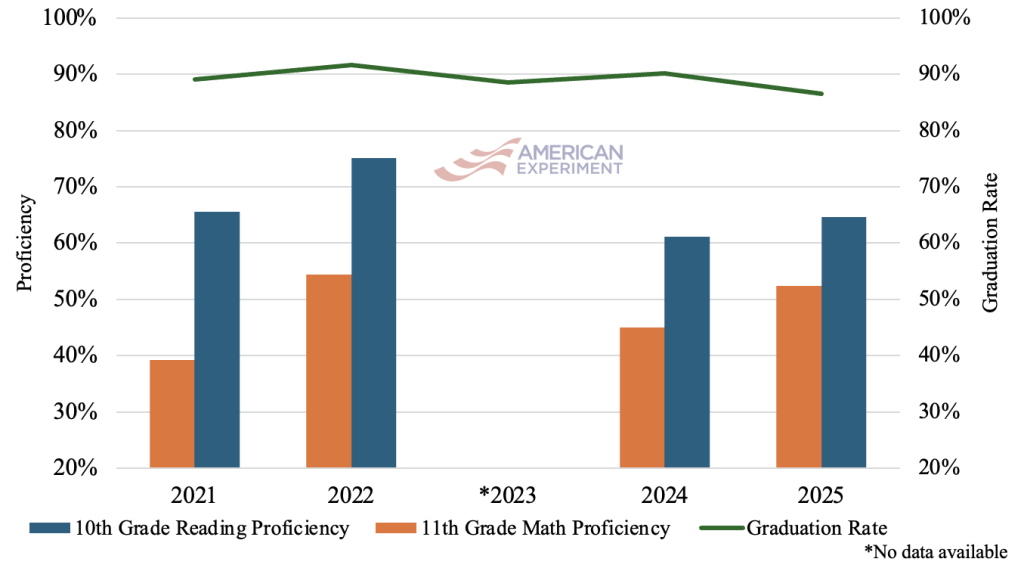
Century High School, 4-Year Graduation Rate & Proficiency
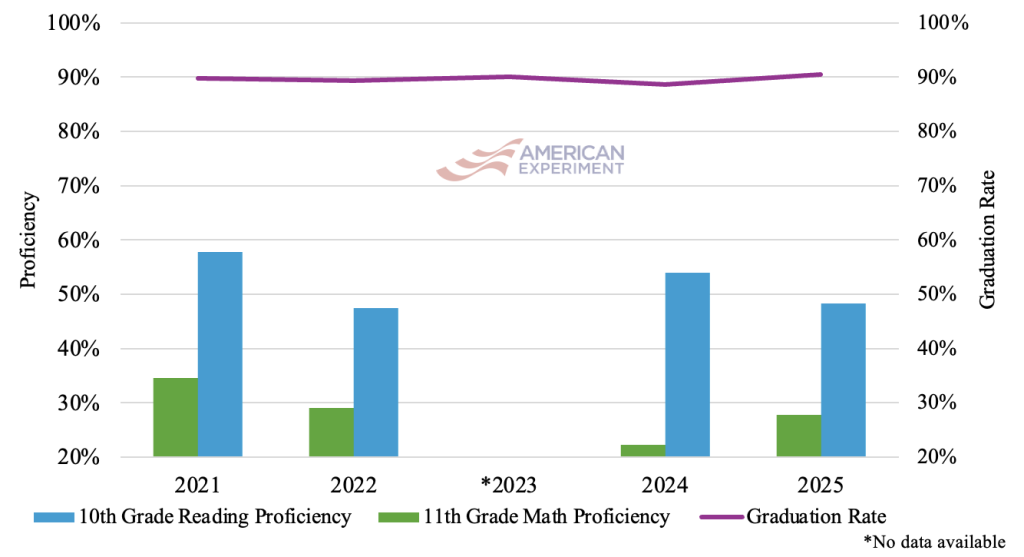
John Marshall High School, 4-Year Graduation Rate & Proficiency
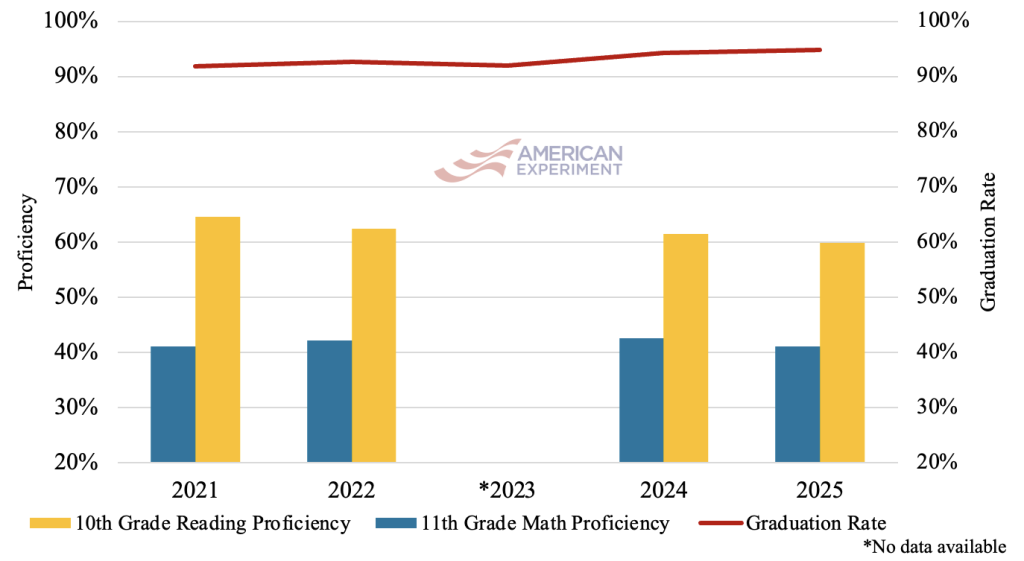
Mayo High School, 4-Year Graduation Rate & Proficiency
“Many high school students in RPS opt out of the MCAs, so the number of students who pass (or fail) isn’t indicative of the whole student body”
According to the Minnesota Report Card, well over a majority of Rochester high school students take the MCAs. In fact, in many cases these rates have been higher than statewide participation rates. And for those who do opt out, that decision does not negatively impact test results and, therefore, does not explain the gap between graduation and proficiency rates.
| MCA Test | Century High School Participation Rate |
Mayo High School Participation Rate |
John Marshall High School Participation Rate |
| Math (Spring 2025) | 70.4% | 83.7% | 93.5% |
| Reading (Spring 2025) | 84.7% | 94.4% | 97.2% |
| Math (Spring 2024) | 65.0% | 83.0% | 90.8% |
“Going forward, RPS will use ACT results as a measure for high school achievement rather than the MCAs”
As a communication strategy, sure, the district can choose to emphasize ACT scores as a local achievement metric. But it can’t opt out of administering the MCAs.
Under the federal Every Student Succeeds Act (ESSA), Minnesota is required to administer statewide testing in reading, math, and science, which are currently the MCAs. There are also participation requirements under the ESSA. Any replacement would require federal approval.
It is also worth noting that the Minnesota Department of Education’s 2024 Technical Manual for Minnesota’s Statewide Assessments documents a “strong positive relationship” between MCA performance and ACT scores.