
Ohio policymakers have announced the creation of a statewide Attendance Dashboard that will be used to combat chronic absenteeism.
Chronic absenteeism occurs when a student is absent from school for more than 10 percent of the academic year. Nationally, there were high, destructive spikes of chronic absenteeism immediately following COVID-19. Only a few states have taken meaningful steps towards recovery.
The Ohio dashboard contains impressive swaths of granular data, down to attendance percentages for specific grades at specific schools. Information will update weekly, as opposed to Ohio’s previous once-yearly update schedule. In a move designed to promote inter-district replication of quality practices, an attendance leaderboard identifies top-performing and fast-improving districts.
Ohio Gov. DeWine and DEW Director Steve Dackin pointed to the dashboard as an opportunity for districts to modernize and begin to report their attendance in a uniform manner. About 24 percent of Ohio districts haven’t yet uploaded their data to the dashboard, generally because of technical difficulties.
Policy writer Jessica Poiner argued that the dashboard creates an incredible opportunity for districts to take chronic absenteeism seriously.
The dashboard provides real-time data that district and school officials can use to identify issues as they occur and address them before they snowball into a bigger problem. Does a nearby district or charter school have better attendance numbers among its at-risk youth? Then schedule a visit, identify what’s working, and implement it. The dashboard makes it possible to learn from other schools. And since it’s updated weekly, district officials will have immediate feedback about whether their efforts are working.
Ohio is just the second state in the country to have a continuously updated public dashboard that tracks granular attendance, after Rhode Island. Rhode Island’s campaign against chronic absenteeism has had strong results.
Minnesota should consider following Ohio’s lead by creating an attendance data dashboard — or, at the very least, by updating attendance data consistently.
About one in four of Minnesota’s students have been chronically absent for the last half-decade. There has not yet been any significant effort to reconnect with students and families to return them to the classroom.
The most recent attendance data published by the Minnesota Department of Education is from 2024. The significant two year delay on publishing regular attendance rates allows the chronic absenteeism conversation to lose significant momentum. Policymakers who would otherwise be able to create and compare successful pilot programs to boost student attendance are stymied by the systemic obscuration of the data.
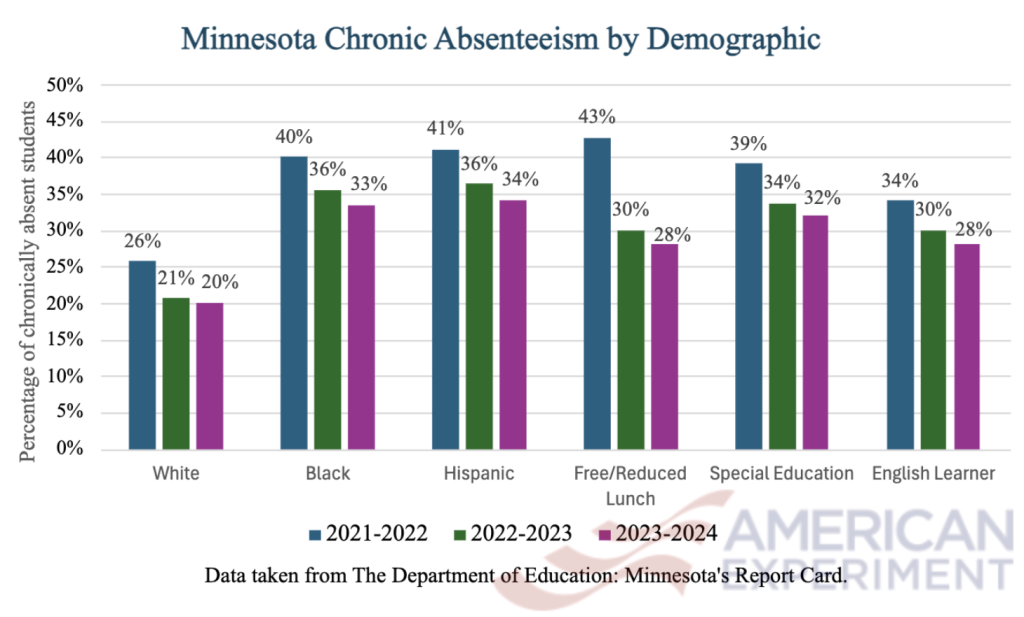
While chronic absenteeism is present in all types of Minnesota schools, some types of students are more likely to be chronically absent. Minority students, students in poverty, and special education students hold high levels of chronic absenteeism. The longer Minnesota allows the education system to continue without a real intervention for these learners, the more stalwart their learning gaps will become.
It’s time for Minnesota to modernize and take the crisis of chronic absenteeism seriously. Ohio has given us an example of strong school leadership. Will we follow it?