Minneapolis Public Schools, the state’s third largest district, is continuing plans to build a brand new $105 million school to rehome Anishinabe Academy.
The PK-5 school “is dedicated to serving and educating the families of Minneapolis through an American Indian, Indigenous lens, with a Native-centered curriculum, and through Ojibwe and Dakota language.” Of the school’s 219 students, 77.6 percent are American Indian. Minneapolis Public School District served 1,731 American Indian students in 2026.
The project is moving forward while the district grapples with significant funding, building allocation, and staffing issues. The district has not been financially stable since 2017, and currently faces a $50 million deficit for the year. The financial department has been so troubled that two outside law firms were hired recently to investigate internal personnel issues connected to vanishing funds, and several top officials were removed from their posts. Financial district oversight was recently outsourced to a private contractor to the tune of almost $70K per month.
The district has been sluggishly working towards right-sizing the district for some time, as its geographic footprint dramatically outweighs actual enrollment. A November 2024 board report found that 51 percent of school buildings were underutilized. No concrete plans for right-sizing have yet materialized.
Plans for a dedicated space for Anishinabe have been in the works for some time, as Anishinabe Academy currently shares space with another organization in south Minneapolis. As board Vice Chair Kim Ellison noted at a recent board meeting, the community has been waiting 15 years for a permanent dedicated school facility. Minneapolis set the formalized planning and design process into motion two years ago, bringing on community organizers to gauge local desires and hiring indigenous contractors.
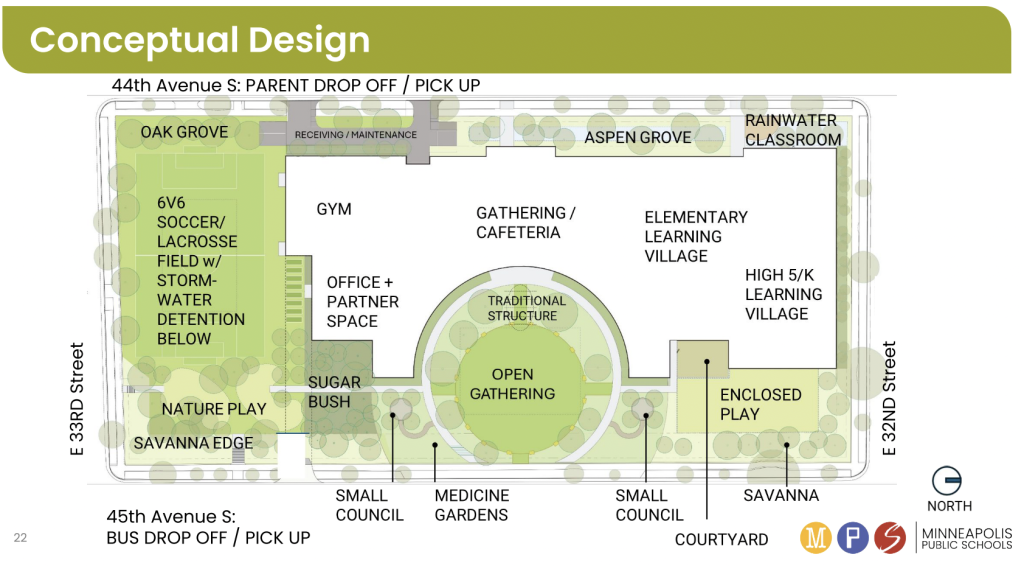
The proposed new PK-8 school building would be built on the site of the former Cooper Elementary School, currently boarded up. The new three-story building would be centered around a nature-filled open gathering place, and feature a rainwater classroom, medicine gardens, and a soccer field. Limited street parking is available for the building, but district officials noted that the addition of an underground parking lot (for an additional $3-5 million) would open about 30 further parking spaces.
During a recent board meeting, the facility planning, design, and construction team, headed by senior operations officer Tom Parent, argued that a totally new, “non-colonial” building was the best choice for Anishinabe Academy. Parent noted “There are very few [district-owned buildings] that even meet the baseline criteria for what Ashinabe Academy believes is necessary to be successful and to match the vision.” Seemingly drawing from prepared remarks, team member Sam Olbekson, member of the White Earth Nation of Ojibwe and architect with Full Circle Indigenous Planning + Design, additionally noted that an expansion to the existing Cooper School is “not recommended by the community due to its expression, that connection to trauma, that connection to history.” One comment by a teacher, in response to the question, “What would make this place feel safe?” was highlighted by the team: “If it didn’t look like a school, as school is a source of trauma for our community.”
Olbekson painted a lovely vision for the building, boarded by the Mississippi river that would act as “teacher” and surrounded by the smell of cedar, saying, “The new Anishinabe Academy is imagined as a living village, a place alive with the rhythms of land and seasons of growth and rest. It is a place to learn, to make, to heal, to gather.”
There’s no denying that any student would enjoy attending their school at such a nature-filled, bespoke site. But does MPS have the current organizational and financial ability to move ahead with the building plans?
The proposed building would have a strong physical priority placed on outdoor spaces, meaning that capacity would be capped at 650-700 students. MPS District guidelines hold that the minimum enrollment for other K-8 schools is currently 1,000, to offer the “holistic MPS experience,” with a full set of electives and class offerings. Board members overwhelmingly agreed in discussion that the district does not have to universally adhere to that guideline, and that the American Indian community served by Anishinabe Academy can have different parameters.
Of course, the steep $105 million price tag was bound to raise eyebrows, but the only question about cost in the recent board meeting came from an honorary student member of the board. Tom Parent noted that funds for capital projects, by law, are distinct from funding that can be sent to teacher salaries, textbooks, or other classroom materials, saying “The funding for this work would be included in the school district’s capitol plan.” Board Vice Chair Kim Ellison said that the separation of the funds made her comfortable to move forward with the building plan, while other plans to right-size the district footprint continued. She said that “the promise has been made” to the Anishinabe community for a new building.
The board votes next month to move to the next stage of planning (design work, which will cost $2.3 million). If the money is invested now, the school will allegedly be on track for a 2028-29 opening. Five board members have already publicly indicated that they fully support the project.
The building project may be derailed in the future, as five board seats are up for reelection this fall. Given the complete lack of curiosity by the board as to how this school could be a wise financial choice for the district (plus the general chaos of the district) it’s possible that a few of those seats will be flipped. But for now, it seems that it’s full steam ahead for the new school.