
The Minnesota Office of Higher Education’s latest student debt report shows that students who earned certificates and associate degrees from the state’s technical and community colleges completed school with significantly lower debt than bachelor’s degree graduates.
American Experiment has long argued that the cultural push toward a four-year degree, while the right path for a number of Minnesotans, can keep young people from knowing about and pursuing alternative career pathways better aligned with their interests and aptitude. It can also weigh them down with unnecessary student debt.
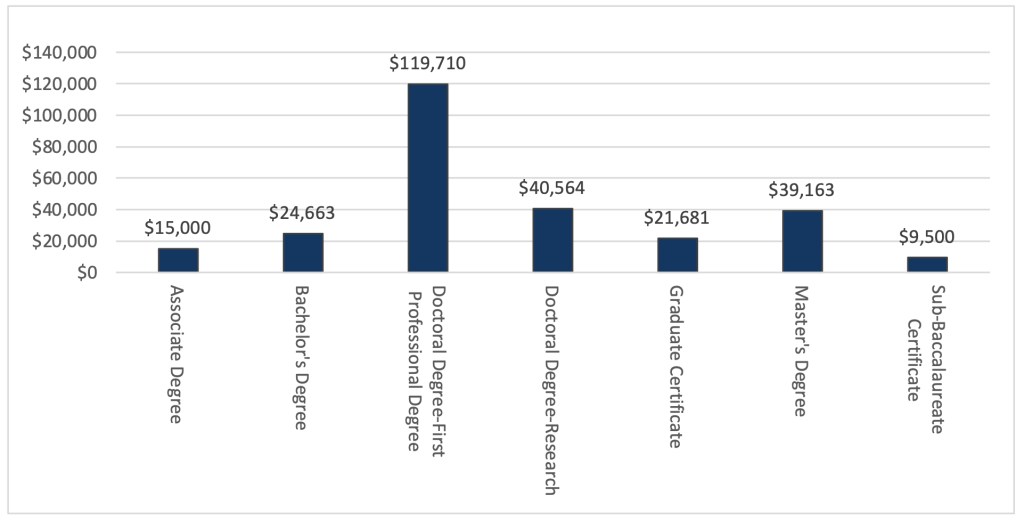
As documented in the OHE’s report, the debt patterns for graduating students vary by award type. The median Minnesota bachelor’s degree holder carries nearly $25,000 in debt at graduation, with 60 percent of students borrowing to get there. That dollar amount stretches to over $39,000 for a master’s degree. (Keep in mind, these numbers don’t capture students who took on debt but never finished school.)
In comparison, sub-baccalaureate certificate graduates leave with a median debt of just $9,500, and only 41 percent of them take on loans at all. Associate degree graduates sit at $15,000 of median debt, with a 48 percent borrowing rate.
Statewide Median Cumulative Debt by Award Type, 2023
While true that a bachelor’s degree for certain career pathways can still be a good investment, such as leading to higher lifetime earnings, its value is no longer as clear-cut.
According to wage data cited in the OHE report, the median bachelor’s degree graduate in Minnesota earns around $52,600 annually, compared to roughly $41,100 for associate degree graduates and $45,900 for certificate holders. But those per-year earning gaps should be weighed against a higher per-year debt, and the additional years spent in school.
Consider, for example, a student who pursues a two-year certificate and enters the workforce two years earlier than a bachelor’s degree graduate. Not only do those two years represent work experience, but real earnings as well. At the median certificate wage of $45,900, that’s roughly $90,000 in earnings accumulated before a bachelor’s degree graduate even walks across a stage. And don’t forget the interest accruing on student loans. A bachelor’s degree holder may find a higher salary, but the break-even point to offset the higher debt could be a number of years in the making.
The narrative around four-degree alternatives is changing, and more high schools are integrating technical and vocational pathways into their school offerings and curriculum, but more can be done to help students weigh their options. High school counselors, who themselves hold four-year degrees, should make sure students who might thrive in, say, the trades or advanced manufacturing, don’t feel compelled to take on four more years in the classroom if it wouldn’t be the right fit.
“Everyone has been told that you have to have a four-year degree to be prosperous at life,” said Tim Worke, chief executive of the Associated General Contractors of Minnesota.
That’s why American Experiment’s Great Jobs Without a Four-Year Degree initiative worked so hard to inform young men and women about the satisfying and lucrative opportunities in the trades and other fields. The initiative brought attention to the wide range of careers available to students who pursue technical education, apprenticeships, and community college programs.
Construction and the skilled trades are facing serious workforce shortages, and the same is true across health care support, technology, and manufacturing. These are in-demand positions that form the backbone of the state’s economy and include competitive wages and manageable debt loads.
For students genuinely interested in the four-year pathway, they can still pursue that route, but they, along with their parents, should approach post-secondary education decisions with a clear idea of all the options that exist. And an understanding of how those options reward — or cost — the graduate. Too many students may still be getting only half the story, and they deserve to hear the rest.