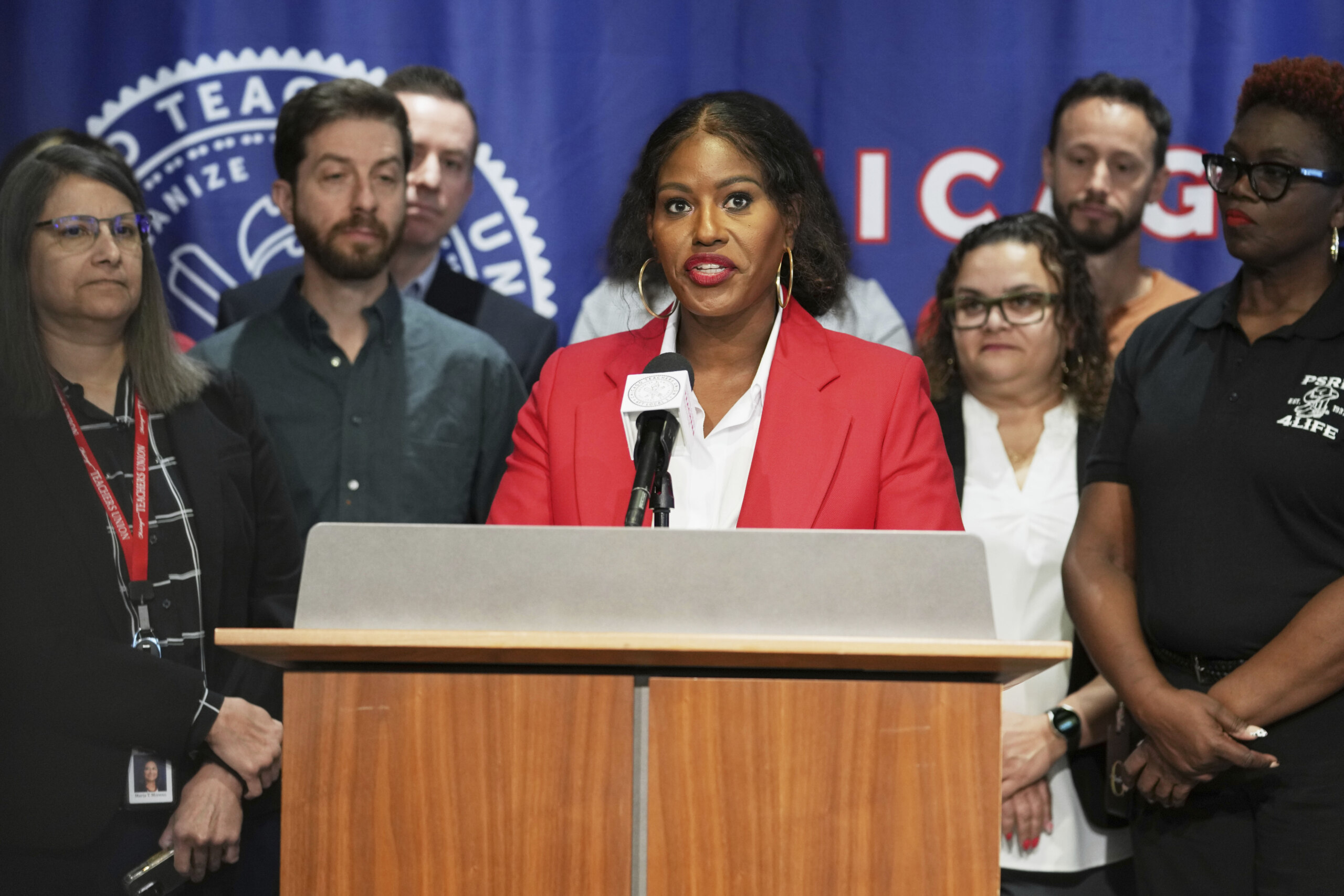
The union helped push a state constitutional amendment in 2022 that allows its contracts to override state law.
The head of Chicago Public Schools was asked in Congress last week whether parents have ever been lied to about the name a child uses in school and whether boys are allowed in girls’ locker rooms.
CEO Macquline King didn’t answer directly, saying instead that district policies are in line with state law.
The problem: In Illinois, teachers union contracts dictate district practices, even overriding state laws if they conflict. That means it’s the Chicago Teachers Union making those name and locker room decisions King was asked about.
In fact, CTU pushed for a first-of-its-kind constitutional amendment in 2022 that elevates government union contracts above state and local laws.
Voters approved the inaccurately dubbed “Workers’ Rights Amendment” — or Amendment 1 — on Nov. 8, 2022. It allows CTU’s latest contract to override any other policies.
So how does the union’s CTU contract dictate district policy about secrecy from parents and broad locker room provisions? Here’s what you need to know:
The CTU contract allows keeping secrets from parents, dictating locker room provisions
The current CTU contract includes provisions that could trouble many parents:
- Secrets from parents: The contract requires the district to “respect students’ privacy, especially if parents or family members do not know how students identify or express their identity.” Teachers “will not be required to reveal a student’s sexual orientation or gender identity” to guardians or parents “without the student’s permission.”
- No limits on locker room, bathroom usage: The contract mandates, “All students and staff are permitted to use the bathroom or locker room that corresponds to their gender identity,” with no limits on when male teachers or students can use female locker rooms or bathrooms.
Instead of referencing these provisions in her testimony, King deflected.
The CTU contract can override state law and district policies
Even before Amendment 1 passed, precedent existed for some Illinois government unions to void state and local laws simply by writing contrary provisions into their collective-bargaining agreements. Nestled toward the end of the Illinois Public Labor Relations Act is this:
“…any collective bargaining contract between a public employer and a labor organization executed pursuant to this Act shall supersede any contrary statutes, charters, ordinances, rules or regulations relating to wages, hours and conditions of employment and employment relations adopted by the public employer or its agents.”
An Illinois Policy Institute review in 2023 revealed that no other state gives such extreme power to government unions to override state and local laws through a collective-bargaining agreement, and without limitation.
It’s more common for states to do the opposite: explicitly prohibit conflicts between union contracts and state or local laws. Illinois is clearly an outlier.
When questioned in the congressional committee hearing, King answered for district policies. But the reality is that it’s not state law that controls what goes on behind school doors — it’s the CTU’s contract.