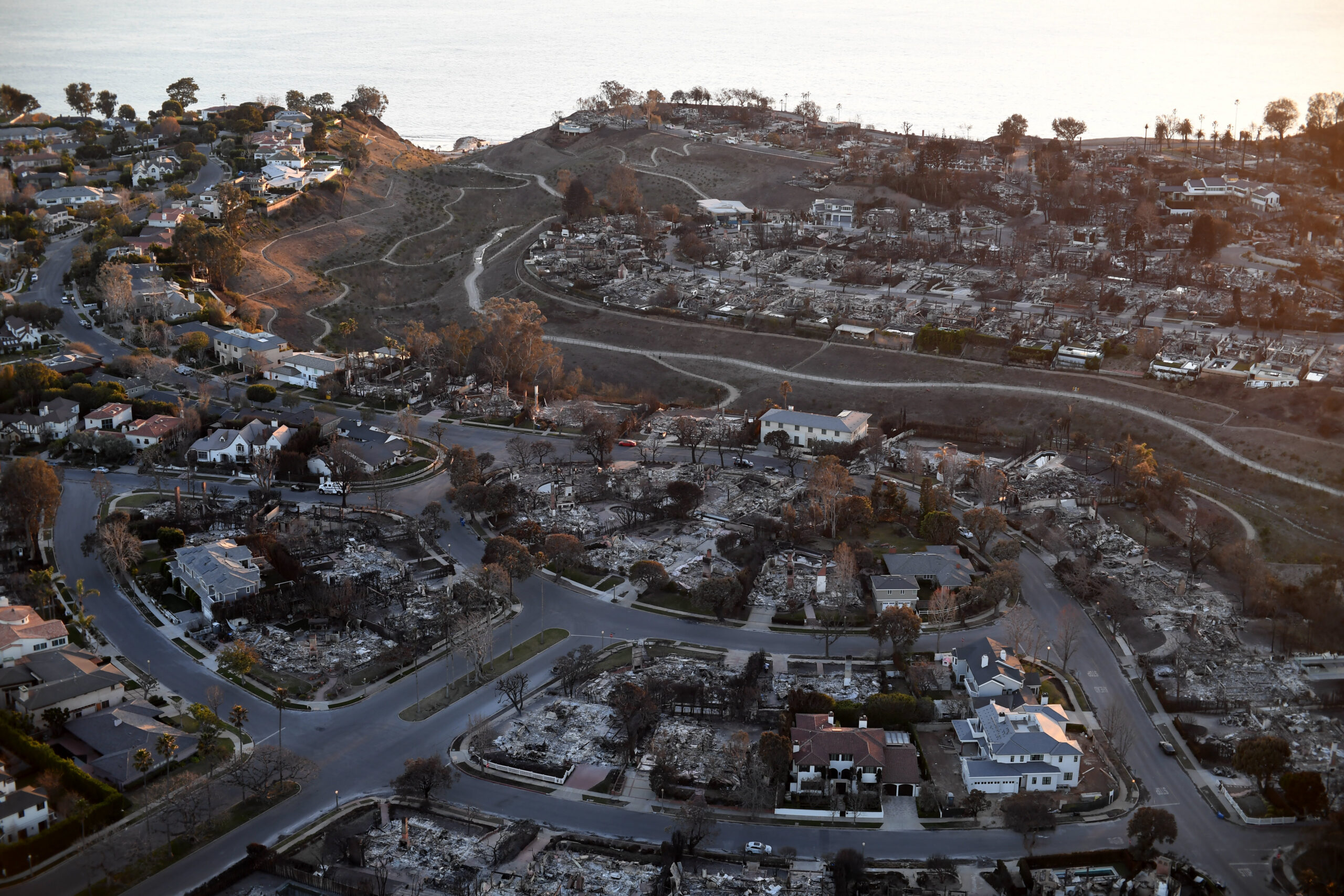
Since the January 2025 wildfires devastated Pacific Palisades and Eaton, what have policymakers done to make sure California cities are better protected from future outbreaks? Policies should be split into “three buckets,” Kyle Greenspan told me; he’s a research associate with the Water Policy Center at the Public Policy Institute of California (PPIC). One bucket concerns “big landscape” problems, such as clearing highly flammable brush in forests. That’s basically a state and federal matter.
The second bucket concerns what can be done by local governments and utilities, or by the state to help or improve local conditions. “The main thing I would point to is ignition reduction, or just reducing the number of fires that start,” he said. “The main types of folks responsible for that are the utilities.” That’s because they operate the power lines that cause most of the fires that start from high winds.
Indeed, the U.S. Department of Justice last September sued Southern California Edison, as its statement explained, “alleging the company’s negligence caused the deadly Eaton and Fairview fires, which burned tens of thousands of acres of National Forest System lands, killed a total of 21 people, and destroyed thousands of buildings.” The Fairview fire burned Riverside County in 2022. The litigation is ongoing.
SCE’s May 2025 Wildfire Mitigation Plan Fact Sheet for 2026-28 outlined:
[A] clear path forward to enhance grid resilience and reduce wildfire risks. With approximately a quarter of the company’s service area at risk for potential wildfires, SCE is further hardening its infrastructure, bolstering situational awareness capabilities, enhancing operational practices and harnessing the power of data and technology to tackle and find solutions to those risks.
Efforts include better grid design and system hardening, inspections, vegetation management, “cutting-edge technologies” and “early fault detection expansion.” The full 730-page 2026-2028 Wildfire Mitigation Plan Revision 1 is worth a read.