John Wayne movies
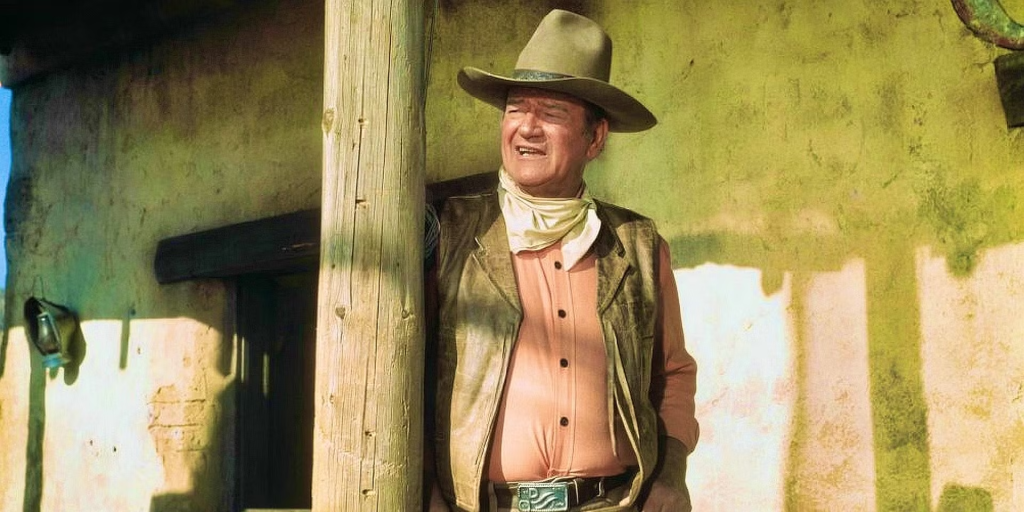
When my dad was nine years old, his father walked out on his family and the resulting vacancy for male role model in his life was largely filled by John Wayne. America sent that fatherless boy, sitting in a darkened cinema thousands of miles away, an example of what it was to be a man.
As an immigrant, like most people in the world, I first met America through its cultural output. For all the negative things people in other countries might say about America, very many of them watch American TV shows and movies, listen to American music, wear American clothes, eat American food…I remember someone saying about 25 years ago that everyone on the planet who was not actually an American was effectively a Canadian, in the sense that they are effectively Americans who pretend not to be. An overstatement, to be sure, but with a significant element of truth.
There are countless American cultural products I could have picked as things I love about the country — the (early) films of Eddie Murphy, the music of Bob Dylan, the books of Jack Kerouac, the TV show Cheers — all of which fascinated me about the place as a kid, but none of them meant as much to me as John Wayne meant to my dad.
He could never bring himself to watch The Cowboys, where Wayne is killed. “But you don’t mind watching Sands of Iwo Jima,” I pointed out, “and he gets killed in that.”
“Yes, but that’s not John Wayne getting killed.”
There was a sense in which certain of Wayne’s characters — the Ringo Kid, Sheriff John T. Chance, or Wil Andersen — were manifestations of the man himself in a way that Sgt. John M. Stryker wasn’t. Watching that father figure die was too much.
What united these characters was that they stepped up. In Stagecoach, the first great John Wayne movie, the Ringo Kid, on the run from the law, has a chance to flee the coach and its passengers for freedom but, when he sees smoke signals heralding nearby Apaches, he decides to stay and protect them. In Rio Bravo, it is Sheriff John T. Chance who rallies a motley band to ensure that a killer is brough to justice. Here, it is Dude, played by Dean Martin, who is set to flee until he hears the bad guys singing “The Cutthroat Song,” realizes that they will show no mercy to Chance and the rest, and decides to stick it out. Dude was inspired by Wayne to do what the Ringo Kid had done in Stagecoach.
In a turbulent world, John Wayne would always be there, holding it together. What a marvelous example to a young boy. It made for a great father, and I love America for giving me that.
John Phelan, economist
_____________________________________________________________________________________________
Freedom of speech
Without hesitation, the thing I treasure the most about the United States of America is our freedom of speech. This freedom is guaranteed among a short list of related freedoms in the First Amendment of the Bill of Rights.
Congress shall make no law respecting an establishment of religion, or prohibiting the free exercise thereof; or abridging the freedom of speech, or of the press; or the right of the people peaceably to assemble, and to petition the Government for a redress of grievances.
I find it almost impossible to imagine living without the ability to speak freely. It’s a freedom so ingrained in Americans that I believe most of us take it for granted – a dangerous tendency that we must recognize and avoid.
Freedom of speech means that our national discourse can become heated and distasteful at times, but the value of such freedom is incalculable, and the alternative is simply unacceptable.
I cherish our freedom of speech, embracing both its power and its pain, and pledge to do my part to preserve it.
God bless the United States of America on her 250th anniversary. May she remain a secure nation of liberty in an increasingly troubled world.
David Zimmer, Public Safety Policy Fellow