A new national poll shows broad, bipartisan consensus that teaching history and civics matters, and that schools aren’t delivering enough of either.
The May survey, commissioned by Morning Consult on behalf of EdChoice, found that about three-quarters of both Americans and school parents believe it is very important for middle and high schools to teach U.S. history. Most of the remaining respondents said teaching history is at least somewhat important, with only about 4 percent calling it unimportant, according to Alli Aldis at EdChoice.
A majority of Americans and school parents feel the same way about schools teaching civics and government, particularly at the high school level.
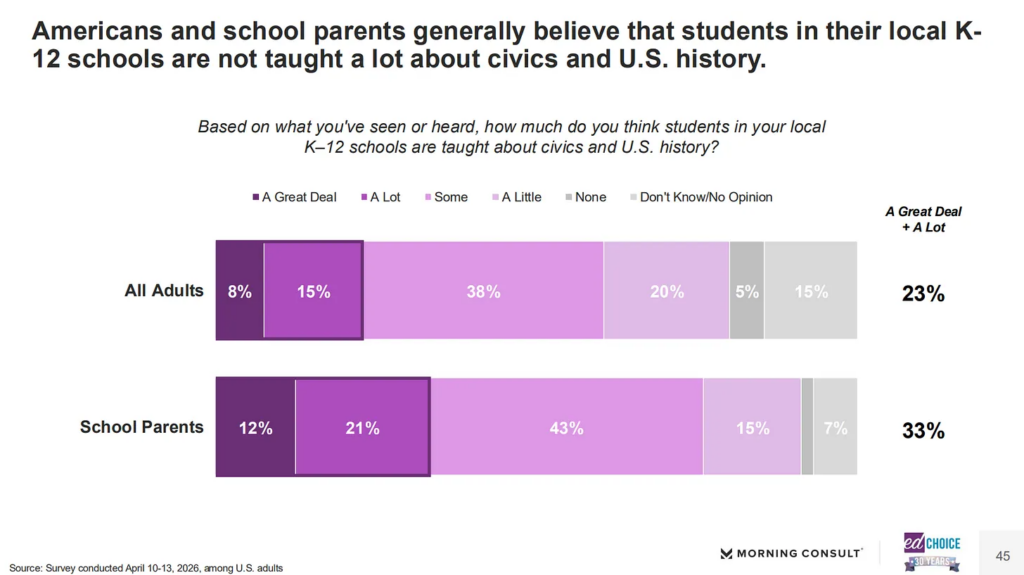
Yet only 23 percent of adults and 33 percent of parents say their local K-12 schools actually teach “a lot” about these subjects. A plurality believe students get only “some” history and civics.
To flesh out that support, the survey presented respondents with a list of social studies topics and asked them to weigh in on their importance.
Teaching students about citizen rights and responsibilities and the U.S. Constitution ranked highest, with over three-quarters of Americans calling them very important. Every topic offered drew at least 70 percent support.
The survey results show there is broad agreement about what students should learn. But how history and civics get taught isn’t just a matter of topic — it’s a matter of framing.
That is why Minnesota’s new social studies standards set to take effect this fall are so concerning. Their structure has shifted to a framework that centers power, oppression, identity, and “systems” across every grade and every social studies strand.
First graders are expected to “identify examples of ethnicity, equality, liberation and systems of power” and “construct meanings” for those terms, years before most are reading independently.
As fourth graders, students “identify the processes and impacts of colonization and examine how discrimination and the oppression of various racial and ethnic groups have produced resistance movements.”
By middle school, sixth graders examine how “discrimination based on race, gender, economic [status], ableism, and social group identity affects” Minnesotans, while seventh graders “examine the benefits and consequences of power and privilege” tied to poverty and wealth.
High schoolers will have to “develop an analysis of racial capitalism, political economy, anti-Blackness, Indigenous sovereignty, illegality and indigeneity.” And woven through every grade level is the expectation that students “understand the roots of contemporary systems of oppression” and “organize with others to engage in activities that could further the rights and dignity of all,” which reads more like a call to activism.
This isn’t to say civics and history have completely disappeared from the new standards. References to founding documents, federalism, and historical events remain. But that content now competes for space with an ideological framework attached to every grade and every strand — U.S. history, world history, economics, government and citizenship, and even geography, where a standard now requires students to analyze how “power structures” “influence” places and regions.
Minnesota may be the clearest current test case for what the EdChoice survey is picking up on.