USD 229 Blue Valley Gillian Chapman says teachers struggle to find affordable housing in the district, but instead of striking at the root of the self-inflicted problem, she formed a committee to explore housing options.
She says the lack of stable, affordable housing is “absolutely an issue in Blue Valley, one that I actually did not expect to encounter.” Ironically, it was just two years ago that Blue Valley and Olathe expressed pride in the high cost of housing in their districts, claiming it provided “a check on resident student growth” when opposing open enrollment. Then-superintendent Tonya Merrigan and Olathe superintendent Brent Yaeger didn’t want underperforming students from lower-income districts transferring in and tarnishing their reputation.
Chapman undoubtedly has good intentions, but the purpose of a school district is to improve student outcomes, and school boards can avoid problems like affordable housing by allocating resources to meet communities’ expectations for student proficiency. Unfortunately, that’s not how most districts spend taxpayer money.
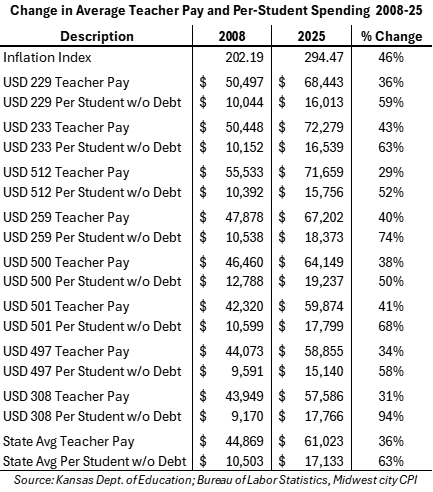 Data from the Kansas Department of Education shows that average teacher pay increased by 36% between 2008 and 2025, while inflation was 46%. At the same time, per-student spending net of debt payments jumped 63%.
Blue Valley saw a 59% increase in spending, but teacher pay is just 36% higher, and that upside-down logic is common.
Olathe has a 20-point spread, a 63% increase in spending, and a 43% pay increase. The spread in Wichita is 34 points (74% spending jump, 40% pay increase). It’s an astonishing 64 points in Hutchinson, where spending is up 94%, and teacher pay is just 31% higher.
Teacher pay didn’t keep up with inflation in every district we examined, not from a lack of funding, but because they spent a lot more money on things that don’t improve student achievement.
Research: students are better off in larger classes with effective teachers; affordable housing isn’t student-focused
A large body of research repeatedly shows that nothing has a greater impact on student performance than good teachers. In fact, students are better off in a larger class with an effective teacher than in a smaller class with an average teacher.
Research also shows no evidence that teacher education or performance on a certification examination contributes to quality teaching. Accordingly, school boards should pay teachers based on their effectiveness rather than on years of service or getting advanced degrees.
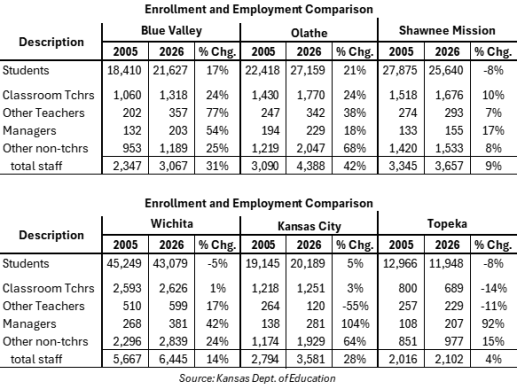
School boards that make improving outcomes their #1 priority can find the resources to raise pay for effective teachers by probing resource allocation. A few examples from the tables below include:
- Why is the employment of classroom teachers growing faster than enrollment? (Blue Valley, Olathe, Shawnee Mission, and Wichita)
- Are we meeting all of the instructional needs that teachers identify? (Every board member would know the answer to this one [“No”] if they conducted building needs assessments as required by state law.)
- The number of managers and other non-teaching positions is growing much faster than enrollment, so shouldn’t we reduce staffing in those positions and reallocate resources to classroom instruction? (Every district)
By the way, our Kansas School Board Resource Center (KSBRC) provides training on resource allocation, strategic planning, and other guidance to improve student outcomes, free of charge to state and local school board members.
It’s been said before, but it bears repeating at least once a week: Student outcomes won’t change until adult behaviors change… and dabbling in affordable housing isn’t the kind of change students need.
Affordable housing is a legitimate topic for city and county elected officials, and they can help by reducing property taxes and eliminating unnecessary, costly barriers such as zoning restrictions, permitting requirements, and other government-imposed barriers that increase housing costs.