TPS ruling and its effects
On June 25, 2026, the Supreme Court ruled to end Temporary Protected Status (TPS) for Haitian and Syrian immigrants, heightening concerns in immigrant communities and sparking the possibility of protections for other immigrant populations being ended as well. Not only is this directly affecting the everyday lives of about 356,000 people nationwide, but also the businesses who employ them. For example, in Massachusetts, about 2,000 direct care workers — which are professionals who provide hands-on assistance in everyday activities for individuals like the disabled — in Massachusetts are at risk of losing work authorization. There is even already a shortage of direct care workers in Massachusetts.
There are about 45,000 total TPS holders in the Commonwealth—a large portion of whom are Haitian. TPS holders may still qualify for other forms of immigration relief, like adjustment of status. But worry is still prominent in these communities, and to what extent they will be able to remain will impact the future of the labor force in America.
A decrease in immigration due to limitations
After the pandemic, the U.S. experienced an uptick in immigration, reaching a total net inflow of 10.5 million people from 2021 to 2024. But during the current Trump administration, policy changes have led to a huge drop in these numbers, including for skilled immigrants. In 2025, only 8.3 million applicants for immigrations were approved compared to 11.4 million in 2024—showing a stark 27% decrease. That decline represents more than a shift in immigration policy; it signals a contraction in the pipeline of workers that many industries have increasingly relied on to fill labor shortages, particularly as the U.S. population continues to age.
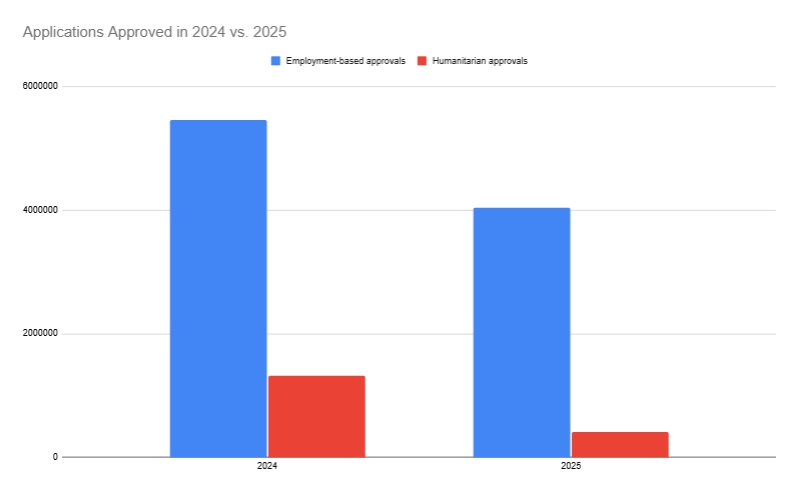
Figure 1: The amount of approved immigration applications in 2024 vs. 2025, data from the U.S. Citizenship and Immigration Services.
Immigration across all major pathways has declined. The humanitarian pathways — which are programs that provide protection and relief to individuals facing urgent crises — in particular, which includes refugees and asylum seekers, has been sharply curtailed. For fiscal year 2026, Trump’s administration capped admission at 7,500, which is significantly less than fiscal year 2024’s 100,000 people. International student visas dropped, backlogs got more clogged, and the front log peaked at almost 250,000 in 2025—numbers in immigration declined fast during Trump’s term.
The effect of declining immigration on states
The Census Bureau currently estimates that immigration could decline nearly 90% from 2024 to mid-2026. If those projections hold, immigration would contribute far less to population growth than it has in recent years, leaving states that depend on new arrivals to sustain their labor force particularly vulnerable.
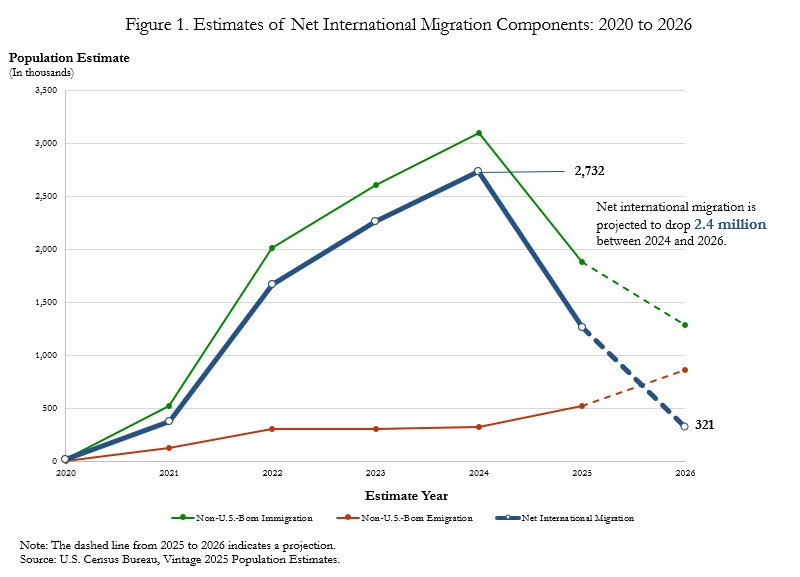
Figure 2: Estimates of net international migration components from 2020 to 2026 from U.S. Census Bureau.
Most vulnerable industries in Massachusetts
For Massachusetts specifically, the population is so dependent on immigration that it’s only growing because of it; if immigration fell to zero next year, it would likely lead to population decline. The Commonwealth loses tens of thousands of domestic residents each year and has one of the lowest birth rates in the country. With a labor force made up of roughly 25% immigrants, this can drastically disturb the Commonwealth’s economy. It’s estimated that 60,000 net new immigrants are needed annually to even maintain the current size of the working-age population. The top three industries that are vulnerable to decrease in immigrants include higher education and research, healthcare support, and construction.
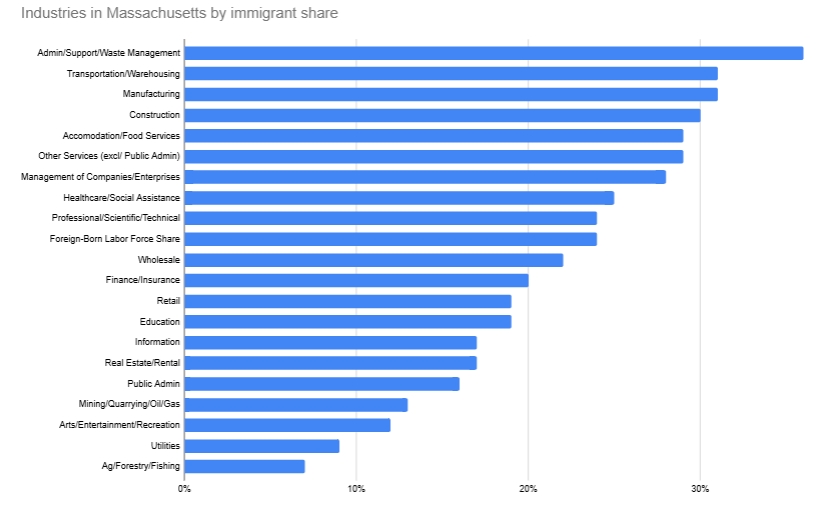
Figure 3: Industries in Massachusetts by immigrant share, data from IPUMS: American Community Survey.
These sectors already face persistent hiring challenges, meaning a sustained slowdown in immigration could make it more difficult for employers to fill vacancies and meet growing demand for services. Healthcare providers, universities, and construction firms all rely heavily on immigrant workers, making Massachusetts especially sensitive to changes in federal immigration policy.
Most vulnerable states
As of 2025, states with the highest levels of net international migration per 100,00 residents a year overall include—in descending order—Florida (761.53), Michigan (705.69), Washington (577.45), Massachusetts (562.48), and New Jersey (555.75). Because these states receive so many immigrants each year, their labor forces are the most vulnerable when it comes to the decline in immigration. Especially because most new immigrants tend to be working age. This is the reason why most of Massachusetts’ labor force gains in the last decade have come from immigrants.
The TPS ruling for Haitian and Syrian immigrants further weakens the U.S.’s talent pipeline and will limit the ability of businesses, and ultimately, state economies to grow. As immigration becomes a more limited opportunity, states like Massachusetts are left increasingly vulnerable to feeling the consequences not just in its community and population, but also its labor force.
Nina Argel is a Roger Perry Government Transparency Intern with Pioneer Institute. She is a rising junior and James Monroe Scholar at the College of William & Mary with a double major in Government and English.