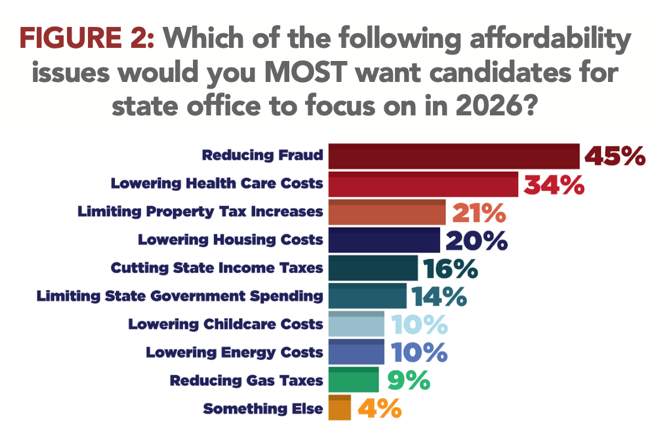
Primary Election Day in Minnesota is Tuesday, August 11. And the top policy issue for voters, as last week’s poll in Thinking Minnesota confirmed, is affordability. The intertwined state policies of energy, environment and natural resources impact on six of nine affordability issues identified in the graphic below: property taxes; housing costs; income taxes; government spending; energy costs; and gas taxes.
Let’s examine a sample of “the Good, the Bad and the Ugly” of energy policy platforms, for both the Minnesota Democratic-Farmer Labor Party (DFL) and Republican Party of Minnesota (GOP), as well as “the bold and the beautiful.” These platforms are rated, not from a partisan DFL or GOP perspective, but from one of sound economics and common sense.
The Good
The GOP‘s “2026 Official Party Platform” states under the heading of “Promote Economic Prosperity” that:
“We support the repeal of all carbon-free electrical mandates and any other renewable energy mandates enacted by the Minnesota Legislature.”
This is good because expensive renewables, have not only been inflating electricity prices and restricting electricity use in the 21st century, unreliable renewables have also been crowding out natural gas from residential, commercial and industrial customers in favor of (peak- and base-load) electric power generation.
The Bad
The DFL‘s “Ongoing Platform” states under the “Energy & Climate” heading that:
“We believe in safe, sustainable, and secure energy sources that offer coming generations access to fuels and power.
We Support: Increased use of renewable energy sources.”
This is bad because renewables are, not only expensive and unreliable, but also not safe, sustainable nor secure, as Shattered Green Dreams clearly demonstrated in June 2025, including that: “wind and solar power are not environmentally benign, and their widespread adoption entails significant ecological and material costs.”
The Ugly
The DFL platform also states the following under the headings of “Energy & Climate” firstly and then “Natural Resources & The Environment” secondly that:
“We Support: Aggressive energy conservation in transportation, commercial, industrial, residential, and governmental sectors.”
“We Oppose: Nuclear power, as it is not a viable energy source.”
This is ugly because, not only would lifting the state ban on new nuclear power plants make available a viable energy source and make unnecessary aggressive energy conservation, the party’s opposition to nuclear power flies in the face of the bi-partisan supported study which was signed off by the DFL’s own MN Governor Tim Walz on May 27.
The Bold
The GOP platform states under the “Enjoy and Protect our Natural Resources” heading that:
“We oppose policies and mandates based on the Theory of Man-Made Global Warming, as well as any energy policies arising from it.”
This is bold because most Republicans, prior to Trump 2.0, especially in blue or purple states, have been very reluctant to challenge this theory. It is at best a weak theory, and at worst an aggressive religion or worldview, one that combines emotive paganism and close-minded scientism. Even the UN has recently backed-off “the most extreme scenarios [of this theory] that have dominated climate research over much of the past several decades.”
The Beautiful
The GOP platform further states under the heading of “Enjoy and Protect our Natural Resources” that:
“We support a free market for all energy and oppose government mandates, subsidies or monopolies.”
This is beautiful because free-market competition is always the first-best regulator of the price, quantity and quality of goods and services, even those presumed to be natural monopolies. If a monopoly, like Excel Energy, were truly natural then there would be no need to legally protect them from competition as a franchise monopoly.
“It is a myth that natural monopoly theory was developed first by economists and then used by legislators to ‘justify’ franchise monopolies. The truth is that the monopolies were created decades before the theory was formalized by intervention-minded economists, who then used the theory as an ex-post rationale for government intervention. When the first government franchise monopolies were being granted, the large majority of economists understood that large-scale, capital-intensive production did not lead to monopoly, but was an absolutely desirable aspect of the competitive process.” – The Myth of Natural Monopoly: The Case of Railroads
Conclusion
Interestingly, the GOP platform only refers to “affordable” once, in the context of health care, whilst the DFL refers to this word five times, in the context of housing, education, health care, public utilities and transportation. The latter two were under the heading of “Racial, Ethnic, Gender, LGBTQ+, & Economic Justice” including a call for “healing and reparation.”
In conclusion, I paraphrase first the DFL then the GOP, from an energy policy perspective:
“Healthy democracies identify, challenge, and dismantle prejudicial social and economic systems that exploit some groups [e.g. residential, commercial and industrial energy users] while assigning power and privilege to others [i.e. energy activists, bureaucrats and monopolies].”
“We [should thus] support lowering the [new nuclear power ban] burden, exercising [renewable energy mandate] restraint, and creating and maintaining a fair, honest and competitive [energy supply market] to promote economic prosperity.”
Source: Starship Troopers (1997)
The following links below provide more information on both the MN GOP and DFL platforms as well as the five major MN gubernatorial candidates: