Earlier this year on March 5, the Center of the American Experiment (CAE) launched a public campaign to end the moratorium on expanding nuclear power in Minnesota. This was called “Nuke the Mandate, Free the Nukes!” As CAE put it then:
“The campaign…features billboards, TV ads during the high school hockey and basketball tournaments, radio and podcast advertising and social media promotion. The TV ad focuses on the fact that Minnesota is just one of nine states to ban the expansion of nuclear power, the cleanest form of energy.”
Things have moved quickly since. The legislature approved of a bill to fund a Minnesota Nuclear Energy Study on May 17, which was signed into law by the governor on May 27. The study kicked off on July 1 by the Great Plains Institute (GPI), who are seeking public input between August 14 and September 14. The study ends by January 30. GPI states that:
“The study…will reflect a balanced representation of perspectives [and] inform policymakers regarding the potential impact of new nuclear generation on the public interest of Minnesota, including affordability, reliability, environmental protection, and public health.”
GPI has a website devoted to a Request for Information (RFI) for this study. One can either upload a response document or enter responses by topic area in the online form. GPI also has a different website with further information on the study. Responses must be submitted by 11:59 p.m. CT on September 14, 2026. In the meantime, questions about this RFI may be submitted by email to GPI at [email protected].
Affordability
Two common ways to look at electricity affordability is by ranking prices across states and tracking that over time within one state. Both are valid. Tracking is more tangible, as it relates to a ratepayer’s past, present and likely future bills. Ranking is less tangible, as it is a ratepayer’s counterfactual for the past and present, and a future possibility if one were to move interstate one day.
Nevertheless, in April 2026, the American Legislative Exchange Council (ALEC) ranked Minnesota 32nd amongst the 50 states in the 5th edition of the ALEC Energy Affordability Report. That being 12.35, which is an average retail price in cents per kilowatt hour. ALEC documented MN’s generation mix as: fossil fuels (47%); renewables (29%); and nuclear (20%).
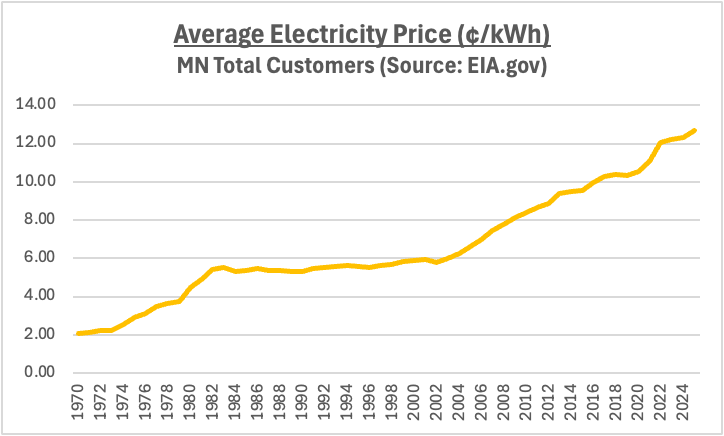
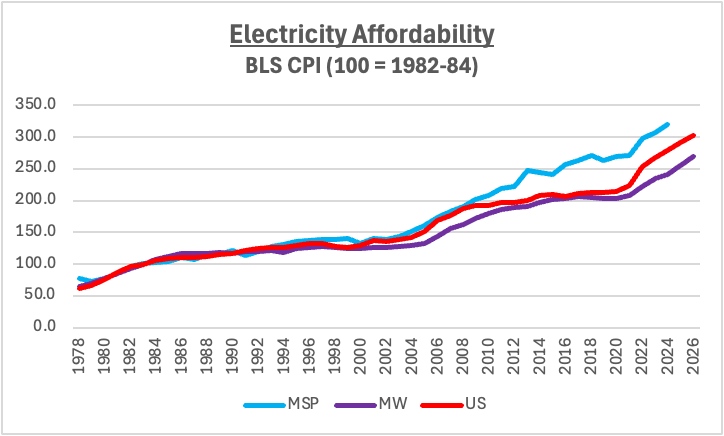
In summer 2026, I tracked electricity prices over time, on behalf of CAE, as follows:
- average electricity price (AEP), which increased 118% from 2002 to 2025 (i.e. 5.80 to 12.67), as per the first chart below;
- consumer price index (CPI), which inflated 131% from 2002 to 2024 (i.e. 139 to 321 points), as per the second chart below;
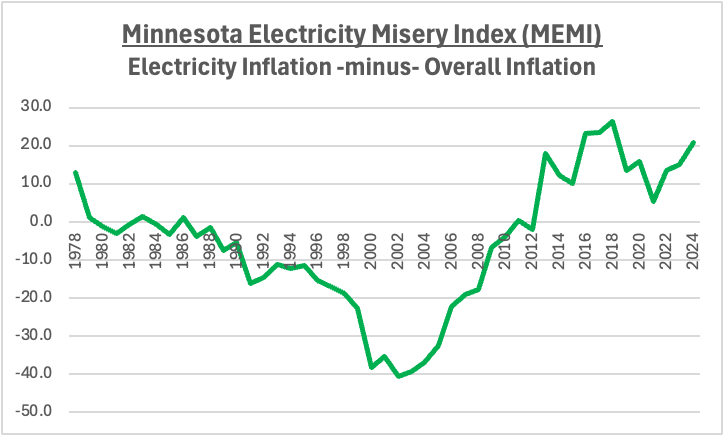
- electricity misery index (EMI), which climbed 67 points from 2002 to 2018, as per the third chart below, the equivalent of 165% worth of extra electricity CPI inflation on top of overall CPI inflation.
Environment
CAE released a landmark report in June 2025 on the environmental costs of renewables (e.g. wind and solar), versus that of fossil fuels (e.g. coal and natural gas) and nuclear, entitled Shattered Green Dreams. Highlights from this report, authored by former CAE policy fellow Sarah Montalbano, who is now with Always On Energy Research (AOER), include:
- Debates about the feasibility and desirability of an “energy transition” should include the negative impacts of wind and solar. If voters and policymakers decide the benefits outweigh the costs, it should only be done with a clear accounting of both.
- A wide variety and large quantity of minerals are used in solar panels, wind turbines, battery storage, transmission lines, and more. The US currently sources most of its minerals from foreign countries that do not adhere to modern environmental or worker health and safety standards.
- The low electricity density of wind and solar generation means that they require at least 10 times as much land per unit of power produced as coal or natural gas-fired power plants. If the US were powered entirely by wind turbines, the land area necessary would exceed two Californias.
- Large land use footprints exacerbate habitat loss and disruption to wildlife. Evidence is growing that offshore wind turbines are disruptive to whale populations and wind turbines strike bird and bat populations. Habitat fragmentation disrupts nesting, migration, and wintering activities of some species.
- Some components in wind turbines and solar panels are hazardous. Current recycling pathways are uneconomic and underutilized, which means that decommissioned wind turbines and solar panels often end up in landfills.
- The operating lifespan of wind turbines and solar panels is between 20 and 25 years at maximum, while natural gas plants may operate for 40 years, and nuclear plants operate between 40 and 80 years. Decommissioning and repowering wind and solar energy is required more often than other forms of electricity generation, compounding costs.
- A hypothetical US grid powered by nuclear plants would have the lowest material requirements. Simplified estimates suggest that US electricity demand in 2026 could be met through 464 1-GW nuclear plants alongside natural gas peaking. This would use only 12,811 tons of uranium for fuel annually and generate only 371 tons of high-level waste for the entire US.
Reliability
Another important CAE piece was published in April 2025 on the Levelized Cost of Blackouts. Highlights from this piece, authored by two other former CAE policy fellows of Isaac Orr and Mitch Rolling, who are also both now with AOER, include:
- The most common measure used to estimate the value of lost electric service is called the Value of Lost Load (VOLL), which can be thought of as a customer’s willingness to pay to avoid losing electricity for a given period of time. VOLL can be as low as $11/kWh for residential customers and up to $67.78 per kWh for commercial and industrial users.
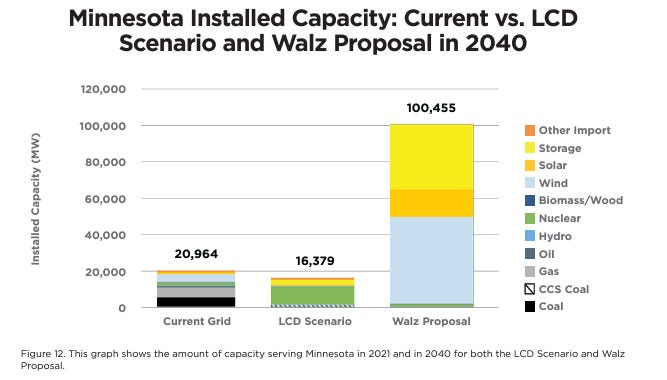
- The first chart below shows that electricity generation capacity in 2021 of 20,964 MW, using a mix of renewables, fossil fuels and nuclear, was projected to increase by 379% to 100,455 MW, driven entirely by renewables (i.e. wind, solar and storage).
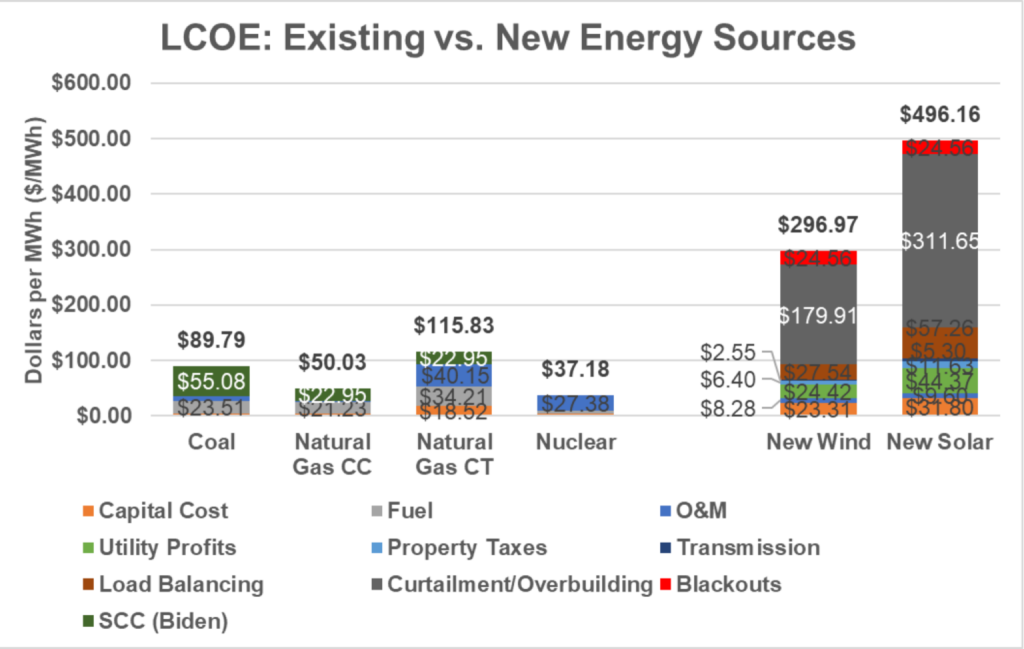
- The second chart below shows the Levelized Cost of Blackouts (LCOB) for new wind and solar sources, as one average figure over time, of $24.56 per MWh.
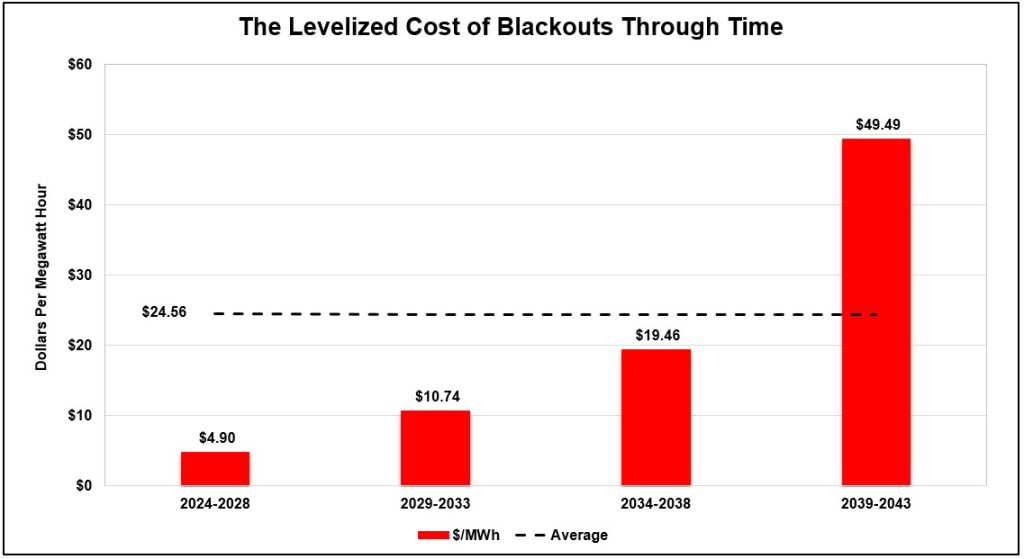
- The third chart below shows how the Levelized Cost of Blackouts (LCOB) increases throught time, compared to that average of $24.56 per MWh. In 2024-2028, it is $4.90. In 2029-2033, it increases by 119% to $10.74. In 2034-2038, it rises by 81% to $19.46. In 2039-2043, it skyrockets by 154% to $49.49.
- The second chart below also shows the Levelized Cost of Energy (LCOE), where nuclear at $37.18 per MWh is: 26% less expensive than combined cycle at $50.03; 59% less expensive than coal at $89.79; 68% less expensive than natural gas at $115.83; 87% less expensive than wind at $296.97; and 92% less expensive than solar at $496.16.
Warning
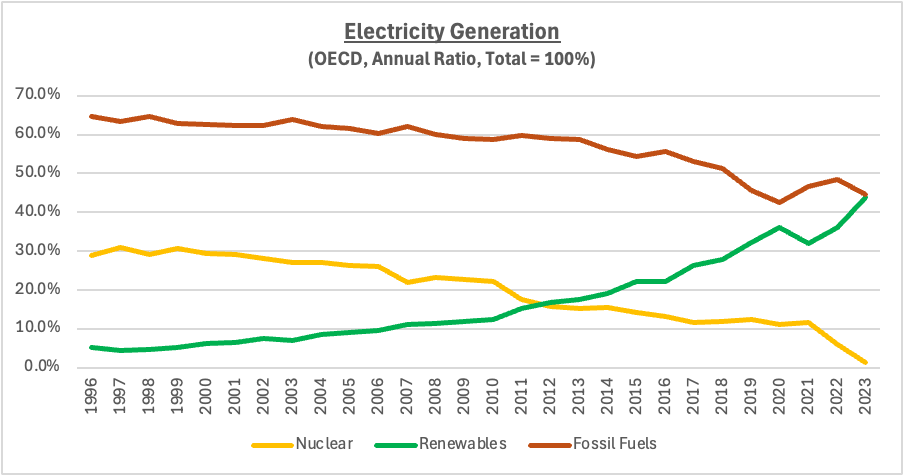
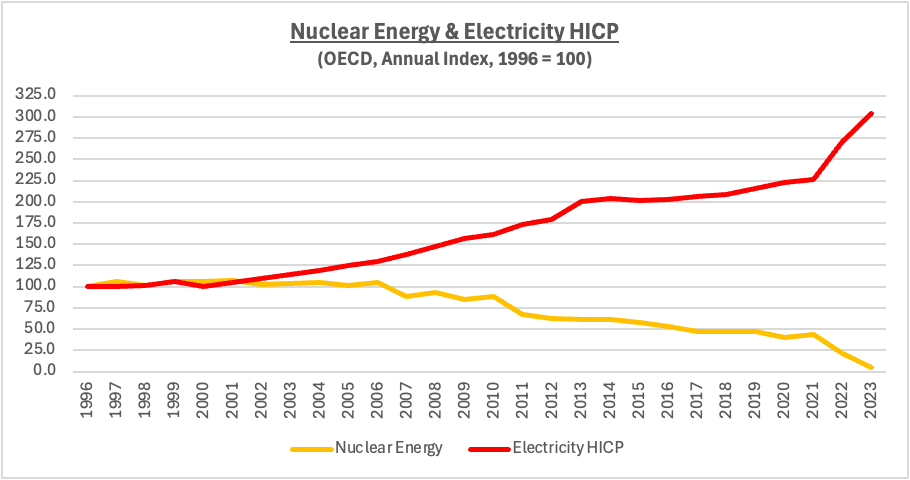
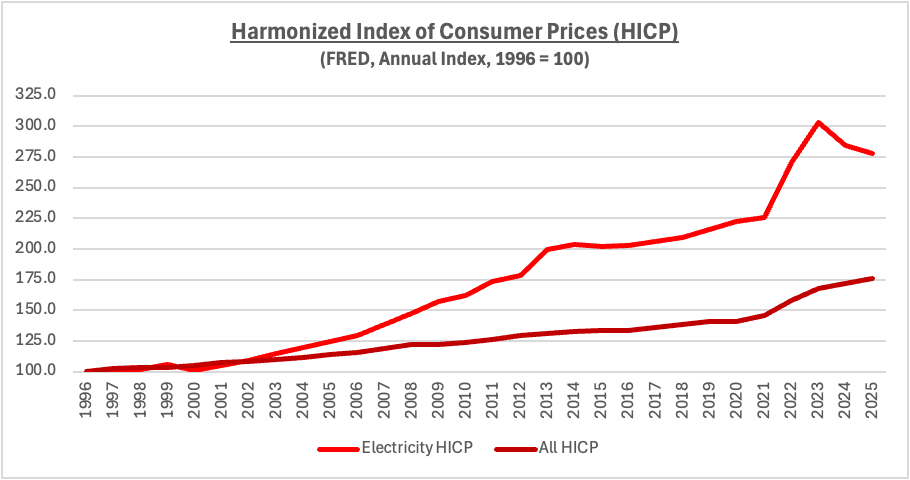
My first article for CAE provided a warning for Minnesota: Germany’s nuclear energy regrets. That showed what happens when nuclear is, not just held constant as renewables take over, but when the former are removed from the grid entirely. Highlights from this article include:
- The first chart below shows the declines in the electricity generation source ratios of both fossil fuels and nuclear as well as the rise of renewables. The nuclear ratio is significantly reduced from 30% in 1996 to 20% in 2010. It then falls to 10% in 2021 and collapses to 0% in 2023.
- The second chart demonstrates how prices are driven by marginal costs not total costs. Relatively cheaper nuclear, compared to renewables, declines every year from 2006 to 2023, 104.5 to 4.5 or 96%, thus inflating electricity Harmonized Index of Consumer Prices (HICP) by 135% from 129 to 303.
- The third chart illustrates electricity prices pulling up all HICP prices in the 21st century. The former goes from 100 in 2000 to 303 in 2023 or 203%, with the latter going from 105 to 167 or 59%. Electricity, as an input into everything, fuels cost-push inflation, just as currency inflates demand-pull inflation.
Conclusion
Germany should have properly applied the precautionary principle and not shut down nuclear power. Minnesota needs to heed this warning and, thus, focus on the opportunity costs, benefits and risks of failing to allow nuclear to meet this states economic, environmental and social wants and needs. Therefore, old and new nuclear should be rebuilt and built in both Germany and Minnesota.
This conclusion is reinforced by what the legendary economist Julian Simon once wrote:
“Nuclear power is fundamental to a discussion of energy because it establishes the long-run ceiling to [efficient and reliable] energy costs. No matter how much any other source of energy costs us, we can turn to nuclear power at any time to supply virtually all our energy needs for a very long time.”
“The opposition to it is mainly ideological and political. … The aim of [which] is not increasing the availability of energy and consumer benefits, but decreasing the use of energy for supposed environmental gains and beliefs about the morality of simple living.”