The Article 48 amendment to the Massachusetts constitution gives citizens the power to propose laws and constitutional amendments, and to seek repeal of existing laws. So why, a century after its passage, are Beacon Hill leaders bellyaching about the ballot initiative process now?
Earlier this year, House Speaker Ron Mariano lamented that Massachusetts could overdo it with ballot initiatives, which are “fraught with peril,” and risked making the Bay State “look like California with 24, 25 questions on every ballot.” Senate President Karen Spilka complained that ballot initiatives are “all sponsored by special interest groups.” After spending days in Special Joint Committee on Initiative Petitions hearings, Rep. Michael Day accused paid signature gatherers and campaign spending of “perverting what the process is supposed to be.”
Nine ballot questions! Can you believe that? Surely 9 questions are wildly out of proportion with Massachusetts history. To quote a certain orange-haired world leader, unprecedented!
The first figure, which presents the number of statewide ballot questions from 1970 to 2024, merits its title: “Hogwash!” Massachusetts voters faced nine statewide questions in 1972, 1976 and 1994; and eight in 1986 and 2000. This year’s ballot may be the busiest in 32 years, but 2026 is no anomaly.
Figure 1. Hogwash! Statewide ballot questions, 1970-2024, by biennial election
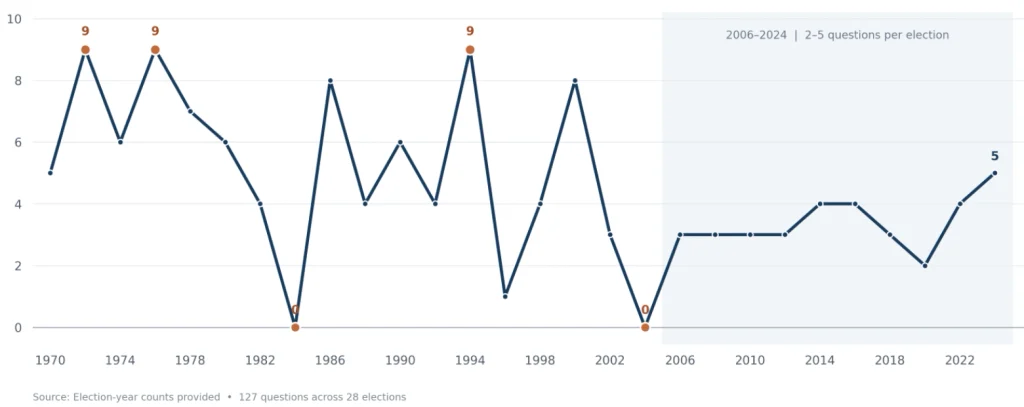
From 1970 through 2000, voters faced 90 statewide questions, or just under 6 per election. Over the last quarter century, they have faced 37, or 3 per elections. No election since 2006 has featured more than five questions. Nine questions in 2026 is unusual only by recent standards.
The second figure provides more data on the questions, including winners and losers, as well as the number of nonbinding questions put before the voters from 1970 to 2024. The figure tells us something important: Voters aren’t rubber stamps. Over the arc of 54 years, Massachusetts voters faced 127 statewide ballot questions, 10 of which were non-binding. Of the 117 binding questions, 69 passed and 48 failed—a rejection rate of 41 percent. In 1978, they approved all seven; in 1988, they rejected all four. In 1994 and 2000, they split their decisions almost evenly.
Figure 2. Massachusetts Voters Aren’t Rubber Stamps: Ballot Question Results, 1970–2024
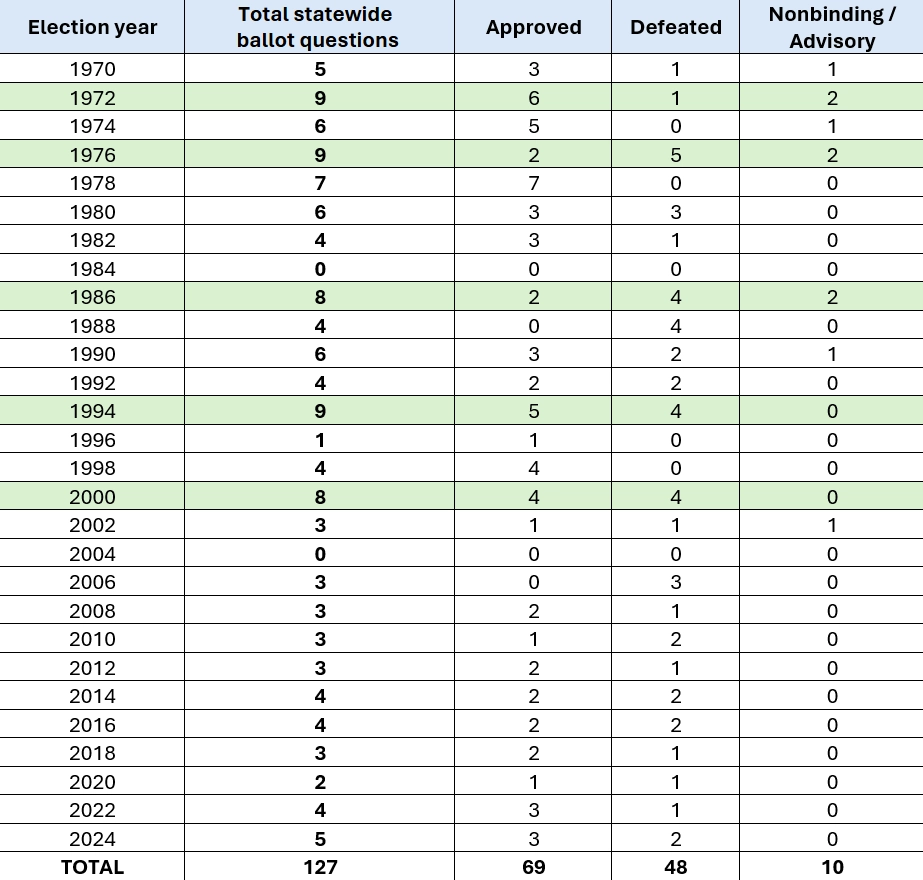
Source: Massachusetts Secretary of State. Pioneer reviewed each statewide ballot question from 1970 through 2024, question by question. Totals include binding and statewide advisory questions.
When Beacon Hill Doesn’t Act: 1986, 1994 and 2000
Not every crowded ballot reflected citizens going around Beacon Hill. Seven of the 9 questions in 1972 were constitutional amendments advanced by the Legislature itself. Other peak years—1986, 1994 and 2000—tell a very different story.
In 1986, Citizens for Limited Taxation and the Massachusetts High Technology Council proposed limiting growth in state tax revenues to the growth in taxpayers’ wages and salaries. The House rejected the initiative; the Senate took no vote. Supporters collected the additional signatures needed to reach the ballot, and voters approved the measure 54 to 46. The measure became Chapter 62F, the tax-limitation law a 2026 ballot question seeks to strengthen.
Nine questions went before voters in 1994—7 of which were citizen initiatives and two referenda on laws enacted by the Legislature. Every one of the questions was citizen-driven, and they included term limits, rent control, taxes and campaign spending. Voters approved term limits and abolished rent control, among other decisions.
In 2000, voters faced eight questions, including an initiative to roll the income tax rate back to 5 percent. The Legislature chose not to consider or vote on the tax proposal. Voters passed it.
These sorts of fights are precisely why Massachusetts adopted the initiative process. Massachusetts has a long history of citizen protest against political institutions that ignore their concerns, from the Stamp Act riots to the Boston Tea Party. Article 48 was a Progressive Era answer: Give citizens a safety valve—an additional legislative route when Beacon Hill won’t act.
And getting a question on the Massachusetts ballot takes hard work and popular support. As Pioneer documented in September, the Commonwealth has one of the nation’s more restrictive initiative processes.
2026: Eight Citizen Initiatives. Zero Legislative Votes.
Eight of this year’s 9 ballot questions are citizen initiatives, covering issues ranging from public records and all-party primaries to zoning, marijuana and taxpayer rebates. (Q9 is different: It asks voters to repeal the firearms law the Legislature passed in 2024.)
The initiative process gives legislators months to act after supporters collect the first round of signatures. For 2026, that meant almost 75,000 certified signatures to put a proposed law before the Legislature. If lawmakers failed to enact it by early May, supporters needed another 13,000 signatures to reach the ballot. Beacon Hill could have chosen to act on any one of these questions through its own deliberative process. But as the official Voter Guide makes clear for all eight: “no vote was taken by the Senate or the House of Representatives before May 6, 2026.”
“Reform” the Ballot Process or Leave It Alone?
Building on Senate action to propose new disclosure rules, the House has voted to create a special legislative commission to review—and, gulp, reform—the statewide initiative petition process. Recommendations on the constitutional amendments are due at the end of 2027. All of this has been proposed in the context of legislative leaders’ consternation at seeing a heightened level of ballot initiative activity.
There are reforms worth making. Pioneer has proposed two: Give citizens more time to collect signatures, reducing their dependence on paid signature gatherers; and create a way to challenge inaccurate ballot summaries produced by the Attorney General and to resolve constitutional questions before voters begin casting their ballots.
Nine ballot questions are hardly a historical anomaly. Article 48 isn’t broken. It isn’t an end run around the constitutional process—it is the constitutional process. And it’s doing what it was meant to do: Give citizens another route when the Legislature is asleep at the wheel.