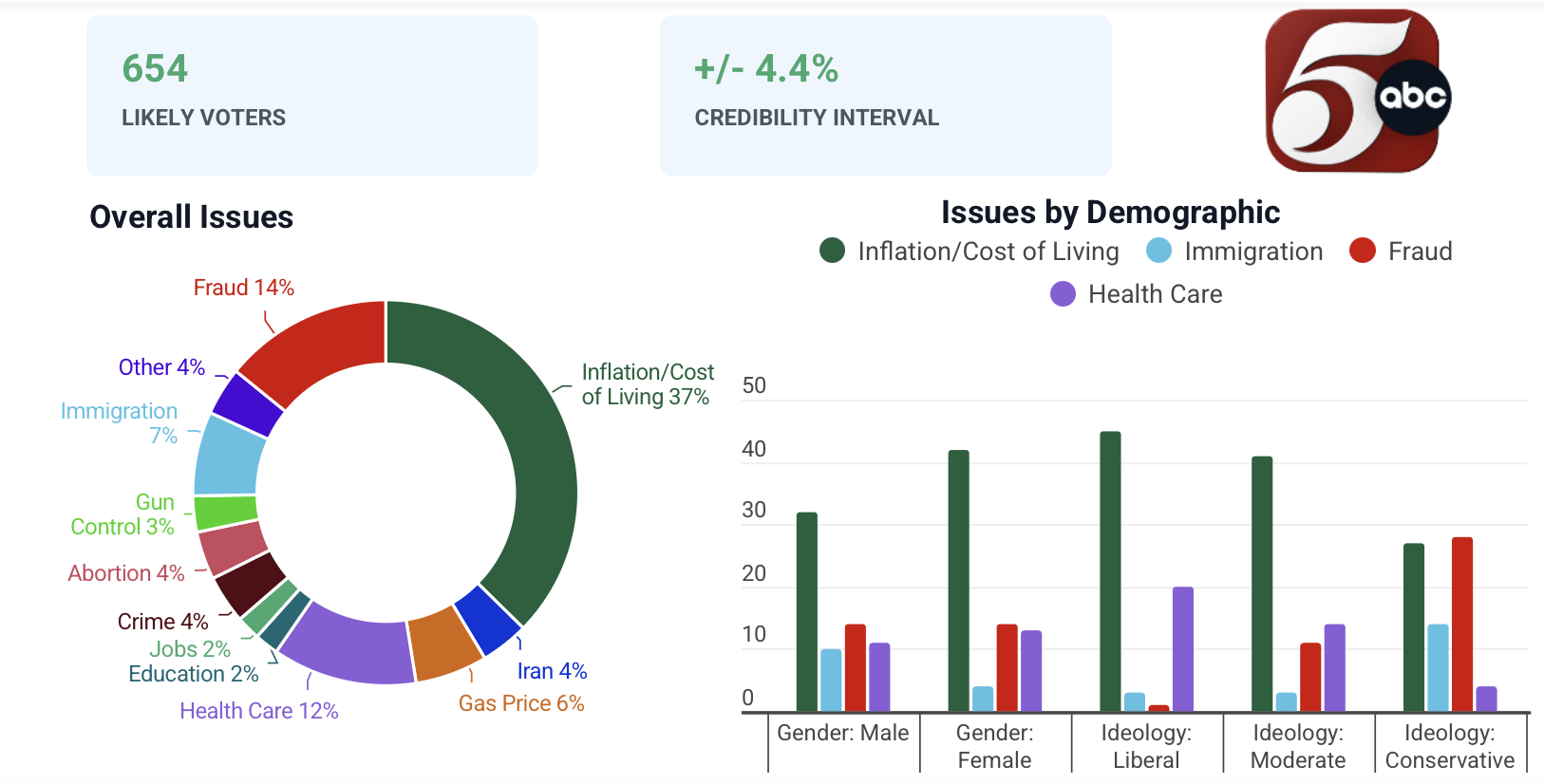
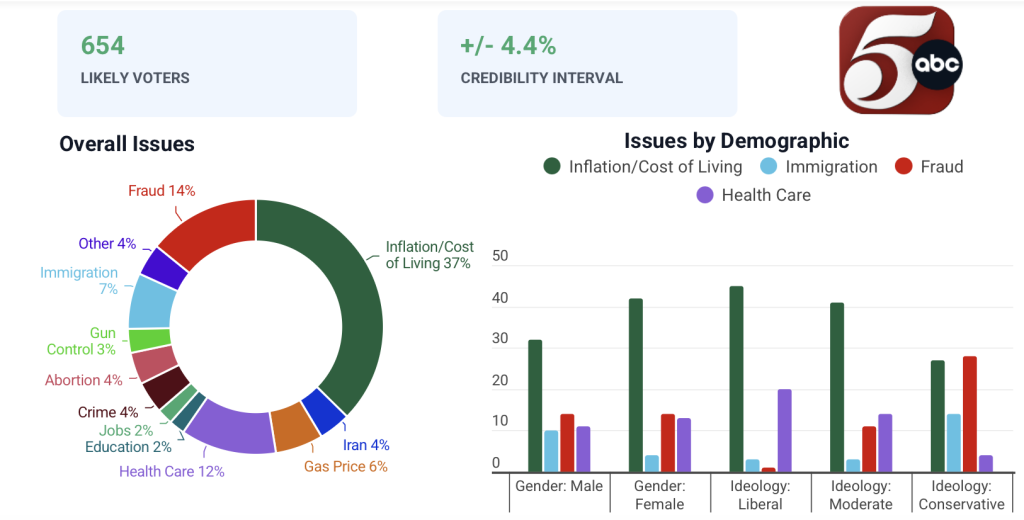
A KSTP/SurveyUSA poll was released on September 17, 2026 showing that inflation/cost of living is the most important issue to 37% of Minnesota voters as a whole. This is top for 41% of women and 32% of men as well as 45% of liberals, 41% of moderates and 27% of conservatives.
This poll is consistent with American Experiment’s polling, as I wrote about on July 30, 2026 in The Good, the Bad and the Ugly: the 2026 energy policy platforms of the DFL and GOP:
The top policy issue for voters is affordability. The intertwined state policies of energy, environment and natural resources impact on six of nine affordability issues identified [of]: property taxes; housing costs; income taxes; government spending; energy costs; and gas taxes.
The rest of that article examined the energy policy platforms of Minnesota’s DFL and GOP. These platforms were rated by me, not from a partisan perspective, but from one of sound economics and common sense. I was unaware at that time of the DFL’s Minnesota Values Project Policy Agenda 2027. I examine that next, using official data and sound economics.
Energy Affordability Context
I provided important energy affordability context on September 10 in Renewables raise electricity prices, official federal statistics corroborate and on September 3 in Nukes and natural gas: End two bans, for the price of one. Four charts are reproduced again below.
- Chart 1 shows Twin Cities (MSP) electricity inflation taking off from 2002, separating above the rest of the US after 2008, and well above the Midwest (MW) thereafter. For 2002-2024, MSP increased 131% versus 92% for MW and 105% for US. Source: BLS CPI.
- Chart 2 shows MSP electricity inflation well below, but rising up from 2002 to overtake, MSP general inflation from 2012 onwards. For 2002-2024, MSP electricity increased 131% versus 67% for MSP general. Source: BLS CPI.
- Chart 3 shows Minnesota state (MN) electricity inflation also taking off from 2002, and leaving natural gas prices well and truly in the dust. For 2002-2025, MN electricity increased 118% versus -9% for MN natural gas. Source: EIA average prices i.e. not CPI.
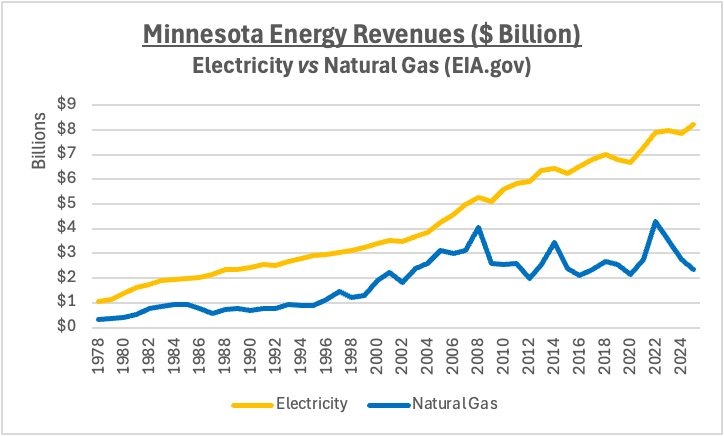
- Chart 4 shows MN electricity revenue taking off from 2002 versus MN natural gas revenue. For 2002-2025, MN electricity increased 131% (from $3.6 to $8.3 billion) versus 27% (from $1.9 to $2.4 billion) for MN natural gas. Source: EIA.
Note that Minnesota’s renewables push started in 2001 (i.e. “voluntary” REO) and then was greatly enhanced in 2007 (i.e. mandatory RES). Thus, electricity inflation, in terms of CPI, prices and revenues, subsequently and sustainably rose from 2002 and 2008 respectively.
Chart 1
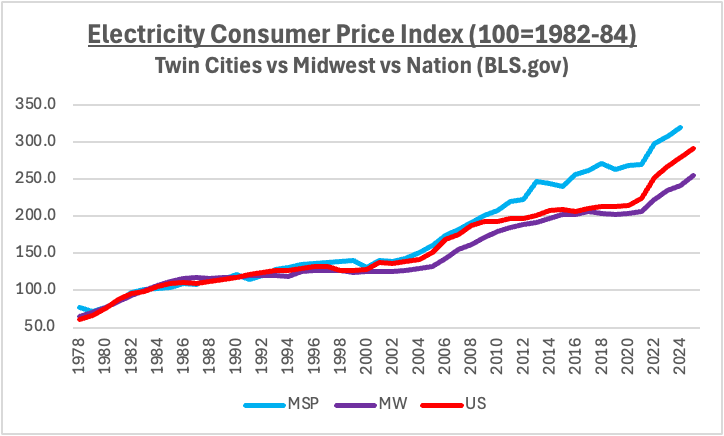
Chart 2
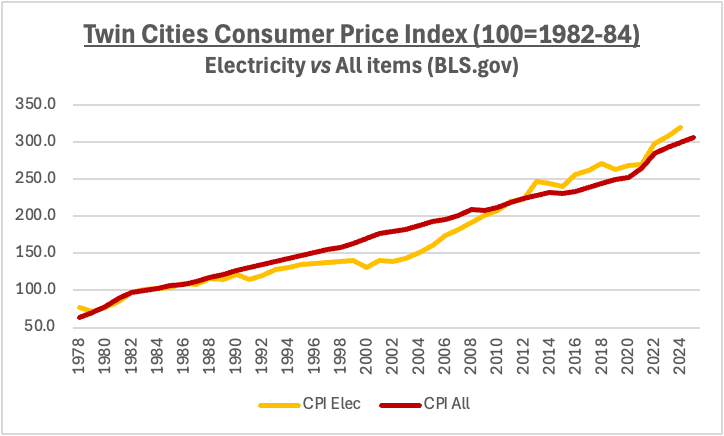
Chart 3
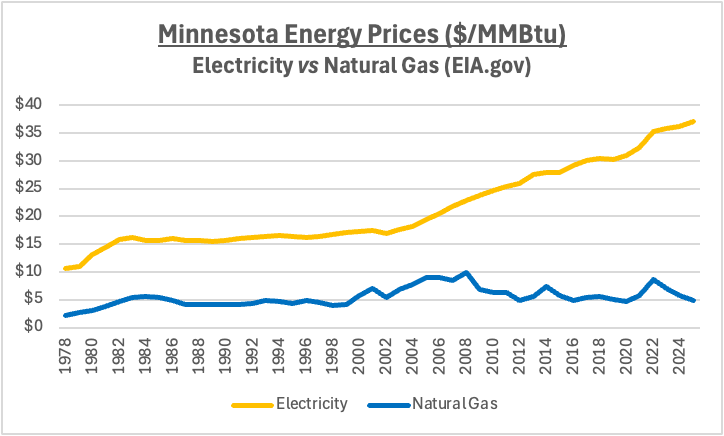
Chart 4
Energy Affordability Policies
In Minnesota, we already have the cold to deal with, and now gas prices are soaring while large corporations bring in huge profit margins. We’re fighting for a better deal.
Gas above probably means gasoline and not natural gas. NYU shows that oil and gas profit margins are 8.3%, which is below both total market of 9.7% and public utilities of 14.2%. The bigger concern, however, is that the DFL supports banning natural gas use for Minnesotans.
We have policy solutions on the table that both decrease prices while moving to cleaner energy so our kids can have a future without the disastrous effects of climate change.
Even if climate change were human-driven and disastrous, which it is not, the DFL’s policies are still for renewables, and against nuclear, which does not decrease but increase prices. However, there is a current bipartisan study looking to possibly end the nuclear moratorium.
We want to cap late fees on utility bills – as prices are increasing, there needs to be reasonable limits on huge late fees families can experience while they adjust.
Although the above is only a band-aid solution to the gaping-wound problem of wind-driven inflation since 2002, this policy is acceptable given public utilities like Xcel are PUC-regulated franchise monopolies that earn supernormal profits well above that under competition.
We’re ready to invest in weatherization and clean heat for both homes and small businesses that will help families update their buildings, use less energy, and decrease costs.
Ratepayers are forced to “invest,” under the NGIA (Natural Gas Innovation Act), in inefficient and ineffective technologies like “geothermal heat pumps that can result in four times the usage of electricity in winter,” in MN where electricity is 7.6 times more expensive than NG.
We want to save ratepayers money by removing the ability for utilities to charge ratepayers for lobbying and CEO pay, following the lead of Colorado.
I have some sympathy for this given public utilities like Xcel are PUC-regulated franchise monopolies and thus are not competitive, efficient or innovative. However, in 2025, $7.6 million for Xcel’s top ten executives was 0.09% of $8,326 million of MN electricity revenues.
To continue to be a leader on climate and clean energy jobs, we will work to ensure Minnesotans have energy-efficient homes and buildings, and access to clean vehicles.
Clean energy jobs are largely driven by regulatory mandates. Such “regulatory inflation thus breeds armies of ‘box tickers’ and auditors whose function is to exist.” Regulatory inflation, in general, leads to regulation costs per US household of $15,859 per year or 20% of all expenses.
Energy Affordability Election
KSTP/SurveyUSA also released a poll on September 16, the day before the election issues poll. This was about the race for MN Governor and the US Senate that showed:
“Just days before the start of early voting in Minnesota, the gap between Amy Klobuchar and Lisa Demuth, and the one separating Peggy Flanagan and Michele Tafoya are narrowing as the battles for governor and US Senate heat up.”
This means there are some real choices to be made on the first Tuesday of November 3, in this long-time Blue State, regarding affordability and especially energy affordability.
Given that, before one votes DFL, GOP or for another party, as an anti-inflation economist, be aware that three energy policies in particular will dramatically increase affordability in MN:
Source: KSTP/SurveyUSA