Is AI really taking jobs?
Currently, Tufts University’s American AI Jobs Risk Index projects that 9.3 million U.S. jobs are at risk of displacement in the next two-to-five years, with an associated $757 billion in household income at risk. The study focuses particularly, on “Wired Belt” metros, tech-heavy, knowledge-industry hubs such as Silicon Valley, Washington D.C., New York, and university towns like Durham-Chapel Hill and Boulder, which the researchers identify as most vulnerable to AI-driven job loss. With new technology comes new behaviors in the employment market, and employers are readjusting to this innovation.
The industries at the highest risk of job displacement include information, finance and insurance, and professional, scientific and technical services. These jobs account for about 7.5% of total labor income from wages and salaries, creating an alarming rate of displacement for many of the nation’s high-skilled workers. Big cities face the highest risk compared to more suburban and rural regions.
In the next two-five years, states projected to be impacted by the most absolute job and income losses include California, Texas, New York, Florida, and Illinois. The trend of about four out of 10 AI job losses are projected to occur in those states. However, the most vulnerable state proportionally is Massachusetts which is estimated to lose more than 260,000 jobs — or about 7.35% of it’s total employment.
Massachusetts: the most vulnerable state
From 2022-2025, employment in Massachusetts’ most vulnerable industries shifted from growth to decline. Employment grew by over 6 percent every quarter from Q2 2021 to Q1 2023 before becoming negative and leading to significant job losses in each quarter from Q3 2023 to Q3 2025. These data display a trend of less employment in these vulnerable industries, which could suggest a drop in demand for the roles.
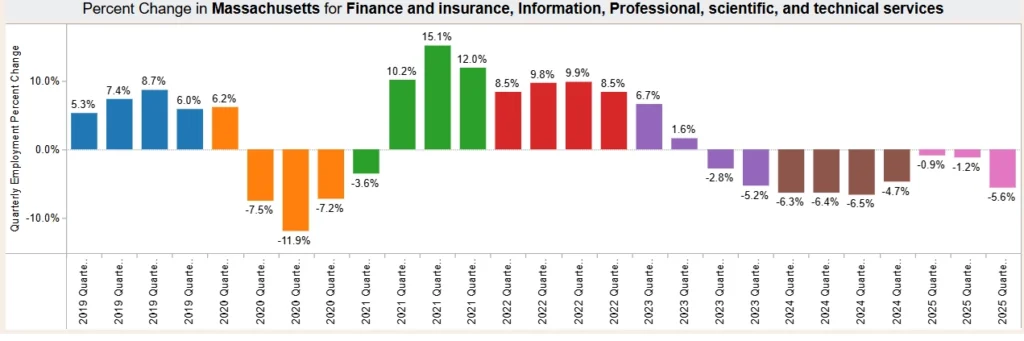
Figure 1: The employment percentage change in the most vulnerable industries to job displacement in the state of Massachusetts from U.S. Data Labs.
Hesitancy of employers to hire workers in AI-vulnerable fields
Not only is there a declining employment trend in Massachusetts’s vulnerable industries, such as information, finance and insurance, professional, scientific and technical services, but there is also a shift in job postings toward roles that can become even more efficient through human and AI collaboration. Following the launch of ChatGPT in November 2022, automation-prone roles fell by 13% nationally, while the demand for augmentation-prone roles grew by 20%. This shift suggests that employers are redirecting hiring toward roles that can benefit from a partnership between humans and AI.
While employers are growing reluctant to hire people into roles AI can replace, causation cannot be confirmed from these data alone. The question that will shape the future is whether that hesitancy reflects avoidance or a pivot toward a more AI-integrated workforce.
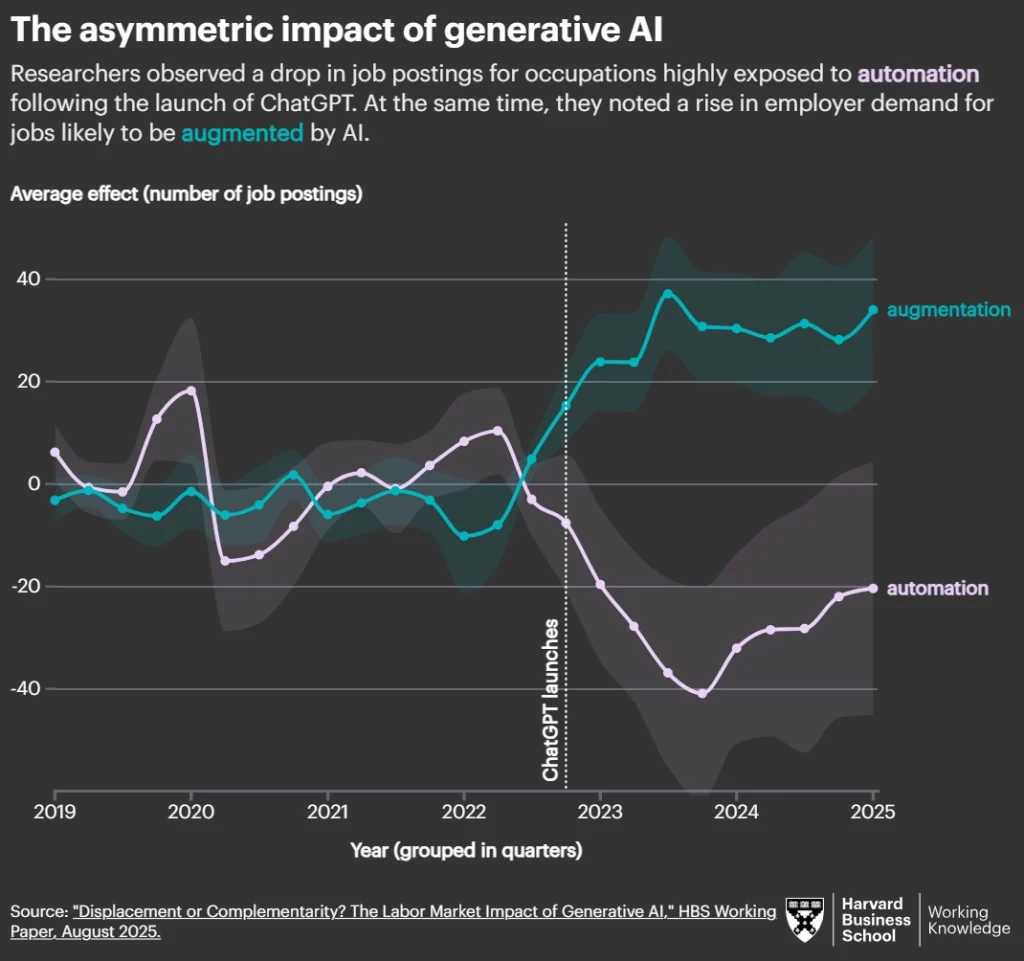
Figure 2: Automation and augmentation potential and its comparative impact on the number of job postings from Harvard Business School Professor Suraj Srinivasan.
Retraining as adaptation to evolving technology—innovation or unsustainable band-aid?
Employers’ hesitancy to hire for AI-vulnerable roles has not gone unnoticed. Many of the highly affected states have considered or passed AI-related legislation and regulation, acknowledging that employers are pulling back from these roles and that vulnerable workers need a solution. Massachusetts has no such legislation, despite being the most vulnerable state.
A common solution, retraining, aims to combat AI job displacement by providing new skills to individuals who lost their jobs or are at risk of job loss. But research suggests that the effectiveness of retraining programs in response to AI job displacement can be limited.
In contrast, augmentation displays greater potential benefit in the long run. Rather than trying to keep the jobs most susceptible to displacement by retraining workers, augmentation leads to transformation and an increase in learning within a company. With innovation, new ways of working can be adopted—boosting performance and leading to a rise in efficiency and productivity over time.
Conclusion
Technology is forever evolving, and data suggest that the job market is already adjusting. The two trends taken together tell a compelling story: the declining employment trend in Massachusetts’s most AI-vulnerable industries since 2022 combined with the national trend of job positions for augmentation-prone roles rising while automation-prone roles have fallen supports the theory that employers are growing hesitant in hiring people into roles that AI can replace.
Retraining offers a short-term solution, but augmentation points towards a more promising path of innovation—one where workers evolve alongside AI rather than competing against it. The real question is whether institutions will move fast enough to make that transition possible.
Nina Argel is a Roger Perry Government Transparency Intern with the Pioneer Institute. She is a rising junior and James Monroe Scholar at the College of William & Mary with a double major in Government and English.