
Over the years, the liberty movement has won some remarkable victories. Think of how school choice has advanced (albeit not yet in Mississippi), or the wave of flat-tax reforms rolled out across many states.
What makes this all the more impressive is that the change has been achieved with often limited resources. Our opponents are almost always able to outstaff and outspend us – and we’ve had to make up the difference with conviction and hard work.
But AI now offers us the chance to change that equation in our favor – if we are willing to adapt. Put simply, AI means we could do far more with what we have.
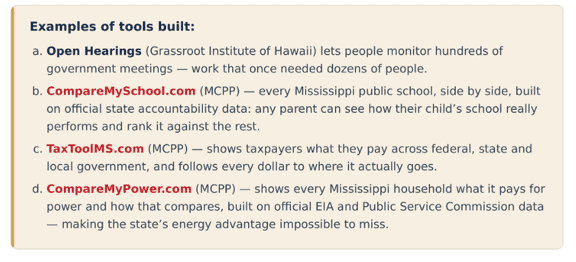
Externally, AI means we can use the oodles of data out there to create tools that carry our case directly to the public. Internally, it lets us automate the routine work that ties up our people — freeing them to focus on the things that need a human touch.
Having experimented with AI in various ways, I wrote this short guide, outlining some of the lessons we’ve learnt here at MCPP. It is a first attempt – tentative steps, not the last word – and you’re welcome to it. You can download it by clicking on the button below.

Cast your mind back twenty years, to around the time I was first elected to the House of Commons. Back then, anyone wanting to see any sort of in-depth program made about a particular subject had to hope that a handful of broadcast executives — at CNBC, at National Public Radio, or, on my side of the Atlantic, at the BBC – would commission it. Long-form treatment of a subject was the business of a few media professionals.
Today it is the business of anyone interested enough to do it. The best long-form content on history, politics or sport is mostly made by outsiders — people like Tom Holland and Joe Rogan, who don’t work for the old broadcasters yet command the audiences those broadcasters can only dream of.
What makes you so sure the same thing won’t happen to today’s think tanks?
We assume that crafting and advocating policy reform is our business — but who is to say an enthusiastic outsider in your own state won’t emerge and do it better? Look at what Nick Shirley achieved in Minnesota: it was not a network news team that exposed daycare centers billing the state for children who simply weren’t there, but a young man with a camera and the right attitude. AI does not just give us the tools to do what we do; it gives them to everyone — so we had better get on and use them.
The public policy landscape today is full of familiar organizations — some think tanks, some media groups, some campaign outfits. AI, I suspect, will begin to blur the boundaries between them.
Then think of the org chart at a typical think tank – it would seem largely familiar to anyone working in this space twenty years ago. Agentic AI will raise some profound questions about how we are organized — and unless we adapt to it, some of the liberty architecture we have built over the past generation could start to resemble the BBC’s history programming department.
We are staring at a once-in-a-generation opportunity. Seize it, and the liberty movement can do more for freedom than ever before.