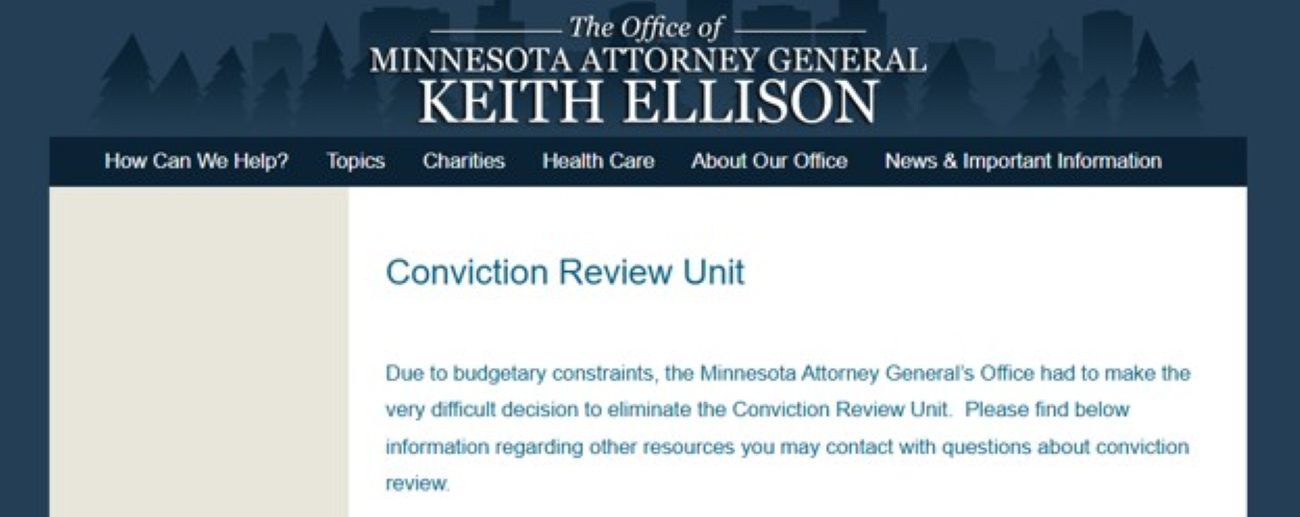
Last week Minnesota Attorney General Keith Ellison advised the 16-person Conviction Review Advisory Board that he was suspending operation of his office’s Conviction Review Unit (CRU). Ellison did not issue an official press release, though several media outlets reported the suspension.
In his responses to media inquiries Ellison cited budget constraints brought on after a federal grant that had supplemented the CRU’s efforts was discontinued. Under the circumstances Ellison said that his office could no longer fund the CRU without compromising other core responsibilities of his office.
Previous reports described the CRU as operating with five full-time employees, including a director. The unit was funded by an undisclosed amount from the Attorney General’s budget, reportedly for two full time employees. The remaining funding came from two federal grants totaling $800,000. We can safely estimate that the amount spent on this effort since its creation in 2021 approaches $2 million – an amount difficult to justify given the results it produced.
No Loss
I have written about my concerns with the CRU and other efforts like the Hennepin County Attorney’s Conviction Integrity Unit. These extra-judicial efforts simply undermine faith in our justice system, and their demise is no loss to justice in Minnesota.
Here’s an excerpt of an article I wrote for Thinking Minnesota in 2024 – it has aged well.
“Perhaps the most problematic reform mechanism is the attorney general’s Conviction Review Unit (CRU). This extra-judicial mechanism offers convicted persons a new form of potential relief from the conviction they received in the court system.
In August 2021, Atty. Gen. Keith Ellison announced the creation of the CRU within his office. The CRU is a full-time unit operating in partnership with the Great North Innocence Project. The endeavor has been heavily funded by federal grants in the initial stages. It is one of only four such units nationally to reside in a state AG’s office. The number of conviction review units across the U.S. has expanded considerably in recent years, from approximately 30 in 2018 to around 100 today.
The CRU’s charter proudly states that it was modeled after a special directive from L.A. County District Attorney George Gascon, a national figure in the progressive prosecutor movement. This emulation of West Coast progressive policies is cause for concern.
According to the Great North Innocence Project, “The purpose of the CRU is to prevent, identify, and remedy wrongful convictions.”
It is telling that the AG’s own charter acknowledges the CRU is an “extrajudicial” process. Webster’s Dictionary defines “extrajudicial” as 1) “not forming a valid part of regular legal proceedings,” 2) “delivered without legal authority,” and 3) “done in contravention of due process of law.”
In his report “Overstating America’s Wrongful Conviction Rate?” Prof. Paul G. Cassell of Quinney College of Law at the University of Utah clearly established the national rate of innocent people being wrongly convicted at between .016 percent and .062 percent. Putting this figure into useful context, Cassell concluded that a U.S. citizen was 30,000 times more likely to become a victim of violent crime than to be wrongfully convicted and sent to prison for a violent crime he or she did not commit.
Despite this extreme rarity, of which an appropriate judicial remedy of appeal already exists, Minnesota has decided to invest energy and resources in overturning convictions, commuting sentences, and reducing accountability for those found guilty by our judicial system.
Throughout our state’s history, we have invested in and valued a robust and credible court system. That system has allowed for appeals that have merit. Those appeals go through an appropriate adversarial process where each side is represented, and an impartial group of judges make decisions based on the law — not emotion or public opinion.
Expanding the number of groups that now “re-investigate” cases that have already been adjudicated only serves to undermine the legitimacy and authority we have rightly bestowed upon our court system. These efforts are often fueled by emotion and take advantage of the misguided notion that it is appropriate to apply today’s morality and conventions to decisions made in the past.
The emotional aspect of these “re-investigations” leaves the results vulnerable to subjective whim rather than an established process based on fact, as does the tendency to give more credibility to new information than information vetted contemporaneously with the events of the case. These tendencies make for good theater, but they make for poor public policy in determining whether justice was appropriately meted out decades earlier.”
“Accomplishments” of the CRU
Since becoming operational in 2021, the CRU has received over 1,100 requests from convicted offenders looking to have their convictions reinvestigated and vacated. According to the CRU, 850 cases (77%) were closed without offering relief after an unbiased initial screening.
Of the remaining 250 cases, the CRU officially completed just four formal reports. These cases had been prominently linked on the CRU’s website prior to the unit being shuttered. A search for those links now results in an “error” message:

Each of the four cases involves a 1st degree murder in which the defendant was found guilty and had exhausted the appeals process decades earlier. The cases were:
1. Thomas Rhodes, District Court File 34-K6-97-001529, convicted in 1998 in Kandiyohi County of killing his wife while boating at midnight, then reporting her death as an accident. The CRU’s efforts focused on discrediting the medical examiner and other experts who testified in the trial nearly two and a half decades earlier. Ultimately, Rhodes ended up pleading guilty to an amended charge of 2nd degree manslaughter – culpable negligence, in exchange for his murder conviction being vacated and his release from prison.
2. Brian Pippitt, District Court File 01-K4-99-000325, convicted in 2001 in Aitken County of 1st degree murder involving the strangulation and beating death of an 80-year-old woman during the burglary. The CRU effort again focused on discrediting witness testimony from decades earlier.
In 2025, the Minnesota Parole Board consisting of Governor Walz, Attorney General Ellison, and Supreme Court Chief Justice Hudson, commuted Pippitt’s sentence and he was freed from prison in January 2026. However, the Aitken County Attorney has not agreed with the movement to completely vacate Pippitt’s conviction in court. The court has scheduled an evidentiary hearing for November 2026.
In June 2026, an independent consultant who had been hired by the Minnesota BCA to conduct an independent review of the conclusions drawn by the CRU filed an affidavit which amounts to a damning assessment of the credibility and accuracy of the CRU’s work. The consultant, Neil Nelson, is a highly respected retired St. Paul Police homicide detective and would not jeopardize his credibility by issuing a faulty affidavit. An exerpt of Nelson’s affidavit follows, and it should concern us all:
“During the course of the review of the CRU’s report, the Independent Consultants found the CRU relied heavily on selective pieces of information and ignored other relevant information to reach overstated and unfounded conclusions that are not supported by all the facts. Moreover, there are alarming inaccuracies and misstatements made in the CRU Report and by Pippitt’s representatives that call into question the overall accuracy and credibility of their findings and, therefore, the claim of innocence.”
3. Edgar Barrientos, District Court File 27-cr-08-53942, convicted in 2009 of 1st degree murder for the drive by shooting of an 18-year-old innocent victim in South Minneapolis. The CRU’s effort once again focused on discrediting witnesses and eyewitness identifications, and rehashing evidence that was considered and evaluated by the jury contemporaneous with the crime, not decades later by a unit biased by its own mission.
Hennepin County Attorney Mary Moriarty bought into the CRU’s claims and joined in their effort to overturn Barrientos’s conviction. When the prosecutor takes this position, rather than maintaining their adversarial role, the fix is in and justice suffers. In November 2024 the court vacated Barrientos’s conviction and Moriarty dismissed charges against him. Barrientos was freed from custody that day.
4. Phillip Vance, District Court File 19-K6-04-736, convicted in 2004 in Dakota County of 1st degree murder for the shooting death of a store clerk in South St. Paul. Vance exhausted all of his appeals, then applied to the CRU for reinvestigation. Vance’s claims mirrored many of the common claims of coerced and faulty witnesses and alibis and alternative suspects that the police did not properly investigate.
After a reported four-year investigation, to its credit, the CRU issued a formal report stating it had uncovered no reliable evidence to support Philip Vance’s claims of innocence and formally recommended against vacating his conviction.
Takeaway
Out of 1,100 claims of innocence the CRU issued just four (4) formal reports over nearly six years.
One (1) concluded there was no evidence to vacate the conviction; one (1) resulted in a change of plea from 1st degree murder to 2nd degree manslaughter; one (1) resulted in a vacated sentence that was uncontested by the Hennepin County Attorney’s Office; and one (1) resulted in the Board of Pardons commuting a sentence, but the court and the Aitken County Attorney’s Office not yet agreeing to exonerate, and an independent evaluator calling into serious question the credibility and accuracy of the CRU investigation.
Given the questionable results of nearly six years of work by the CRU, it makes sense that Attorney General Ellison determined the effort was not worth reprioritizing resources within the office to keep it afloat.
There’s an old tongue-in-cheek saying that prisons are full of innocent people. $2 million and six years of effort by the CRU failed to support the statement in any definitive way. Many argue, as I do, that such efforts do far more to harm our sense of justice than to help it.