On June 26, Massachusetts Governor Maura Healey announced a three-year bachelor’s degree pilot program at Suffolk University and Merrimack College, aiming to cut tuition without sacrificing academic quality. As discussed in my previous blog, tuition costs have soared, and it may be due to the way universities fundamentally operate. In 2023, Massachusetts’ average annual tuition neared $54,000 (Figure 1), with elite institutions costing even more.

Figure 1. Tuition and fee trends at MA Public and Private universities from Pioneer’s U.S. Data Labs.
Progressive politicians advocate for universal free college to expand access to higher education for disadvantaged students. This solution allows state-funded universities to be free for the tuition payer. However, this “free” label is deceptive; it merely shifts the financial burden to taxpayers. Not only could this solution raise taxes, but it has also proven ineffective at educating the most disadvantaged students. The 2005 Kalamazoo Promise offers a case study. While the Promise is donor-funded, its enrollment trends would likely be similar to those in tax-funded universal free college proposals.
The Promise aimed to reduce financial barriers for students in a city with a median income well below average. While the project increased short-term enrollment, it failed to close retention and persistent achievement gaps for socioeconomically disadvantaged students (Figure 2). Even with free tuition, only 27 percent of disadvantaged students successfully completed a full year of college, compared to nearly half of their non-disadvantaged peers.
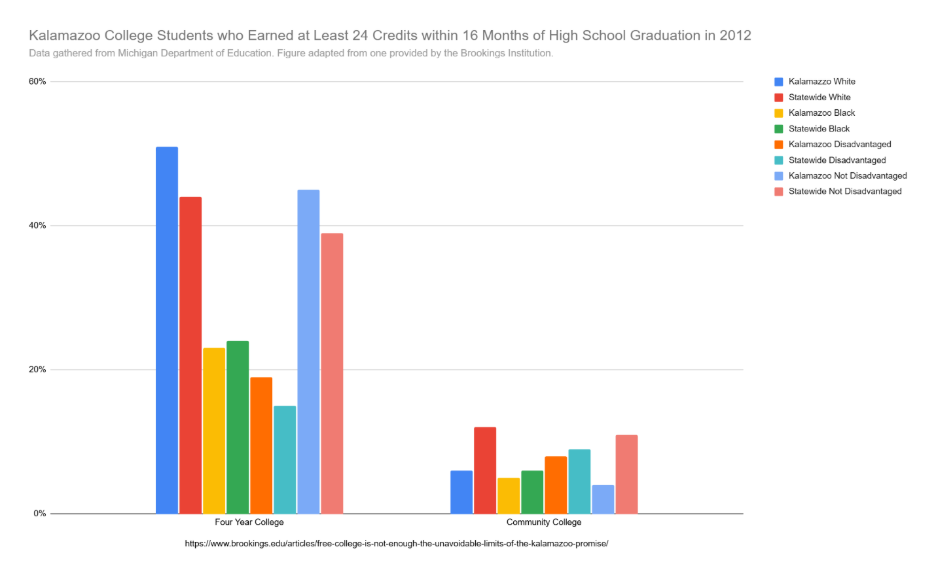
Figure 2. Kalamazoo student retention by racial and socioeconomic status. Measures students who continue to have a standard course load at 16 months post high school graduation. Graph adapted from a 2015 Brookings Institution figure.
Massachusetts has seen a similar trend with its free community college program. The program saw enrollment skyrocket by 40%, but degree completion remains low. Structural barriers, such as the quality of K-12 education, likely impact student retention. While free college programs may not directly cause these gaps, they might have indirectly impacted retention by creating moral hazard. Without individual financial risk, students have less incentive to take their coursework seriously, worsening the high costs of attending college. Nevertheless, the Kalamazoo Promise provides evidence that free-college proposals alone are unlikely to overcome systemic barriers to degree completion. Instead of creating equity, it shifts a massive financial burden onto the taxpayer.
Contrary to free college, an affordable three-year bachelor’s program may improve the tuition crisis. Three-year college programs are relatively new, but the concept has been around since the 1990s. Since then, students have often overloaded, taking extra coursesevery semester to graduate early, but only 2-20% of students are able to pull it off. As a 2018 report from the Progressive Policy Institute points out, students find it incredibly challenging to squeeze four years of school into three.
Rather than students attempting to squeeze a four-year program beyond its structural limits, three-year programs are designed to provide an equivalent education in a shorter time. For instance, Southern New Hampshire University found that test performance among students in its three-year Business Administration program was equal to that of traditional four-year students.
Three-year degree programs are not meant to replace a traditional four-year program. In fact, the state has made it optional for colleges to adopt them. While the traditional college experience offers distinct benefits, such as study abroad, three-year paths significantly reduce costs for career-ready students.
Like universal free college, three-year programs would likely fail in solving systemic barriers; the enrollment gap for the disadvantaged would persist. However, three-year programs are not designed to solve the gap. Instead, they help the middle class, who largely claim a bachelor’s degree is unaffordable. While free-college programs also improved affordability for the middle class, three-year programs do it without spreading the costs onto taxpayers.
Three-year bachelor’s programs are indeed exciting. Ohio and Virginia followed in Massachusetts’ footsteps and recently announced similar pilot programs. These programs are kicking off at relatively small schools. If the pilot programs are successful, larger, elite universities might be persuaded to introduce similar programs. Three-year programs make a bachelor’s degree far more accessible. However, for them to have widespread impact, the government should persuade more universities, including elite institutions, to offer three-year bachelor’s degrees.
Samuel Klein is a Roger Perry Education Intern at Pioneer Institute. He is a rising Junior at the University of Rochester, studying Politics, Philosophy, and Economics (PPE).