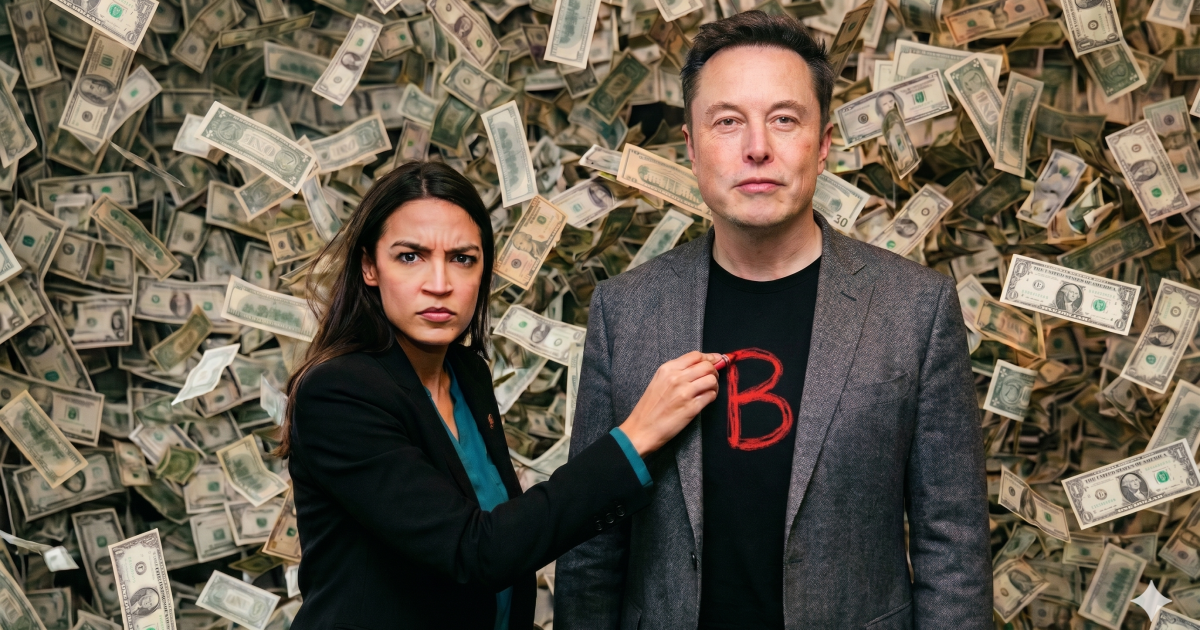
“You can’t earn a billion dollars. You just can’t earn that. You can get market power. You can break rules. You can do all sorts of things. You can abuse labor laws. You can pay people less than what they’re worth. But you can’t earn that.”
These comments made by Rep. Alexandria Ocasio-Cortez on a recent podcast have brought attention to the familiar argument on the left that billionaires do not really “earn” their wealth and that instead it is only achieved by exploitation.
It is a revealing statement, not because it is new, but because it captures a broader worldview that has enthralled the radical left and has increasingly shaped tax, labor, regulatory, and economic policy.
Under this view, great wealth is treated less as evidence of value creation and more as evidence of exploitation. If someone becomes extraordinarily successful, the assumption is that they did not earn it, and because they did not earn it, that money should be reclaimed for the good of “society.”
That view gets it exactly backward.
Billionaires Often Become Wealthy by Creating Value at Enormous Scale

The problem with saying “you can’t earn a billion dollars” is that it ignores how many billionaires become wealthy in the first place. These individuals did not simply take money from someone else; they built companies that millions of people use, that solve real problems, and that employ enormous numbers of workers.
Jeff Bezos and Amazon is a useful example. Bezos did not become one of the wealthiest people in the world because he magically found a billion dollars sitting in his bank account or took it from someone else; he built a company that transformed online retail, logistics, and consumer convenience.
Amazon reported $716.9 billion in net sales in 2025, including $426.3 billion from North America alone. The company also employed roughly 1.5 million people globally as of late 2025, according to the Financial Times. Third-party estimates commonly place Amazon’s customer base at more than 300 million active customers worldwide, reflecting just how many people voluntarily use the platform because they find it valuable.
That is the part of the billionaire debate that often gets left out. When people talk about Jeff Bezos’ wealth, they often treat it as though it appeared out of nowhere. But Amazon became valuable because it created something that hundreds of millions of people use, depend on, and willingly choose in the marketplace. Its success is reflected in the customers who shop there, the small businesses that sell through its platform, the workers employed in warehouses, logistics, technology, and corporate roles, and the broader economic activity created around its infrastructure.
When a company serves that many people, attracts investment, supports more than a million jobs, and becomes part of the daily lives of households and businesses across the country, the wealth of its founder is not some abstract windfall; it is a reflection of real value created at a scale very few people ever achieve.
The same basic point applies beyond Amazon. Whether it is Apple, Microsoft, Tesla, Walmart, Nvidia, or countless other ventures, great fortunes often arise because someone built a product, platform, or service that changed how people live, work, shop, or do business. In a market economy, wealth is not only distributed according to how hard someone appears to work in isolation; it is created by solving problems for other people.
Success Should Not Be Punished

That is where the debate over billionaires often goes wrong. Once someone has created enormous value, employed large numbers of people, served millions of customers, and built something that improves daily life, the policy conversation often shifts from how to encourage more of that success to how much of it the government should take.
Take Graham Platner’s recent comments in a WGME story for example:
“We need that wealth. We need to pull it back in, and we need to put it into social programs that are going to uplift every single American.”
What uplifts every single American is job creation. Encouraging entrepreneurship and the attendant risk-taking that comes with it. Rewarding innovation. Building businesses. Cutting income and property taxes.
A healthy economy should reward people who take risks, invest capital, build businesses, create jobs, and offer products or services that people voluntarily choose to use. That does not mean every successful person is perfect, or that every business decision is beyond criticism. It simply means success itself should not be treated as evidence of wrongdoing.
Yet much of the modern tax debate starts from the assumption that large fortunes are inherently illegitimate. Instead of focusing on fair rules, open competition, and ending government favoritism, policymakers too often reach for higher taxes, new surcharges, wealth taxes, and punitive penalties aimed at people who have already built something valuable.
That approach ignores the important reality that high earners already pay a disproportionate share of federal income taxes. According to IRS data summarized by the Tax Foundation, the top 1% of earners received 20.6% of adjusted gross income in tax year 2023, but paid 38.4% of all federal income taxes. Similarly, the top 1% of taxpayers paid an average rate of 26.3%. That is seven times higher than the average rate of 3.7% that is paid by the bottom half of taxpayers.
This dramatically undercuts the claim that the wealthy are somehow avoiding responsibility altogether. In reality, the very people most often targeted for additional taxes are already carrying a large share of the federal income tax burden.

The Dangers of Punishing Success
Punishing success with ever-higher taxes sends the very damaging message to entrepreneurs that if they build something valuable and grow it large enough, then the government will eventually treat that achievement as a problem to be solved.
That may work as political rhetoric, but it is bad economic policy. Businesses require risk, capital, time, and the willingness to fail. When policymakers punish the rewards of success, they weaken the incentive for the next entrepreneur to take that risk.
The costs do not fall only on billionaires; they fall on workers, consumers, and communities. Less investment means fewer businesses expanding, fewer jobs created, less competition for workers, and slower wage growth. The people hurt most by anti-growth policy are often not the wealthy, but the workers who depend on a growing economy for better opportunities.
As the economist Thomas Sowell once said:
What do the poor most need? They need to stop being poor. And how can that be done, on a mass scale, except by an economy that creates vastly more wealth?
Workers affected by anti-growth policy is especially dangerous for a state like Maine, which needs more people starting companies, expanding payrolls, investing capital, and building services people voluntarily use. Instead of asking how to punish people once they succeed, policymakers should be asking how to make it easier for more Mainers to succeed in the first place.
Success should not place anyone above the law. But success itself should not make someone a political target. A country that punishes builders will get fewer builders. A state that punishes investment will get less investment. And an economy that treats wealth creation as a moral failure will eventually create fewer opportunities for everyone.

Yes, You Can Earn a Billion Dollars
So yes, it is possible to earn a billion dollars. Not by working a normal job, collecting a salary, or punching a clock in the way most people do, but by creating something so valuable that millions of people choose to use it, investors choose to support it, and workers choose to help build it.
That is not something to resent. It is something to understand. When someone builds a company that changes daily life, creates jobs, expands consumer choice, and generates broader economic activity, the benefits do not stop with the founder. They extend to workers, customers, small businesses, suppliers, shareholders, and communities.
The existence of billionaires is not proof that the economy is broken. In many cases, it is proof that free people, operating in a free market economy, can create value on a scale that would have been unimaginable just a few generations ago. That kind of success is good for billionaires, but it is also good for everyone else who benefits from the jobs, products, services, and opportunities they help create.
The real danger is not that some people become extraordinarily successful. The real danger is building a political culture that assumes extraordinary success must be illegitimate. If policymakers treat wealth creation as something to punish rather than something to encourage, the country will get less investment and fewer innovators who are willing to take a risk to create new jobs and more opportunities.
Billionaires are not the problem. Punishing success is.