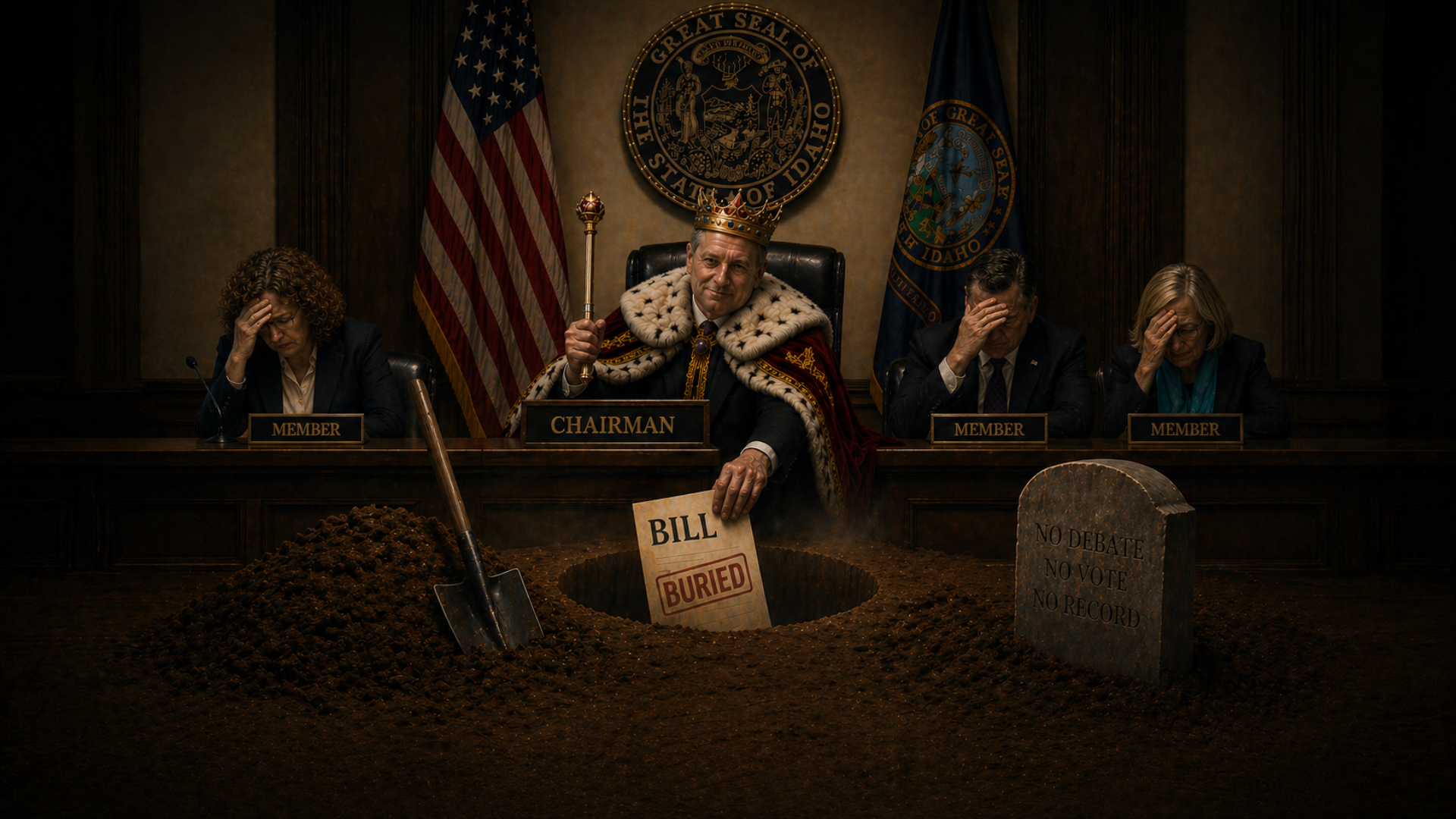
It isn’t a power afforded in House or Senate rules. It isn’t written into Mason’s Manual of Legislative Procedure, and it certainly isn’t penned into the Constitution. Yet, during legislative sessions at the Idaho Capitol, it is utilized and treated as an authorized exercise of power.
We are, of course, talking about the chairman’s drawer.
You know, that convenient proverbial desk drawer where bills are placed until the clock runs out, and the legislation quietly dies without a vote. No headlines. No recorded support or opposition. No debate by our elected officials. No accountability.
Legislative committees exist for a simple reason: to review legislation efficiently before being debated by the body of the whole and to send bills to the House or Senate floors with a “do pass,” “do not pass,” or without recommendation.
In practice, however, the chairman’s drawer has transformed this intended mechanism of efficient review into an abusive leadership tool akin to gubernatorial veto power, allowing one person to silence debate and deny the full Legislature — and by extension, the people of Idaho — the opportunity to weigh in on some of the most critical issues facing Idaho.
Ironically, this abuse is most often put into practice with conservative legislation that reflects the principles of limited government, individual liberty, parental authority, and fiscal restraint. Liberal leaning bills, including those authored by Big Ag, the medical industrial complex, Idaho Power, or teachers unions, etc., are almost never drawered. During the 2026 legislative session, for example, House Bill 745, which sought to limit taxpayer subsidies to government unions, was held by Chairman Dan Foreman in the Senate Commerce and Human Resources Committee.
Similarly, House Bills 953, 954, 955, and 956 — which would restrain the Department of Health and Welfare and Child Protective Services — were denied hearings and held by Chairman John Vander Woude in the House Health and Welfare Committee, resulting in them being filed as personal bills. House Bill 669, which would have enacted a full repeal of all cloud-seeding operations and banned weather-modification activities in Idaho, was denied a hearing and held by both Chairman Vito Barbiari and Chairman Ron Mendive in the House Environment, Energy, and Technology Committee and the House Resources and Conservation Committee, respectively. This, too, was filed as a personal bill as a result.
Personal bills represent a little-understood procedural workaround legislators use when a committee chairman refuses to grant a hearing to a bill through their committee. Filing a bill as a personal bill creates a public record of the legislation and allows for a formal introduction on the floor. However, this process is largely symbolic — personal bills do not advance through committees, are not assigned hearings, and are effectively barred from consideration during a session. Filing a personal bill with the Clerk’s Office is a legislator’s last resort to document legislation leadership chooses to bury.
Senate Bill 1298, regarding self-defense, was held by Chairman Jim Guthrie in the Senate State Affairs Committee and immigration bills such as House Bill 592, House Bill 656, and House Bill 660; Medicaid expansion repeal (House Bill 850) and eligibility (House Bill 912), and the ever-elusive grocery tax repeal (ultimately filed as a personal bill, House Bill 633) were all killed at the pleasure of the chairman.
The list could go on, but you get the idea: most of the best bills die in drawers.
These bills are not fringe proposals by a select few Idahoans. They embody the conservative mandate Idaho voters have repeatedly given the legislature: enforcing immigration law as a matter of sovereignty and rule of law, protecting parents’ rights against state intrusion, reforming failing welfare and education systems, claiming sovereignty over our air and water, and cutting spending. Yet a handful of chairmen exercised power never granted by the people or the Constitution to kill these critical bills silently and unilaterally.
This practice stands in direct contradiction to the Founding Fathers’ design for republican government. Jefferson’s Manual of Parliamentary Practice (1801) presumed committees would deliberate and report, not disappear legislation into oblivion. According to Jefferson, the purpose of committees is to facilitate discussion, refine bill ideas and language, and organize legislation before reaching the body of the whole for proper debate and voting.
In Federalist 51, James Madison warned, “ambition must be made to counteract ambition” through structural checks, precisely to prevent the very concentration of power the chairman’s drawer enables. The Founding Fathers believed free speech in government needed to be accompanied by procedures to safeguard against the tyranny of the majority; however, procedure without virtue has largely become a different kind of tyranny. The Founders rejected rule by a privileged few; they established a system of open deliberation among elected representatives accountable to a sovereign citizenry.
Conservative philosophy insists on the rule of law over the rule of men, transparency over secrecy, and the consent of the governed over arbitrary gatekeeping. When a single chairman has the power to nullify the work of the legislature or the will of the people without a trace, it mocks the principles the United States was founded upon. The Founders instituted prudence through open institutions and respect for the inherited constitutional order; the drawer replaces both with unaccountable fiat.
The chairman’s drawer is a de facto veto power that subverts the legislative process, shields lawmakers from accountability, and disenfranchises voters.
Committees were never meant to be legislative graveyards, yet increasingly they are becoming just that. Arbitrary rule is a dangerous thing that the Founders structured our government to largely avoid.
A chairman may hold a bill or refuse to grant a hearing (essentially holding, even before a bill is given a number) for any reason. This includes pressure from agencies or special interest groups, fear of a bill being on record, losing financial and endorsement support during elections, pressure from legislative leadership, the “gentleman on the second floor” (Governor) not liking it, or — possibly worst of all — perhaps the chairman simply does not like the legislator carrying the bill.
This is the evil genius of the chairman’s drawer — chairmen do not need to provide an explanation for killing legislation. Their power and authority are nothing short of an unconstitutional shadow veto. The practice of the chairman’s drawer kills debate, dodges accountability, and treats the people’s elected representatives as subservient to leadership authority. This is a top-down rather than a bottom-up authority structure, inconsistent with a republican government. If Idaho’s legislature believes in limited government and the consent of the governed, then it should abolish this precedential power granted to leadership and restore the Founders’ vision of open deliberation, recorded votes, and accountability to voters.
No more buried bills. No more silent tyranny. The drawer must die.